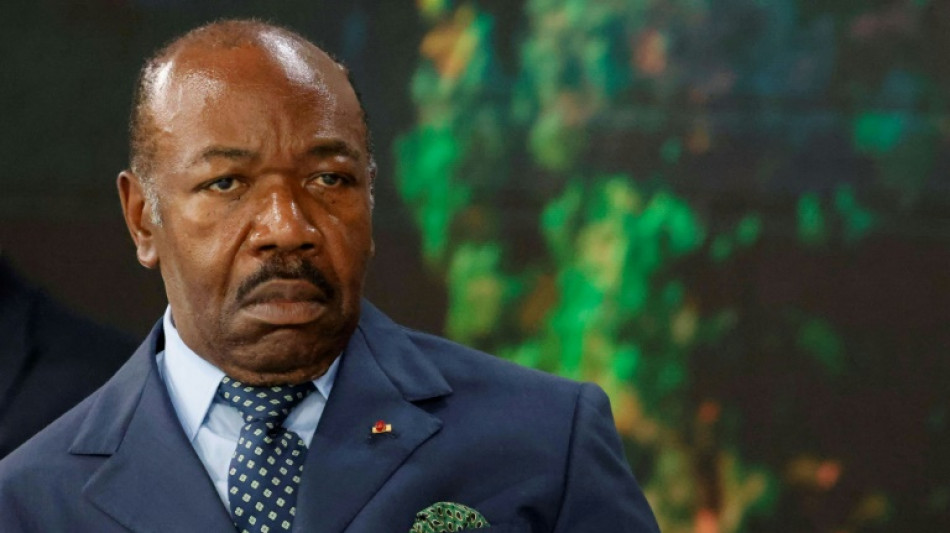
Ali Bongo, scion of Gabon's ruling family / Photo: © AFP/File

 Rene Eyre Revisits Autobiographical Performance 'Say A Little Prayer' in London

 UAE's HCT Holds Record Graduation and Announces Major Training Expansion

 NASA Awards $10B Lunar Contract Framework to SpaceX, Blue Origin

 Katy Perry Tells Fans Ex-Husband Russell Brand 'Should Be in Jail' During UK Concert

 South African election results renew debate over identity-based voting

 South African voters report smoother local election but declining IEC trust

 Dolly Parton museum and Nashville hotel open after singer’s death

 George and Amal Clooney attend New York political-comedy reading

 British buyers pay substantial premiums for period-home appearance

 Thomas Markle released to house arrest after child-abuse-image charge

Gabonese President Ali Bongo Ondimba, whose ouster has been announced by rebel officers, came to power in 2009, succeeding his father Omar, the country's ruler for more than four decades.
Prior to Wednesday's dramatic announcement, Bongo's spell in office was marked by disputed elections and a stroke that spurred rumours about his fitness for office and fuelled a minor attempted coup.
The 64-year-old had hoped to leave his doubters on the back foot as he battled for a third term in presidential elections last Saturday.
He carried out a whirlwind national tour, made high-profile foreign visits and pitched Gabon's credentials as a proclaimed guardian of the forests.
After a vote that the opposition said they had won, the national election authority early Wednesday declared Bongo the victor with 64.27 percent of the vote.
Just an hour or so later, a group of army officers made a televised address saying they were "putting an end to the current regime", dissolving all of Gabon's institutions and declaring the election results void.
- 'Monsieur Fils' -
The upheaval provided a stark contrast to Bongo's gilded start in life as carefree scion of the wealthy ruling family.
He was born to a teenage girl, Josephine Kama, in the Congolese city of Brazzaville, which at the time was still part of France's rapidly shrinking colonial empire.
To many Gabonese, the young man was known by his initials of ABO, Ali B -- or, less flattering, as "Monsieur Fils" (Mr. Son).
He nurtured ambitions as an aspiring funk singer -- in 1977 he recorded an album, now a YouTube curiosity, featuring top-class musicians and entitled "A Brand New Man".
But within three years, shepherded by his father, he abandoned the path of entertainment and entered politics, renaming himself Ali Bongo and converting to Islam like his parent.
- Oil wealth -
Bongo senior, who took office in 1967, had the reputation of a kleptocrat -- one of the wealthiest men in the world, with a fortune derived from Gabon's oil.
He was also a pillar of "FrancAfrique" -- a now much-contested strategy by which France bound itself to its former African colonies through cronyism, often tainted with corruption and rights abuses.
Bongo worked as his father's faithful lieutenant, travelling the globe and forging contacts at the time of the second oil boom.
But to his detractors, Bongo lacked his father's charm and communication skills.
He attended some of Brazzaville's top schools and studied law in France but did not learn any of Gabon's local languages -- a major disadvantage.
And because he had been born abroad and out of wedlock, he also fought for years against rumours that he was a foreigner who had been adopted.
His lavish spending, especially on luxury cars, also raised eyebrows in a country where oil wealth contrasts with widespread poverty.
In 1989, he was appointed foreign minister aged just 30 but had to step down two years later when a new constitution stipulated that cabinet members had to be at least 35.
He was back in government by 1999, heading the defence ministry.
There he remained until shortly before the start of the election campaign caused by his father's death in 2009.
- Renewal -
The handover was not a surprise, given the years of grooming and Bongo's own ambitions, despite some opposition within the ruling Gabonese Democratic Party (PDG).
In 2016, Bongo was re-elected by 5,500 votes, edging out opposition challenger Jean Ping after a campaign marred by bloody clashes and allegations of fraud.
Pitching to a country that had been run for decades by his family, Bongo tried the difficult task of posing as an agent of change -- packing each speech with pledges of "renewal" and "innovation".
A stroke in 2018 sidelined him from public life for 10 months and led to a very brief, and still unexplained, attempt on power by soldiers.
After a long convalescence, he embarked on an image revamp, putting himself forward as a man of rigour bent on rooting out "traitors" and "profiteers" in his inner circle.
He also unveiled a string of projects, including diversifying the economy, opening up markets to Asian investors, trimming the state sector and promoting Gabon's environmental treasures.
Bongo married French-born Sylvia Bongo Ondimba in 1989. They have four children.
O.Krause--BTB