Russian teen eco-activists fight for future as risks mount
/ Photo: © AFP

 Rene Eyre Revisits Autobiographical Performance 'Say A Little Prayer' in London

 UAE's HCT Holds Record Graduation and Announces Major Training Expansion

 NASA Awards $10B Lunar Contract Framework to SpaceX, Blue Origin

 Katy Perry Tells Fans Ex-Husband Russell Brand 'Should Be in Jail' During UK Concert

 South African election results renew debate over identity-based voting

 South African voters report smoother local election but declining IEC trust

 Dolly Parton museum and Nashville hotel open after singer’s death

 George and Amal Clooney attend New York political-comedy reading

 British buyers pay substantial premiums for period-home appearance

 Thomas Markle released to house arrest after child-abuse-image charge

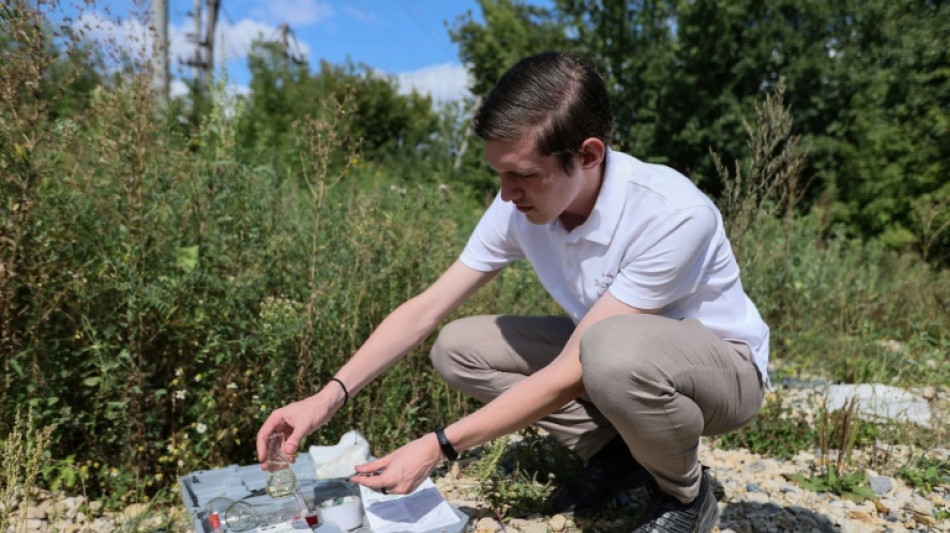
Egor Chastukhin, an 18-year-old environmental activist, holds a flask to a drain spurting out warm, putrid water near the historic city of Penza in western Russia.
"It smells like herbal tea," he jokes after taking a waft of the sample while Sonia, his wife, jots down notes.
She records the odour and its yellowish colour as two other teenage activists, Alexei Zetkin and Yakov Demidov, look on.
The water's source is a nearby paper factory previously fined for pollution. Its destination is a tributary of the Sura river, around 600 kilometres (372 miles) from Russia's capital Moscow.
The group carries out a spot test on the liquid, which shows excess levels of chlorine, iron and organic matter.
"People who drink this water, fish in it and bathe in it need to understand the danger," Egor told AFP.
The chances of that happening are slim.
Environmental groups in Russia not linked to the government -- those like Egor's -- have long faced pressure from authorities.
And since an unprecedented crackdown on dissent launched after Russia's full-scale military intervention in Ukraine, their future is in doubt.
Russia has outlawed the work of Greenpeace and the World Wide Fund for Nature, branding them and dozens of other Western-linked groups "undesirable".
The exiled coordinator of the climate action nonprofit Bellona, Ksenia Vakhrusheva, told AFP there were no longer any Russian environmental organisations powerful enough to bring about "systemic change".
- 'Threat to the state' -
What remains of ecological advocacy in Russia rests on the shoulders of under-resourced activists like Egor, who are still trying to raise awareness in spite of the risks.
"What we're doing is legal and harmless. But tomorrow they could link it to extremism or terrorism. The slightest transmission of information could become an alleged threat to the state," Egor says.
Suddenly, a press officer and factory employee holding a camera arrive on the scene, with the rag-tag group taking off after a security guard appears -- a move that is sometimes followed by a police visit.
Several metres away, men under some trees continue to fish the polluted water.
The group regularly inspects rivers and dumps. Together with a more experienced activist with a legal background, they report violations to local prosecutors or the environmental protection agency.
Sometimes with surprising success.
In November 2021, Egor and his friend Alexei, then high school students, tested the water discharged by the paper factory.
- 'Small victories' -
Alexei sent the results to the authorities, who fined the factory manager about $5,000 after confirming the violations.
The factory is run by a local politician from the Kremlin-loyal United Russia party, and says it has since invested in modernising its equipment.
Following the probe, Alexei, then a member of a pro-government environmental group, was accused of carrying out the inspection without the approval of his superiors and kicked out.
In February last year, he set up Eko-Start, and he and Egor campaign together.
After the factory, activists and AFP journalists visited a landfill outside Penza, a jumble of rotting vegetables, batteries and medical waste emitting toxic fumes.
"The owners of the dump are high-ups in the region. They save money by not sorting the waste and not respecting the rules on storage," Alexei said.
Alexei met Egor in the Komsomol, the youth wing of the Russian Communist Party, which, though subservient to the Kremlin at the national level, sometimes represents opposition locally.
Both have since left the group.
Egor describes himself as a "Trotskyite-internationalist", saying he is against "Stalinists" and political repression.
While many young Russians are apolitical or support President Vladimir Putin, Alexei thinks the conflict in Ukraine has politicised many, and pushed some to take a stand in opposing -- or supporting -- the government.
"If you don't do politics today, politics will come for you tomorrow," he says.
K.Thomson--BTB