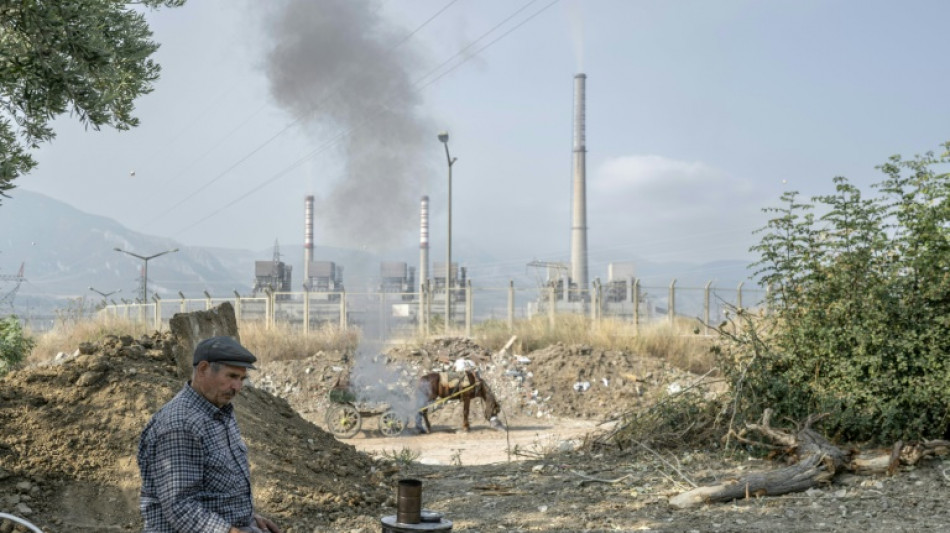
Years of coal plant expansion torment Turkey's villagers / Photo: © AFP

 Rene Eyre Revisits Autobiographical Performance 'Say A Little Prayer' in London

 UAE's HCT Holds Record Graduation and Announces Major Training Expansion

 NASA Awards $10B Lunar Contract Framework to SpaceX, Blue Origin

 Katy Perry Tells Fans Ex-Husband Russell Brand 'Should Be in Jail' During UK Concert

 South African election results renew debate over identity-based voting

 South African voters report smoother local election but declining IEC trust

 Dolly Parton museum and Nashville hotel open after singer’s death

 George and Amal Clooney attend New York political-comedy reading

 British buyers pay substantial premiums for period-home appearance

 Thomas Markle released to house arrest after child-abuse-image charge

Kneeling in the morning shade under a tree, Osman Arslan brews tea behind a coal-fired power plant that rises above his Turkish Aegean village like a beast.
Having just returned from a pilgrimage to Mecca with his wife, the middle-aged man recalls the golden days when there was no thermal power plant in Soma.
His olive trees were much healthier back then, Arslan says as smoke from the fire he lit for his tea mixes with that rising from the plant's smokestacks.
Since at least 300 people died here in Turkey's worst mining disaster in 2014, hardly anyone supports the Soma plant.
Yet like others belching pollution across the vast country, it has used up most of the local coal and is looking to expand in search for more.
This has led to protests and occasional attempts by locals to physically block the expansion.
Villagers and environmental activists have been locked in clashes with the police in the southwestern Mugla province since their plant began cutting down trees and olive groves in search for more coal last month.
- Human cost -
An AFP tour of five Turkish coal-fired power plant villages witnessed the high human cost of relying on the outdated, highly polluting energy source.
Olives in the Aegean town of Milas, and tomatoes and beans in the southeastern Afsin plain, are no longer flourishing, while respiratory diseases have become the most life-threatening problem in southwestern Yatagan.
The Yatagan plant, one of Turkey's oldest, emits a heavy methane smell that permeates the air. Visible layers of dust cover trees and gardens.
Okan Goktas, 44, who irrigates fields in the late afternoon, says his father retired from the Yatagan plant.
"Many of the villagers in the surrounding area work there," he says.
Government "support for agriculture is almost non-existent, so people have no choice but to work at the plant," he says.
Although President Recep Tayyip Erdogan has pledged Turkey will reach net-zero emission by 2053, critics questions his commitment.
Turkey was the last among the Group of 20 major economies to ratify the Paris Climate Accords, doing so only after the environment became a top political issue in the wake of deadly 2021 wildfires.
In the meantime, the power plants are getting formal government permission to expand.
The Yenikoy and Kemerkoy plants have mowed down lands where globally exported Milas olives once grew.
Villagers say the Yenikoy plant buys agricultural lands at cut-rate prices, capitalising on peoples' desperation to get at least some return for their ancestral lands.
- Insatiable -
But the Yenikoy plant seems insatiable and is looking for more forests and farmland to feed on.
In the past two years, several bays have been almost completely swallowed by new lignite deposits, forcing villagers to migrate so that the plant can survive.
Others feel trapped because they depend on plants for their livelihoods.
Nail, 63, who preferred not to give his last name for fear of a backlash, said a plant in his Aegean coast town of Karabiga employs 600 workers, including his son.
Yusuf, who watches the local power plant from his balcony in the eastern Kahramanmaras province town of Afsin, also works at the local plant.
The employee, who also asked to have his last name withheld, blames the plant's pollution for poor local crops.
Brothers Ali and Yusuf Avci agree.
Watering their hardy corn, they say they can no longer grow more fragile beans and tomatoes because the plant covers crops with a black blanket of dust from the burned coal.
Yusuf Avci, 48, thinks the plant does not use proper air filters at night, and the two brothers filed a lawsuit.
They lost because experts who conducted an inspection concluded no harm was done.
F.Müller--BTB