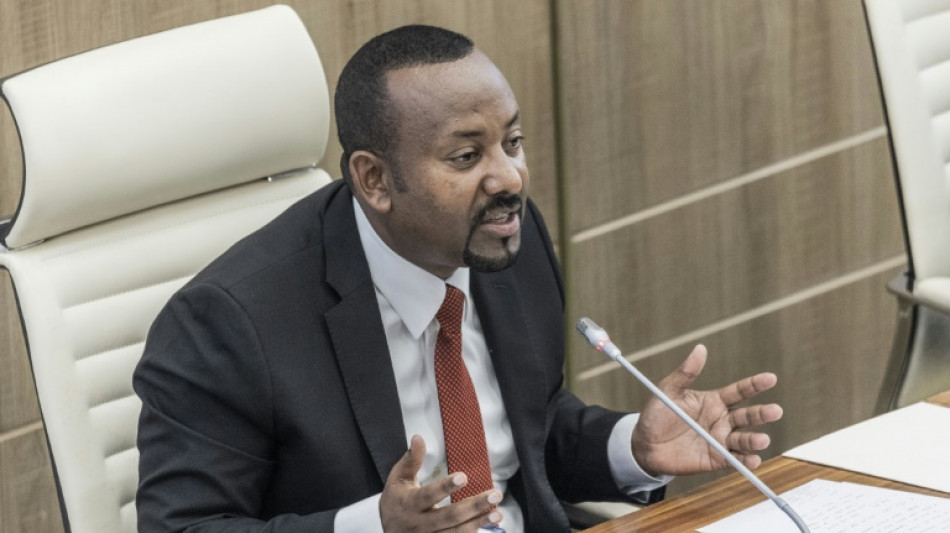
Head of Ethiopia's crisis-hit Amhara region resigns / Photo: © AFP

 Rene Eyre Revisits Autobiographical Performance 'Say A Little Prayer' in London

 UAE's HCT Holds Record Graduation and Announces Major Training Expansion

 NASA Awards $10B Lunar Contract Framework to SpaceX, Blue Origin

 Katy Perry Tells Fans Ex-Husband Russell Brand 'Should Be in Jail' During UK Concert

 South African election results renew debate over identity-based voting

 South African voters report smoother local election but declining IEC trust

 Dolly Parton museum and Nashville hotel open after singer’s death

 George and Amal Clooney attend New York political-comedy reading

 British buyers pay substantial premiums for period-home appearance

 Thomas Markle released to house arrest after child-abuse-image charge

The head of Ethiopia's violence-stricken region of Amhara, which the federal government has placed under a state of emergency, has stepped down, according to an official statement reported Friday.
Amhara's parliament "has accepted the resignation submitted by the regional president, Dr. Yilkal Kefale, and appointed Arega Kebede in replacement," the body said in a statement reported by the official Amhara Media Corporation.
The resignation on Wednesday came after the legislature, known as the Regional Council, discussed "the region's current security situation", it said.
"After the discussion a consensus agreement was reached (on the need) for consistent reform," it said.
Tension in the northern region ratcheted up this year after the end of a devastating war in the neighbouring region of Tigray that also drew in fighters from Amhara.
In April the federal government announced it was dismantling regional forces across the country.
The move triggered protests by Amhara nationalists who said it would weaken their region.
Clashes erupted in early July between the national army and local fighters known as Fano, prompting the authorities in Addis Ababa on August 4 to declare a six-month state of emergency.
The Ethiopian Human Rights Commission (EHRC), an independent state-affiliated organisation, on August 14 said heavy fighting had subsided in major urban areas on August 9 but was continuing in other parts of the region.
The military leadership set in place in Amhara under the state of emergency said on August 23 that the situation had "returned to normal conditions" thanks to "measures taken during the second and third phase of military operations."
"The general command gave strict order to continue the military operation in order to strengthen and secure the peace and stability," it said.
The situation in Amhara is impossible to verify on the ground, as the federal authorities restrict access to the region.
The toll from the fighting remains unclear, but the EHRC has voiced concern over civilian casualties from the use of heavy artillery.
Doctors in two of the affected cities told AFP in early August that there had been scores of deaths and injuries among civilians.
On August 13, at least 26 people in the town of Finote Selam died in an air strike, a hospital official and local resident told AFP.
A mosaic of more than 80 ethno-linguistic communities, Ethiopia has struggled territorial conflicts within its borders.
It is structured as a federal republic, comprising 12 regional states that are arranged on ethnic and linguistic lines, and two administrative councils, which includes Addis Ababa.
The Amhara region is inhabited mostly by the Amhara people, the country's second most populous ethnic group.
The Regional Council, which is dominated by Ethiopian Prime Minister Abiy Ahmed's Prosperity Party, had appointed Yilkal, an academic, in October 2021. His successor is a relative unknown on the political scene.
O.Bulka--BTB