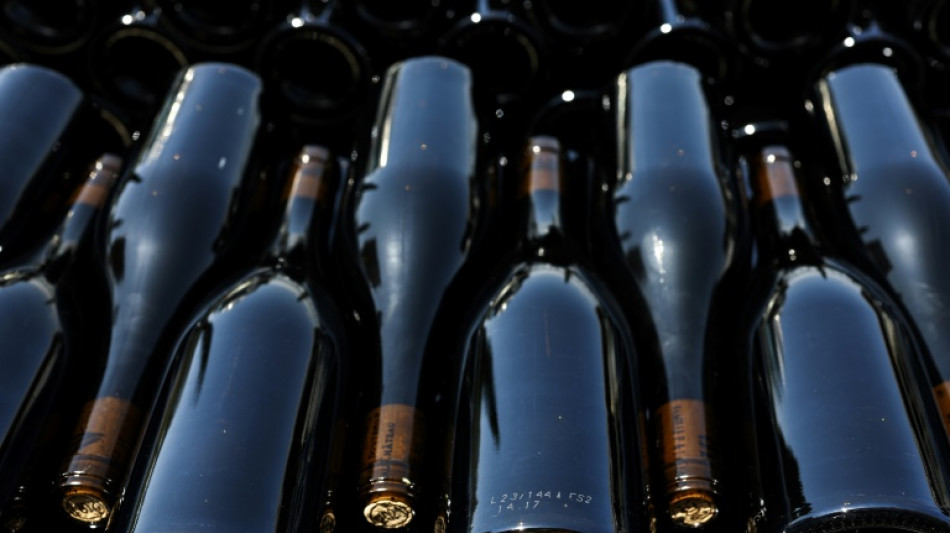
France, EU to spend 200 mn euros on destroying excess wine / Photo: © AFP

 Fritz takes 250th hardcourt win in ATP Washington opener

 US singer D4vd to stand trial in killing of teenage girl

 Sudan RSF leader 'unleashes' fighters after army gains in Kordofan
 Ramsay-Peaty to learn lessons for LA after missing out on Commonwealth gold

 Spain wildfire burns campsite to ash, leaving tears and despair

 'Thrilled' 76ers sign James with eyes on NBA title run
 Brazil's Amazonia theaters earn UNESCO World Heritage status

 Fury of fire-ravaged French village at being 'sacrificed' for millionaires' peninsula

 Border crossings shut as heavy snow coats Argentine Andes

 Singer Carly Simon diagnosed with Parkinson's: statement

 Burnham meets Zelensky, pledges new 'Stone Cloak' for Ukrainian drones

 Newcastle winger Barnes signs long-term contract extension
 Iran, US hold fire as Saudi Arabia intercepts drones
 Chad says will withdraw from the International Criminal Court

 UK funeral director faces jail over bodies left 'on racks'

 German authorities criticised after Pride attack

 Flooding forces residents to flee homes by boat in Pakistan

 Polish village puts faith in Europe's tallest Virgin Mary statue
 Farmers help battle French forest inferno before new heatwave
 Heat, overcrowding, pushes Italian prison guard union to sue

 UK TV comedy star and naturalist Bill Oddie dies at 85

 AstraZeneca profit rises on strong cancer drug sales

 Olympic triathlon champ Beaugrand to sit out European athletics
 Spain races to contain blazes before temperatures rise

 Pirlo bitter over debate that cost him Italy coaching job

The French government announced Friday that 200 million euros ($216 million) would be set aside to fund the destruction of surplus wine production in a bid to support struggling producers and shore up prices.
Several major wine-producing regions in France, particularly the famed Bordeaux area, are struggling because of a cocktail of problems from changes in consumption habits, the cost-of-living crisis and the after-effects of Covid-19.
A fall in demand for wine has led to over-production, a sharp fall in prices, and major financial difficulties for up to one in three wine makers in the Bordeaux region, according to the local farmers' association.
An initial European Union fund of 160 million euros for wine destruction has been topped up to 200 million euros by the French government, Agriculture Minister Marc Fesneau told reporters at a press conference on Friday.
The money was "aimed at stopping prices collapsing and so that wine-makers can find sources of revenue again," but he stressed that the industry needed to "look to the future, think about consumer changes ... and adapt."
The southwest Languedoc region, the country's largest wine area known for its full-bodied reds, has also been hit hard by the fall in wine demand.
The alcohol from destroyed wine can be sold to companies for use in non-food products such as hand sanitiser, cleaning products, or perfume.
"We're producing too much, and the sale price is below the production price, so we're losing money," Jean-Philippe Granier from the Languedoc wine producers' association told AFP earlier this month.
The agriculture ministry also announced 57 million euros in June to fund the pulling up of around 9,500 hectares of vines in the Bordeaux region, while other public funds are available to encourage grape-growers to switch into other products, such as olives.
- Output up, sales down -
Europe last suffered a so-called "wine lake" in the mid-2000s, which forced the European Union to reform its farm policy to reduce the massive overproduction of wine which was being stimulated by its own subsidies.
The 27-member bloc still spends 1.06 billion euros annually on the sector, according to EU figures.
As well as a long-term trend of consumers switching into beer and other alcohols, the industry was badly hit by the Covid-19 crisis which shut restaurants and bars worldwide, leading to a sharp fall in sales.
Recent rises in the price of food and fuel, linked to rocketing global energy prices and the invasion of Ukraine, have also seen buyers reduce their spending on non-essential goods such as wine.
While approving emergency help for the sector in June, the European Commission said that wine consumption for the current year was estimated to have fallen 7 percent in Italy, 10 percent in Spain, 15 percent in France, 22 percent in Germany and 34 percent in Portugal.
Wine production in the bloc, the world's biggest wine-making area, rose 4.0 percent.
The Commission said the worst affected vineyards were those producing red and rose wines from certain regions of France, Spain and Portugal.
B.Shevchenko--BTB