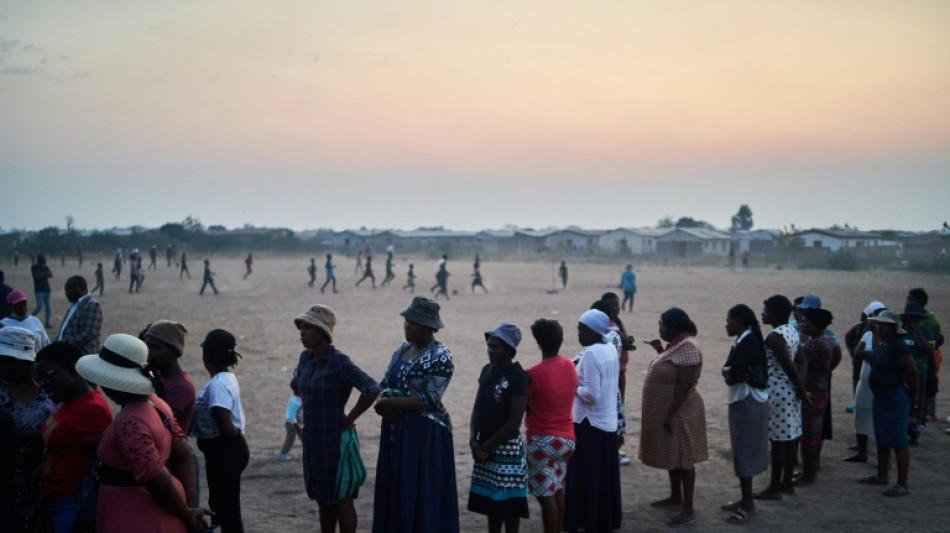
Aspects of Zimbabwe vote 'fell short': regional observers / Photo: © AFP

 Rene Eyre Revisits Autobiographical Performance 'Say A Little Prayer' in London

 UAE's HCT Holds Record Graduation and Announces Major Training Expansion

 NASA Awards $10B Lunar Contract Framework to SpaceX, Blue Origin

 Katy Perry Tells Fans Ex-Husband Russell Brand 'Should Be in Jail' During UK Concert

 South African election results renew debate over identity-based voting

 South African voters report smoother local election but declining IEC trust

 Dolly Parton museum and Nashville hotel open after singer’s death

 George and Amal Clooney attend New York political-comedy reading

 British buyers pay substantial premiums for period-home appearance

 Thomas Markle released to house arrest after child-abuse-image charge

Poll observers from a regional southern African bloc SADC on Friday said certain aspects of Zimbabwe's tense presidential and legislative elections did not conform to democratic principles.
The Southern Africa Development Community (SADC) cited cancellation of opposition rallies, biased state media and alleged voter intimidation among some of the issues that sullied the election.
"Some aspects of the harmonised election fell short of the requirements of the constitution of Zimbabwe, the electoral act and the SADC principals and guidelines governing democratic elections," said head of the delegation Nevers Mumba.
The observers deployed by the 16-nation SADC group, however said the period running to the election and the voting phases were "peaceful and calm".
The poll is being watched across southern Africa as a test of support for 80-year-old President Emmerson Mnangagwa's ZANU-PF party, whose 43-year rule has been battered by a moribund economy and charges of authoritarianism
The election was forced to stretch into an unprecedented second day over delays in printing of ballot papers in some key districts including in the opposition stronghold Harare.
The largest opposition, Citizens Coalition for Change (CCC), which poses the biggest challenge to Mnangagwa and had more than 100 of its campaign meetings banned, lashed the electoral process as "fundamentally flawed".
SADC added that "it was the contention of a number of stakeholders that the state-owned media houses remain biased against the opposition".
Less than a quarter of polling stations in Harare -- an opposition stronghold -- opened on time on Wednesday, the first day of voting.
The problems forced Mnangagwa, who is seeking a second term, to issue a late-night directive extending the vote by another day.
- 'Disputed election' -
CCC leader Nelson Chamisa slammed the delays as "a clear case of voter suppression, a classic case of Stone Age... rigging".
Chamisa, 45, is the main challenger to Mnangagwa, 80, who came to power after a coup that deposed late ruler Robert Mugabe in 2017.
Meanwhile 41 local monitors were arrested late at night on election day and had their computers and mobile phones confiscated by police who alleged the equipment was "used to unlawfully tabulate" results from polling stations, describing the activity as "subversive and criminal".
The monitors, mostly women and men in their 20s and early 30s -- and who work for local pro-democracy NGOs -- arrived Friday at a Harare court crammed into the back of an open white truck to appear before a magistrate.
As they waited in the sun, some waved and held back tears as they were greeted by a small group of family and friends. Several sported blue caps or green t-shirts bearing the words "election observer".
The elections are also being monitored by international observers from the European Union, Commonwealth and African Union, who are expected to issue their verdicts later Friday.
"At this stage it's all pointing towards a disputed election," said Kealeboga Maphunye, an African studies professor at the University of South Africa in an online debate organised Friday by the South Africa-based Southern African Liaison Office.
O.Lorenz--BTB