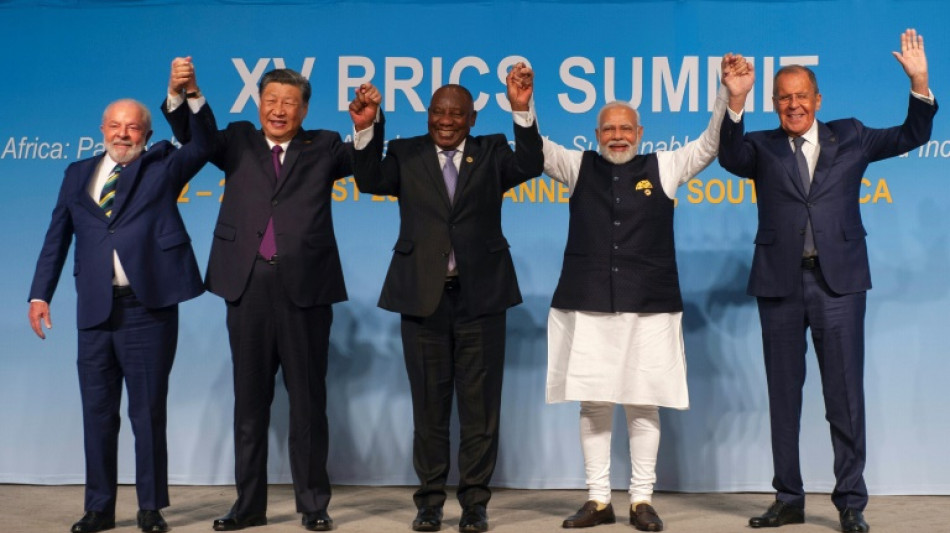
BRICS leaders agree to expand membership at summit / Photo: © POOL/AFP

 Rene Eyre Revisits Autobiographical Performance 'Say A Little Prayer' in London

 UAE's HCT Holds Record Graduation and Announces Major Training Expansion

 NASA Awards $10B Lunar Contract Framework to SpaceX, Blue Origin

 Katy Perry Tells Fans Ex-Husband Russell Brand 'Should Be in Jail' During UK Concert

 South African election results renew debate over identity-based voting

 South African voters report smoother local election but declining IEC trust

 Dolly Parton museum and Nashville hotel open after singer’s death

 George and Amal Clooney attend New York political-comedy reading

 British buyers pay substantial premiums for period-home appearance

 Thomas Markle released to house arrest after child-abuse-image charge

BRICS leaders have agreed to expand the club of major emerging economies and adopted conditions for entry, South Africa said Wednesday, as the bloc pursues greater clout to shape the world order.
Calls to enlarge the BRICS -- Brazil, Russia, India, China and South Africa -- has dominated the agenda at its three-day summit in Johannesburg and exposed rifts between members.
China is seeking to rapidly grow the BRICS amid rising competition with the United States but the group's other major power, India, is wary of the intentions of its geopolitical rival.
South African officials say nearly two dozen countries have formally applied to join the BRICS, which accounts for 40 percent of the world's population and a quarter of the global economy.
On Wednesday, South African Foreign Minister Naledi Pandor said BRICS leaders had "agreed on the matter of expansion" and a detailed announcement would be made before the summit's close on Thursday.
"We have a document that we have adopted that sets out guidelines and principles, processes, for considering countries that wish to become members of BRICS," Pandor told state-run Ubuntu Radio.
"That's very positive."
Indian Prime Minister Narendra Modi had told the summit he supported opening the door to new members and "welcomes moving forward with consensus".
"We stand at the cusp of expanding the BRICS family," said South African President Cyril Ramaphosa.
The bloc makes decisions by consensus and no new members have been admitted since South Africa in 2010.
- 'Turbulence and transformation' -
Chinese President Xi Jinping, on just his second trip abroad this year, said expanding the bloc would "pool our strength (and) pool our wisdom to make global governance more just and equitable."
"We gather at a time when the world is undergoing major shifts, divisions, and regrouping. It has entered a new period of turbulence and transformation," said Xi, whose nation represents about 70 percent of the BRICS total GDP.
US officials have played down the likelihood of BRICS emerging as a geopolitical rival, describing the bloc as a "very diverse collection of countries" containing both friends and rivals.
The BRICS are a disparate mix of big and small economies, democratic and authoritarian states, but share a collective desire to challenge the Western-led global order they say does not serve their interests or rising clout.
The summit has underlined divisions with the West over the war in Ukraine, and the support Russia enjoys from its BRICS partners at a time of global isolation.
South Africa, China and India have not condemned Russia's invasion while Brazil has refused to join Western nations in sending arms to Ukraine or imposing sanctions on Moscow.
Russian President Vladimir Putin, who faces an international arrest warrant over alleged war crimes in Ukraine, was the only BRICS leader not to attend in person, and addressed the summit via video link where he railed against sanctions.
Russia was "desperate for friends and partners so it's not surprising that they are so keen to have an expansion," said Gustavo de Carvalho, senior researcher at the South African Institute of International Affairs.
- BRICS divide -
Analysts said that in considering new members, Brazil, South Africa and India would have to balance a desire for good ties with China and Russia against the risk of estranging the United States, a major trading partner.
Like the BRICS themselves, the countries applying vary greatly, from G20 giants like Indonesia and Saudi Arabia to isolated states like Iran that are openly hostile to the United States and its allies.
Some 50 heads of state and government have joined BRICS leaders in Johannesburg.
BRICS leaders say the level of interest was proof its message resonated deeply in the "Global South" -- a broad term referring to nations outside the West.
Brazil's President Luiz Inacio Lula da Silva, who has championed the BRICS development bank as an alternative to the Washington DC-based lending institutions, said he supported the entry of Argentina.
But the South American powerhouse feared "diluting" the influence of BRICS should it expand too quickly, said Carvalho.
B.Shevchenko--BTB