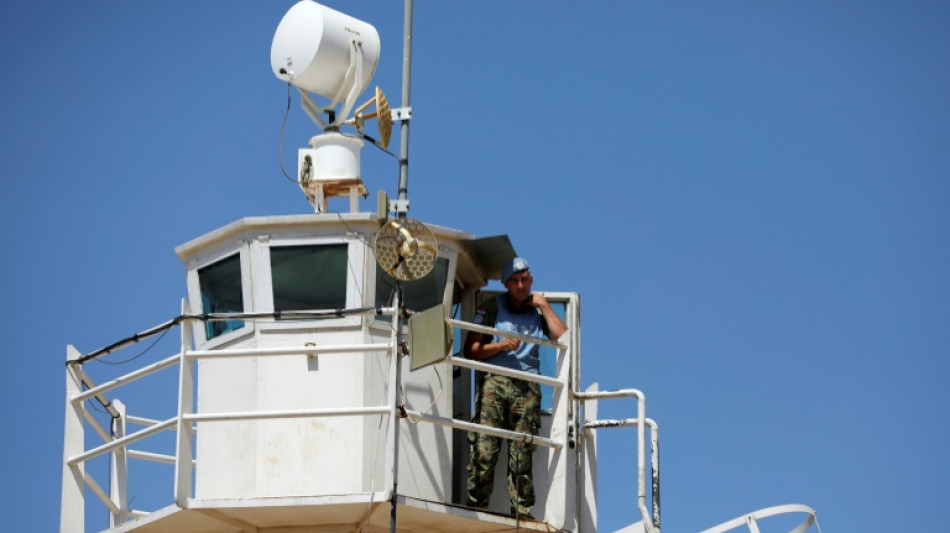
Divided border village at heart of Israel-Lebanon tensions / Photo: © AFP

 Netanyahu heads to US for first Trump meeting since Iran war
 Documentary on Stan Lee's final years faced industry opposition, filmmaker says

 Fritz takes 250th hardcourt win in ATP Washington opener

 US singer D4vd to stand trial in killing of teenage girl

 Sudan RSF leader 'unleashes' fighters after army gains in Kordofan
 Ramsay-Peaty to learn lessons for LA after missing out on Commonwealth gold
 Spain wildfire burns campsite to ash, leaving tears and despair

 'Thrilled' 76ers sign James with eyes on NBA title run
 Brazil's Amazonia theaters earn UNESCO World Heritage status

 Fury of fire-ravaged French village at being 'sacrificed' for millionaires' peninsula

 Border crossings shut as heavy snow coats Argentine Andes
 Singer Carly Simon diagnosed with Parkinson's: statement

 Burnham meets Zelensky, pledges new 'Stone Cloak' for Ukrainian drones
 Newcastle winger Barnes signs long-term contract extension
 Iran, US hold fire as Saudi Arabia intercepts drones
 Chad says will withdraw from the International Criminal Court
 UK funeral director faces jail over bodies left 'on racks'
 German authorities criticised after Pride attack
 Flooding forces residents to flee homes by boat in Pakistan
 Polish village puts faith in Europe's tallest Virgin Mary statue

 Farmers help battle French forest inferno before new heatwave

 Heat, overcrowding, pushes Italian prison guard union to sue
 UK TV comedy star and naturalist Bill Oddie dies at 85

 AstraZeneca profit rises on strong cancer drug sales
 Olympic triathlon champ Beaugrand to sit out European athletics

Straddling the frontier between Lebanon and the Israeli-annexed Golan Heights, the picturesque village of Ghajar has become a lightning rod for tensions between the hostile forces on either side.
The latest tit-for-tat exchange saw Israeli Defence Minister Yoav Gallant and the chief of Lebanon's powerful Hezbollah movement, Hassan Nasrallah, vow to send the other's country "back to the Stone Age" if the other escalates violence.
On the sleepy streets of Ghajar, home to manicured flower beds and ice cream trucks, an invisible boundary is intended to keep the two sides apart.
"The Blue Line is in the air," resident Abu Youssef Hussein Tawfiq Khatib told AFP, referring to the United Nations demarcation line drawn when Israeli troops withdrew from south Lebanon in 2000.
"You see that the town is open, there are no borders or anything," added the 79-year-old, wearing a traditional white headdress near the village mosque.
But weeks earlier, Israelis erected a controversial fence topped with barbed wire on the Lebanese side of the Blue Line.
The move followed cross-border fire in April that was the heaviest since a devastating war between Israel and Hezbollah in 2006. That and other incidents have sparked fears of renewed conflict.
Any miscalculation could have devastating consequences. The month-long 2006 war killed 1,200 people in Lebanon -- mostly civilians -- and 160 Israelis, mostly soldiers.
With the neighbouring countries still technically at war, Lebanon condemned the Ghajar fence as a unilateral Israeli "annexation" of the northern part of the village.
On July 6, an anti-tank missile was launched from Lebanese territory towards the new barrier, prompting retaliatory strikes by Israeli forces.
- 'Atmosphere of alert' -
Despite the cross-border exchanges, Ghajar resident Nahlah Saeed insisted that right now "here's safe -- Israel's safe".
"In the future, I don't know. I know that I live well, happily," said Saeed, 63, sitting in the shade outside a house.
According to municipal figures, the village is home to around 3,000 people, who took Israeli citizenship after Israel seized the Golan Heights from Syria in the Six-Day War of 1967 and then annexed it in 1981 in a move never recognised by the international community.
Village spokesman Bilal Khatib said residents had the "right to build a fence around our own homes".
"The council built the barrier and stopped the soil being swept away, protecting these homes. A second reason was that we had, more than once, wild animals entering the village," he told AFP in his office.
Under the scorching sun, UN peacekeepers patrol the northern side of the new fence, which is metres high and looks over Lebanese homes in the village of Wazzani.
On both sides of the Blue Line, local officials told AFP about title deeds and pointed to maps which they said prove their ownership of the disputed land.
Wazzani mayor Ahmad al-Mohammed said he has "adapted to the atmosphere of alert".
"In recent years, there was Israeli bombardment, which took a human, material and livestock toll. But people don't leave the village, because they must be tied to their source of livelihood," he told an AFP journalist in south Lebanon.
Lebanese authorities consider the expansion of Ghajar, with its pastel-coloured homes spreading to the north in recent decades, as an infringement on their land.
On the outskirts of Wazzani, shepherd Imad al-Mohammed rode a horse as he took his flock out to pasture.
"When the Lebanese lands in the vicinity of Ghajar are recovered, the pasture lands will increase and I'll take the sheep there," he told the AFP correspondent, pointing across to homes now behind the Israeli fence.
- 'Peace before everything' -
The UN is mediating the fence affair and acts as an intermediary in talks over the Blue Line, at which refreshments must be served separately to the opposing sides by the Italian contingent.
"Despite all the tensions in the area, there is still a commitment from the parties, or no appetite for a conflict," said Andrea Tenenti, spokesman for the United Nations Interim Force in Lebanon (UNIFIL).
Under international agreements backed by the two governments, "Israel is obliged to withdraw from the northern part of the village of Ghajar," Tenenti said.
Lebanon, meanwhile, is obliged to remove a tent that was erected across the Blue Line northeast of Ghajar earlier this year.
An Israeli security official, speaking on condition of anonymity as he was not authorised to speak publicly, said the "rogue terrorist army" Hezbollah was behind the tent and UN mediation on the matter was underway.
"Nobody wants this to escalate, right, so he (Nasrallah) is also trying to keep it under the threshold. We're keeping it under the threshold," the official said.
He cited Israeli forces using non-lethal weapons to push back Hezbollah members who approached the border around 40 kilometres (25 miles) southwest of Ghajar, wounding three militants.
Standing within view of the valley, Khatib, the elderly Ghajar resident, underlined the importance of "peace before everything".
"That's it, and everyone has the rights that belong to them. I take the land that belongs to me, and he takes the land that belongs to him," he said.
F.Pavlenko--BTB