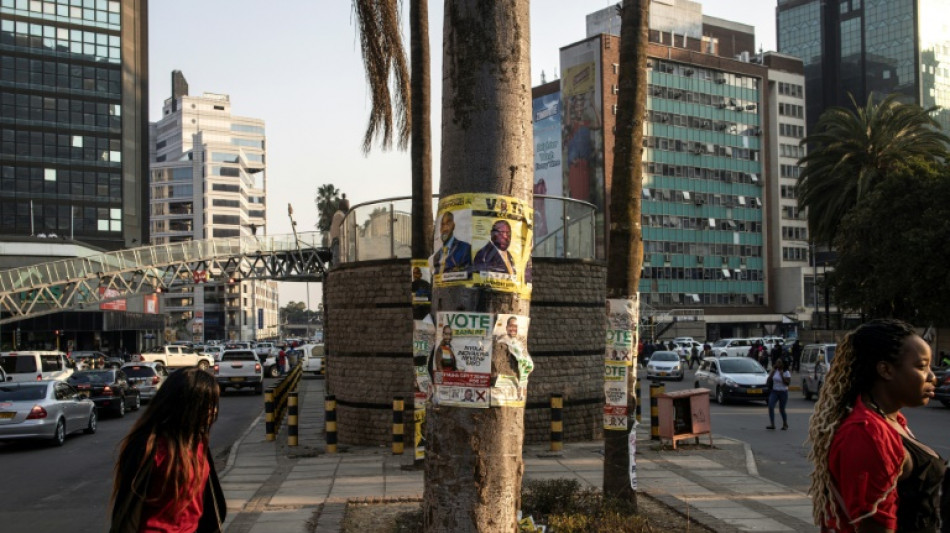
Zimbabwe to vote in uphill election for defiant opposition / Photo: © AFP

 Rene Eyre Revisits Autobiographical Performance 'Say A Little Prayer' in London

 UAE's HCT Holds Record Graduation and Announces Major Training Expansion

 NASA Awards $10B Lunar Contract Framework to SpaceX, Blue Origin

 Katy Perry Tells Fans Ex-Husband Russell Brand 'Should Be in Jail' During UK Concert

 South African election results renew debate over identity-based voting

 South African voters report smoother local election but declining IEC trust

 Dolly Parton museum and Nashville hotel open after singer’s death

 George and Amal Clooney attend New York political-comedy reading

 British buyers pay substantial premiums for period-home appearance

 Thomas Markle released to house arrest after child-abuse-image charge

Zimbabweans go to the polls on Wednesday in closely-watched presidential and legislative elections, after a campaign tainted by a crackdown on dissent, fears of vote rigging and public anger at the economic crisis.
The opposition, traditionally stronger in urban areas, is hoping to ride a wave of discontent at the southern African country's economic troubles, amid high inflation, unemployment and widespread poverty.
"We are tired of this. We are (living from) hand to mouth," said Paddington, 27, a fruit vendor, as he sat on a rusty blue truck with a flat tyre and a load full of oranges at the bustling market of Mbare, Harare's oldest township.
President Emmerson Mnangagwa, 80, who came to power after a coup that deposed late ruler Robert Mugabe in 2017 and is seeking re-election, has promised growth and new infrastructure.
He sounds confident of victory.
"I'm going for my second term, it's my last term," he told state media on the eve of the polls.
Asked whether the president was the right person to turn things around, Paddington, the orange seller, who preferred not to give his full name, broke into a nervous laughter.
"He's not the right guy."
Pointing to a Mnangagwa electoral poster on the front door of his truck, he said, "That's to be safe and make money," hinting at fears of retaliation from authorities for those who openly speak against the government.
- Rigging fears -
Mnangagwa's main challenger is Nelson Chamisa, 45, who leads the yellow-coloured Citizens Coalition for Change (CCC) party.
The lawyer and pastor has promised a new Zimbabwe "for everyone", tackling corruption, relaunching the economy and pulling the country out of international isolation.
"Zimbabwe, our time has come," he told a large campaign rally in Harare on Monday. "We are going to win with a big and wide margin".
Yet, in a nation with a history of tainted elections, few believe he will emerge the outright winner.
The CCC has complained about being unfairly targeted by authorities, its members arrested, dozens of events blocked and little or no airtime on national television.
But election authorities dismissed concerns about irregularities in the voters roll as "the product of creative imagination".
"We are ready. If there are any issues, we will deal with them," said Rodney Kiwa, deputy chairman of the Zimbabwe Electoral Commission (ZEC).
Chamisa is used to disputed elections.
He narrowly lost to Mnangagwa in 2018, in a poll he condemned as fraudulent and which was tainted by a deadly crackdown on post-election protests.
Government spokesman Nick Mangwana said authorities had confidence in the electoral process and believed things would go peacefully.
"There is a lot of calmness in the country," he told AFP. "I just wish every Zimbabwean would accept the choice of the Zimbabwean people."
- Crocodile pledges -
The former British colony, then named Rhodesia, broke away from London in 1965 under white-minority rule.
After a long guerrilla war, it gained independence in 1980 and was renamed Zimbabwe.
But under Mugabe, the fledgling democracy spiralled into authoritarianism and economic decline.
Things have hardly improved since Mnangagwa came to power.
The agriculturally- and mineral-rich country is burdened by "unsustainable" debt levels, according to the World Bank.
Inflation officially stood at 101 percent in July but some economists say the real figure is higher.
Stable jobs are hard to come by for its more than 15 million people, about two-thirds of whom are under 25.
Meickle Dumukwa, 55, an onion seller, said he believed the president would deliver on his promises and fix broken roads -- something he said would drastically slash the time it takes him to get onions from the farm to his market stall in the capital.
"They have promised so many things, so we are looking forward to those things. I am happy to change my life going forward," he said.
To clinch re-election, Mnangagwa, nicknamed "the crocodile" for his ruthlessness, must win an absolute majority of votes.
If he doesn't garner at least 50 percent plus one of the votes, he will face a run-off.
Polling stations open at 07:00 am (0500 GMT) and shut 12 hours later.
P.Anderson--BTB