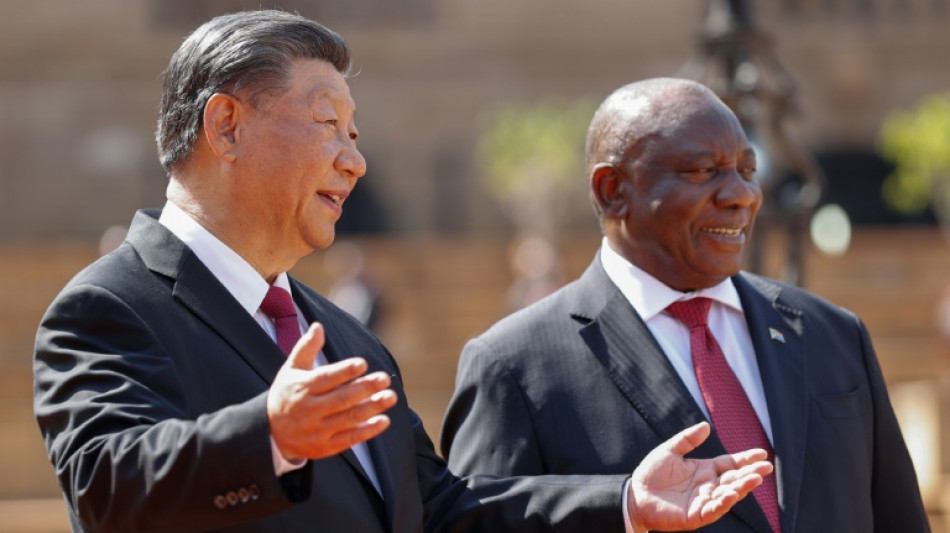
China urges BRICS expansion at summit of emerging economies / Photo: © AFP

 Rene Eyre Revisits Autobiographical Performance 'Say A Little Prayer' in London

 UAE's HCT Holds Record Graduation and Announces Major Training Expansion

 NASA Awards $10B Lunar Contract Framework to SpaceX, Blue Origin

 Katy Perry Tells Fans Ex-Husband Russell Brand 'Should Be in Jail' During UK Concert

 South African election results renew debate over identity-based voting

 South African voters report smoother local election but declining IEC trust

 Dolly Parton museum and Nashville hotel open after singer’s death

 George and Amal Clooney attend New York political-comedy reading

 British buyers pay substantial premiums for period-home appearance

 Thomas Markle released to house arrest after child-abuse-image charge

China on Tuesday threw its weight behind plans to expand the loosely-defined BRICS club of large emerging economies, which is seeking to assert its political and economic clout on the global stage.
The BRICS nations of Brazil, Russia, India, China and South Africa, which represent a quarter of the global economy, are meeting for three days and interest in joining the group has surged.
In a speech read on his behalf by his Commerce Minister Wang Wentao at the start the BRICS summit in South Africa, President Xi Jinping said "hegemonism is not in China's DNA".
He said the talks taking place in Johannesburg were not aimed at "asking countries to take sides, or creating bloc confrontation, rather to expand the architect of peace and development".
"Whatever resistance there may be, BRICS, a positive and stable force for goodwill continue to grow," he said. "We will forge a stronger BRICS strategic partnership, ...actively advance membership expansion", and "help make the international order more just and equitable".
China is the BRICS most powerful economy and Xi's state visit to South Africa, just his second international trip this year, comes as Beijing pushes to rapidly expand the group's membership.
- Divisions over Ukraine war -
But the US does not see BRICS "as evolving into some kind of geopolitical rival to the United States," said Jake Sullivan, White House National Security Advisor.
Washington will forge ahead with "strong positive relationships we have with Brazil, India and South Africa," he said adding "we will continue to manage our relationship with China and we will continue to push back on Russia's aggression".
The summit in Johannesburg has underscored divisions with the West over the war in Ukraine, and the support Russia enjoys from its other BRICS partners at a time of global isolation.
South Africa, China and India have not condemned Russia's invasion while Brazil has refused to join Western nations in sending arms to Ukraine or imposing sanctions on Moscow.
Russian President Vladimir Putin, who is the target of an international arrest warrant over alleged war crimes in Ukraine, did not attend in person and addressed the summit via pre-recorded video.
He blamed sanctions for "seriously" affecting the global economic situation through the "violation of all the basic norms and rules of free trade and economic life".
- 'Equal footing' -
Indian Prime Minister Narendra Modi and Brazil's President Luiz Inacio Lula da Silva are also at the talks where some 50 other leaders have been invited.
Representing 40 percent of the world's population, and democratic and authoritarian states at varying levels of economic growth, the BRICS nations share a common desire for a global order they see as better reflecting their interests and rising clout.
BRICS is also championing its own development bank as an alternative to the World Bank and International Monetary Fund, and proposals to reduce the use of the US dollar in global trade.
"We want to sit at the negotiating table on an equal footing with the European Union, the United States or any other country," Lula said in a social media post on Tuesday.
The theme of its 15th summit is "BRICS and Africa" and comes as the continent emerges as a renewed diplomatic battleground with the United States, Russia and China jostling for influence.
The bloc began as four nations in 2009 but expanded the following year with the addition of South Africa.
Officials say more than 40 countries have shown interest in joining from across the 'Global South', a broad term referring to nations outside the West.
Like the BRICS themselves, these countries run the gamut and include traditionally non-aligned nations like Indonesia and others that are openly hostile to the United States and its allies, like Iran.
"It goes to show that the BRICS family is growing in its importance, in its stature and also in its influence in the world," said Ramaphosa.
burs-np-sn/pvh
Y.Bouchard--BTB