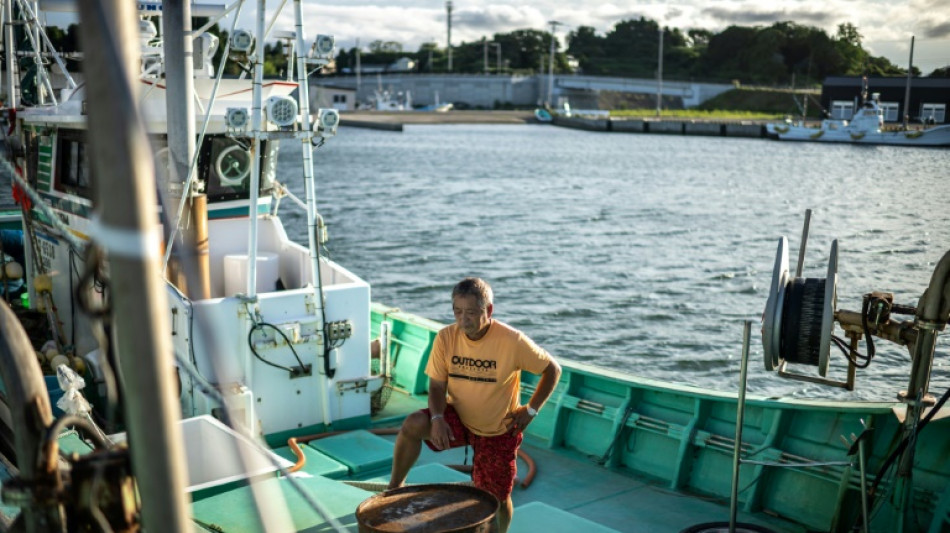
Water release finds little support in Fukushima / Photo: © AFP

 Fritz takes 250th hardcourt win in Washington, Draper pulls out
 'Appy marriages: AI helps hundreds of Japanese wed

 Netanyahu heads to US for first Trump meeting since Iran war
 Documentary on Stan Lee's final years faced industry opposition, filmmaker says

 Fritz takes 250th hardcourt win in ATP Washington opener

 US singer D4vd to stand trial in killing of teenage girl

 Sudan RSF leader 'unleashes' fighters after army gains in Kordofan
 Ramsay-Peaty to learn lessons for LA after missing out on Commonwealth gold

 Spain wildfire burns campsite to ash, leaving tears and despair

 'Thrilled' 76ers sign James with eyes on NBA title run
 Brazil's Amazonia theaters earn UNESCO World Heritage status

 Fury of fire-ravaged French village at being 'sacrificed' for millionaires' peninsula
 Border crossings shut as heavy snow coats Argentine Andes
 Singer Carly Simon diagnosed with Parkinson's: statement

 Burnham meets Zelensky, pledges new 'Stone Cloak' for Ukrainian drones
 Newcastle winger Barnes signs long-term contract extension
 Iran, US hold fire as Saudi Arabia intercepts drones
 Chad says will withdraw from the International Criminal Court

 UK funeral director faces jail over bodies left 'on racks'
 German authorities criticised after Pride attack

 Flooding forces residents to flee homes by boat in Pakistan

 Polish village puts faith in Europe's tallest Virgin Mary statue

 Farmers help battle French forest inferno before new heatwave
 Heat, overcrowding, pushes Italian prison guard union to sue

 UK TV comedy star and naturalist Bill Oddie dies at 85

Most Fukushima fishermen are tight-lipped but Haruo Ono can't keep his thoughts to himself on Japan's plans to release treated cooling water from the stricken nearby nuclear power plant into the Pacific from Thursday.
"Nothing about the water release is beneficial to us. There is no advantage for us. None. It's all detrimental," Ono, who lost his brother in the 2011 tsunami that crippled the plant, told AFP.
"Fishermen are 100 percent against," the 71-year-old said at his modest home in Shinchimachi, around 60 kilometres (40 miles) north of the nuclear plant in northeast Japan.
"The sea is where we work. We make a living off of the sea, we're at the mercy of the sea. So if we don't protect the sea, who would?"
Around 1.34 million tonnes of water, equivalent to more than 500 Olympic swimming pools, have accumulated at the Fukushima plant since the earthquake and tsunami that killed 18,000 people in 2011.
It has been contaminated by being used to cool the highly radioactive reactor cores that went into meltdown, combined with groundwater and rain.
But plant operator TEPCO says the water has been diluted and filtered to remove all radionuclides except tritium, which is far below dangerous levels.
- 'Sewer' -
The plan gradually to begin releasing the water at a maximum rate of 500,000 litres (132,000 US gallons) a day via a pipe one kilometre (half a mile) out to sea has won approval from the UN nuclear watchdog.
But many in the Japanese fishing industry are worried about the reputation of the country's seafood, just as it was starting to recover 12 years after the Fukushima disaster.
"Fukushima was seen as something people should avoid (after 2011). Even car number plates from Fukushima was taken off when people had to evacuate to other prefectures," local artist Tomomi Kodama, 40, told AFP.
"Now if the water is released from the plant, I am worried about how the world would possibly accept it," she said.
As well as being a major source of national pride, seafood is a major Japanese industry, with almost 600,000 tonnes -- worth around $2 billion -- exported in 2022.
China is its biggest customer, accounting for around a quarter of this, but Beijing has accused Tokyo of treating the ocean like a "sewer" with the water release.
In a move that experts say is partially motivated by rivalry in other areas, China even before the release banned food shipments from 10 Japanese prefectures and imposed radiation checks for elsewhere.
These time-consuming controls have already led to a 30-percent slump in Japanese seafood imports into China last month, Japanese and Chinese media reported, citing Chinese customs data.
Hong Kong, another important market for Japanese seafood exports, has also threatened restrictions, and it is unclear how consumers elsewhere will react.
- Insecurity -
Masanobu Sakamoto, head of Japan's national fisheries cooperative, reiterated on Monday his opposition to the move.
"(Scientific) safety doesn't necessarily equate to a feeling of security in society. There are concerns that the once the water is discharged, there will be reputational damage," he said.
"There is no way people in the fisheries industry can rest reassured," he said.
People in the fishing industry "really had a hard time in many aspects (after 2011). And now, after 12 years, they are finally settling down and moving toward happiness -- gradually," said Ono, whose three sons are also fishermen.
"What the government is doing now is to abandon Fukushima. What the government should truly protect is the people of Fukushima, the fishermen, not TEPCO," he said.
M.Furrer--BTB