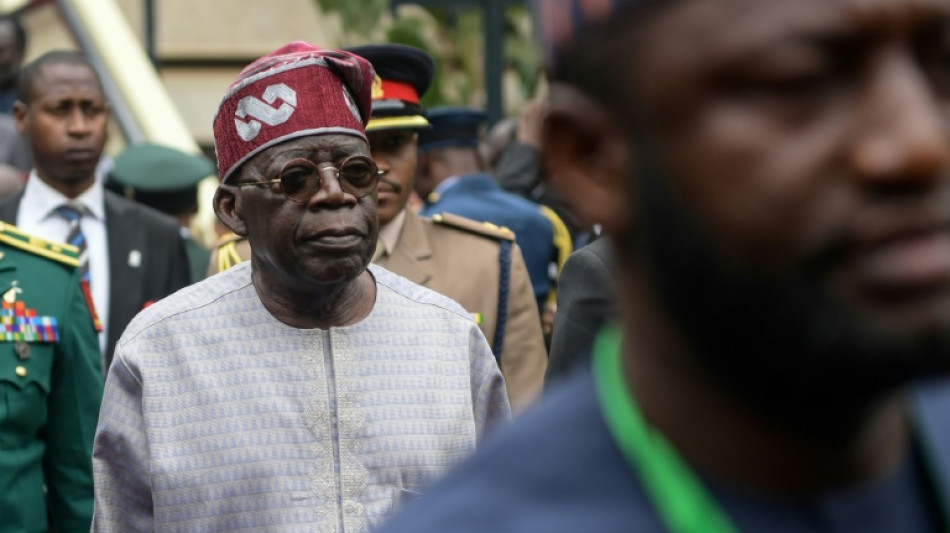
Nigeria's president inaugurates cabinet to tackle economic, security woes / Photo: © AFP

 Rene Eyre Revisits Autobiographical Performance 'Say A Little Prayer' in London

 UAE's HCT Holds Record Graduation and Announces Major Training Expansion

 NASA Awards $10B Lunar Contract Framework to SpaceX, Blue Origin

 Katy Perry Tells Fans Ex-Husband Russell Brand 'Should Be in Jail' During UK Concert

 South African election results renew debate over identity-based voting

 South African voters report smoother local election but declining IEC trust

 Dolly Parton museum and Nashville hotel open after singer’s death

 George and Amal Clooney attend New York political-comedy reading

 British buyers pay substantial premiums for period-home appearance

 Thomas Markle released to house arrest after child-abuse-image charge

President Bola Ahmed Tinubu on Monday swore in a cabinet of 45 ministers, urging them to build public trust as his new government takes on Nigeria's huge economic and security challenges.
Since he took office at the end of May, Tinubu has unleashed a raft of reforms aimed at revitalising the economy and investment, but the initiatives have caused a short-term surge in living costs.
Africa's most populous nation and largest economy is also trying to contain armed groups in parts of the country, including a long-running jihadist insurgency.
"The challenges we face today are very daunting," Tinubu said at the cabinet's inauguration ceremony.
But, he stressed, "We have the opportunity to implement long overdue reforms."
The new lineup includes Finance Minister Wale Edun, who once served under Tinubu as finance commissioner when the president was governor of Lagos state from 1999-2007.
Edun, a UK-educated economist and former staff member of Chase Bank and the World Bank, will also serve as coordinating minister for the economy.
The defence portfolio is headed by Mohammed Badaru Abubakar, a wealthy businessman and former state governor, while the new interior minister is Olubunmi Ojo, a former lawmaker.
The new foreign minister is Yusuf Tuggar, a British-educated diplomat who served as Nigeria's ambassador to Germany.
Tinubu will be in charge of the oil ministry like his predecessor, but he will be assisted by junior oil minister Heineken Lokpobiri, who served as agriculture minister in the last admistration.
The president also appointed Ekperikpe Ekpo, a former lawmaker with Tinubu's ruling APC, to be in charge of gas.
- 'Public faith' -
Nigeria is one of Africa's top oil and gas producer although it has struggled with foreign investment and also large-scale theft of oil from its key southern crude fields.
The former governor of southern Rivers state and key member of the opposition PDP party, Nyesom Wike, will be the minister in charge of Abuja, the nation's capital.
“Your assignment began immediately as your country honors you today. By this call to service, you must each work to make yourselves worthy in the eyes of God and all our nation's people," Tinubu said.
"Your highest obligation is to return public faith in government," he said.
Tinubu’s cabinet is larger than that of his predecessor Muhammadu Buhari who had 36 in his first term of office. Under the Nigerian constitution, the president must include a member from each of the country’s 36 States.
Tinubu, elected in February in a vote that opponents are still contesting in court, faces a myriad of challenges including huge foreign debt, weak naira currency, high inflation and unemployment as well as widespread insecurity.
The president has also already taken tough economic measures including the removal of fuel subsidies, which has led to rising costs of living and transportation.
Tinubu has also floated the naira exchange rate by abolishing multiple change rates, but this measure has lead to a massive depreciation in the value of the national currency.
The president is grappling with a 14-year Islamic insurgency in the northeast, kidnapping and banditry in the northwest and north central as well as separatist agitation in the southeast.
K.Thomson--BTB