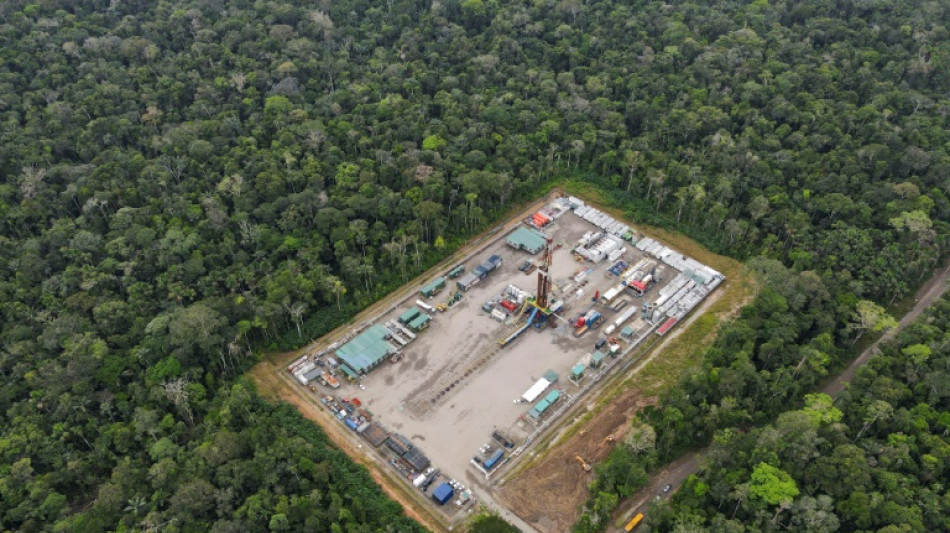
Ecuador votes to stop oil drilling in Amazon reserve / Photo: © AFP/File

 Rene Eyre Revisits Autobiographical Performance 'Say A Little Prayer' in London

 UAE's HCT Holds Record Graduation and Announces Major Training Expansion

 NASA Awards $10B Lunar Contract Framework to SpaceX, Blue Origin

 Katy Perry Tells Fans Ex-Husband Russell Brand 'Should Be in Jail' During UK Concert

 South African election results renew debate over identity-based voting

 South African voters report smoother local election but declining IEC trust

 Dolly Parton museum and Nashville hotel open after singer’s death

 George and Amal Clooney attend New York political-comedy reading

 British buyers pay substantial premiums for period-home appearance

 Thomas Markle released to house arrest after child-abuse-image charge

Ecuadorans have voted to stop an oil drilling project in an Amazon reserve, according to the results Monday of a referendum hailed as a historic example of climate democracy.
The "Yes" vote to halt exploitation of an oil block in the Yasuni National Park, one of the most diverse biospheres in the world, won by 59 percent, with 98 percent of votes tallied.
"Today Ecuador takes a giant step to protect life, biodiversity, and indigenous people," the country's two main indigenous organizations, Confeniae and Conaie, posted on social media.
After years of demands for a referendum, the country's highest court authorized the vote in May to decide the fate of "block 43," which contributes 12 percent of the 466,000 barrels of oil per day produced by Ecuador.
The block is situated in a reserve which stretches over one million hectares and is home to three of the world's last uncontacted Indigenous populations and a bounty of plant and animal species.
Drilling began in 2016 after years of fraught debate and failed efforts by then president Rafael Correa to persuade the international community to pay cash-strapped Ecuador $3.6 billion not to drill there.
The government of outgoing President Guillermo Lasso has estimated a loss of $16 billion over the next 20 years if drilling is halted.
The reserve is home to the Waorani and Kichwa tribes, as well as the Tagaeri, Taromenane and Dugakaeri, who choose to live isolated from the modern world.
National oil company Petroecuador had permission to exploit 300 hectares, but says it is only using 80 hectares.
The Amazon basin -- which stretches across eight nations -- is a vital carbon sink.
Scientists warn its destruction is pushing the world's biggest rainforest close to a tipping point, beyond which trees would die off and release carbon rather than absorb it, with catastrophic consequences for the climate.
The fate of the reserve has drawn the attention of celebrities such as Hollywood star and environmental activist Leonardo DiCaprio.
"With this first-of-its-kind referendum worldwide, Ecuador could become an example in democratizing climate politics, offering voters the chance to vote not just for the forest but also for Indigenous rights, our climate, and the well-being of our planet," he wrote on Instagram this month.
Swedish climate campaigner Greta Thunberg also hailed the "historic referendum."
The NGO Amazon Frontlines said the vote was a "demonstration of climate democracy, where people, not corporations, get to decide on resource extraction and its limits."
Locals in Yasuni were divided, with some supporting the oil companies and the benefits that economic growth have brought to their villages.
R.Adler--BTB