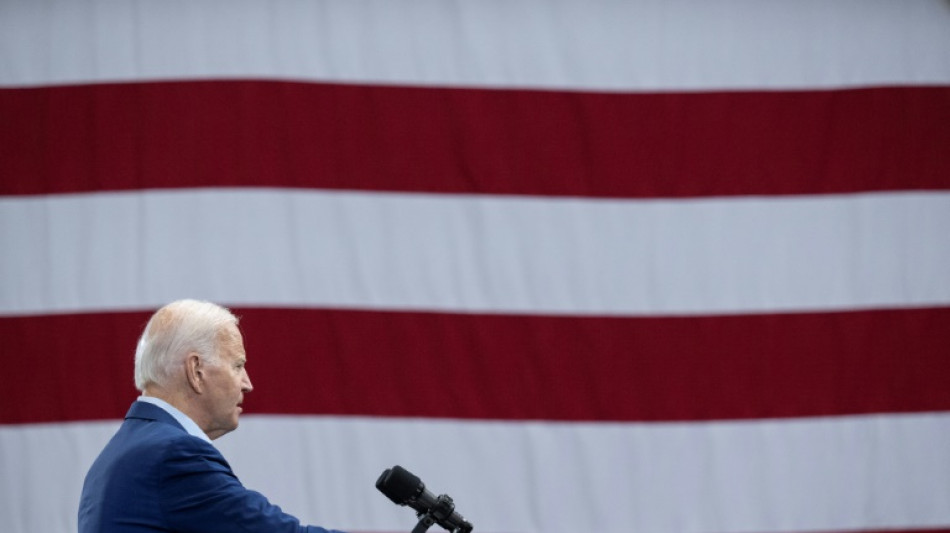
Biden announces curbs on US investments in China / Photo: © AFP

 Mercedes CEO urges German 'productivity offensive' as China woes hit profit

 Praise the Gods! Greek PM thanks Nolan for the 'The Odyssey' spotlight

 Zidane's long road leads back to France helm
 Firefighters on offensive in France, Spain as new heatwave arrives

 Seoul, Tokyo lead fresh tech rout as most of Asia retreats
 US tariffs refund boosts Philips

 Taiwan detains Nvidia worker in chip smuggling probe: source familiar with case

 Why are tech stocks tanking?
 BitMart под давлением: 22 000 USDT и 930 000 SNC не разблокированы по истечении 48 часов — у BitMart не хватает средств?
 Made by AI? EU tells firms to stick a label on it from Sunday

 Open champion Fox welcomed home by thousands after 'whirlwind few days'

 Seoul, Tokyo lead Asian plunge as tech stocks suffer fresh rout

 More than skin deep: Dutch abuse victims erase forced tattoos
 AI cameras spot suicide attempts in South Korea's capital

 Ukraine's Zelensky expected at White House to secure Trump's support

 West Indies lead Pakistan by 155 at close of third day

 Ramsay-Peaty beaten again as Australia reign supreme in Commonwealth pool

 IMF boss hails 'much sounder' Argentine economy under Milei

 HIV progress in 'real danger' as global funding plummets

 Commonwealth Games as 'training day', says Olympic champion McClenaghan

 Trump says 'good chance' of progress in Iran talks as foes hold fire

 Renault to face criminal trial in France over dieselgate

 Trump sees 'good chance' for Iran deal, warns strikes could resume

 India activists demand release of detained 'cockroach' protesters

 LVMH says growth accelerates in second quarter

US President Joe Biden on Wednesday issued an executive order aimed at restricting certain American investments in sensitive high-tech areas in China -- a move that could further strain ties between the world's top two economies.
The long-anticipated rules, expected to be implemented next year, target sectors like semiconductors and artificial intelligence, as Washington seeks to limit access to key technologies.
"The commitment of the United States to open investment is a cornerstone of our economic policy and provides the United States with substantial benefits," Biden said in a letter to Congressional leaders announcing the executive order.
"However, certain United States investments may accelerate and increase the success of the development of sensitive technologies and products in countries that develop them to counter United States and allied capabilities."
The program is set to prohibit new private equity, venture capital and joint ventures investments in advanced semiconductors and some quantum information technologies in China, according to the Treasury Department.
"The outbound investment program will fill a critical gap in the United States' national security toolkit," a senior government official said on condition of anonymity.
"What we're talking about is a narrow and thoughtful approach as we seek to prevent (China) from obtaining and using the most advanced technologies to promote military modernization and undermining US national security."
The Treasury is considering a notification requirement for US investments in Chinese entities involved in less advanced semiconductors, and activities relating to certain types of artificial intelligence.
China could exploit US investments to further its ability to produce sensitive technologies critical to military modernization, the Treasury Department said.
But it anticipates creating an exception for certain US investments into publicly traded securities and transfers from US parents to subsidiaries.
- Chilling effect? -
While the volume of dollars or numbers of transactions covered by a ban or notification regime are likely to be quite small, it does not necessarily mean the overall impact will be limited, said Emily Benson, director of the Project on Trade and Technology at the Center for Strategic and International Studies (CSIS).
"It's possible that while they're not directly subject to bans, companies will rethink the nature of their investments and that could have a chilling effect on bilateral investment over time," Benson told AFP.
The latest restrictions come shortly after visits by several high-level US officials to China as Washington and Beijing aim to stabilize ties.
During Treasury Secretary Janet Yellen's trip to the Chinese capital last month, officials from both sides talked about what such curbs might look like, and she told reporters that any new moves would be implemented in a transparent way.
"I emphasized that it would be highly targeted and clearly directed narrowly at a few sectors where we have specific national security concerns," Yellen said at the time.
She added that she wanted to allay fears that Washington would implement measures with broad-based impacts on the Chinese economy.
Nicholas Lardy, nonresident senior fellow at the Peterson Institute for International Economics (PIIE), noted that "the share of investment in China that's been financed by foreign capital in recent years is about one to two percent."
"If you want to have an impact, you've got to get other countries that are making these kinds of investments in China to have a similar regime," he said.
On Wednesday, a senior government official said key allies and partners have recognized the importance of this issue and "some are seeking to align" their policy approaches.
Outbound investment curbs would not represent an all-out effort to prevent Washington and Beijing from cooperating more deeply, Benson noted.
But "the administration has been trying to land high-level meetings with Chinese officials and it will fall on the US to really demonstrate through targeted language that this is not going to cause huge disruption in investment," she said.
K.Thomson--BTB