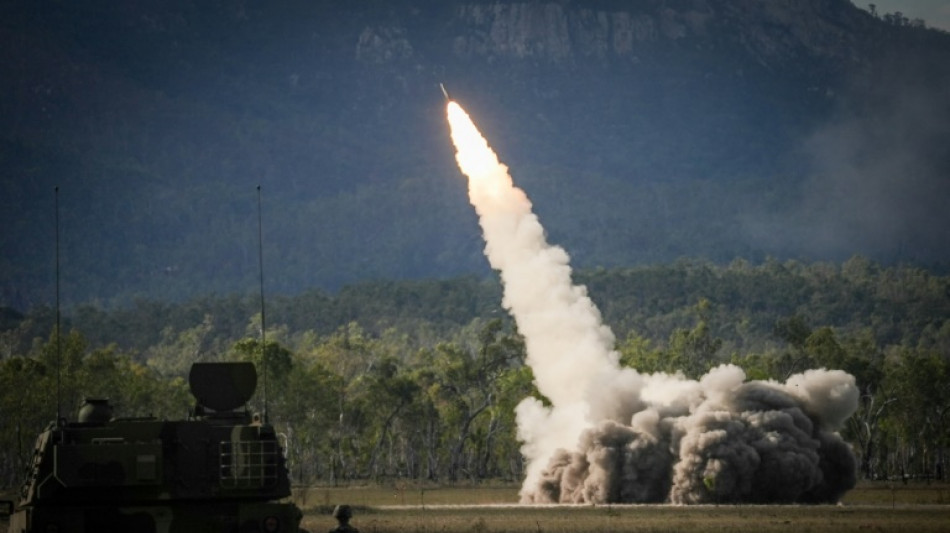
Pentagon eyes missile testing role for Australia / Photo: © AFP/File

 Mercedes CEO urges German 'productivity offensive' as China woes hit profit

 Praise the Gods! Greek PM thanks Nolan for the 'The Odyssey' spotlight

 Zidane's long road leads back to France helm

 Firefighters on offensive in France, Spain as new heatwave arrives
 Seoul, Tokyo lead fresh tech rout as most of Asia retreats
 US tariffs refund boosts Philips

 Taiwan detains Nvidia worker in chip smuggling probe: source familiar with case

 Why are tech stocks tanking?

 BitMart под давлением: 22 000 USDT и 930 000 SNC не разблокированы по истечении 48 часов — у BitMart не хватает средств?
 Made by AI? EU tells firms to stick a label on it from Sunday

 Open champion Fox welcomed home by thousands after 'whirlwind few days'

 Seoul, Tokyo lead Asian plunge as tech stocks suffer fresh rout

 More than skin deep: Dutch abuse victims erase forced tattoos
 AI cameras spot suicide attempts in South Korea's capital

 Ukraine's Zelensky expected at White House to secure Trump's support

 West Indies lead Pakistan by 155 at close of third day

 Ramsay-Peaty beaten again as Australia reign supreme in Commonwealth pool
 IMF boss hails 'much sounder' Argentine economy under Milei

 HIV progress in 'real danger' as global funding plummets
 Commonwealth Games as 'training day', says Olympic champion McClenaghan

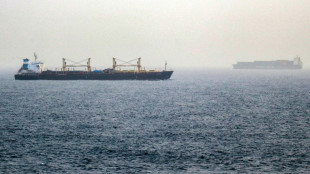 Trump says 'good chance' of progress in Iran talks as foes hold fire

 Renault to face criminal trial in France over dieselgate
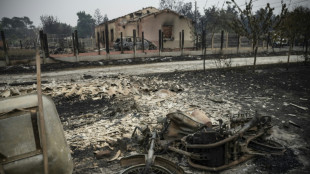
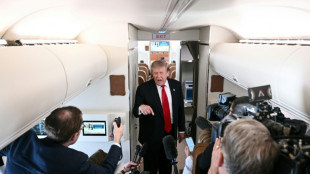 Trump sees 'good chance' for Iran deal, warns strikes could resume

 India activists demand release of detained 'cockroach' protesters

 LVMH says growth accelerates in second quarter
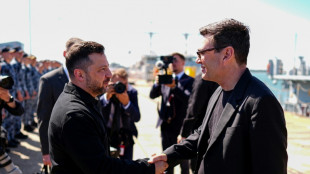
Australia could be a testing ground for US hypersonic and other long-range precision weapons under the AUKUS pact, a top Pentagon official told AFP on Wednesday.
US Secretary of the Army Christine Wormuth said Australia's contribution to the three-way AUKUS agreement, which includes Britain, "doesn't always have to be dollars".
The pact was signed in late 2021 and is seen as a way of countering China's growing clout in the Asia-Pacific region.
Work under AUKUS has so far focused on supplying Australia with nuclear-powered submarines, a fleet capable of travelling stealthily over vast distances and striking foes at long range.
But the pact is increasingly focused on developing advanced capabilities such as long-range precision firing, artificial intelligence and hypersonic weapons.
Wormuth said Australia could be a proving ground for these weapons.
"One thing Australia has in spades is long distances and relatively unpopulated land," she told AFP in a telephone interview from Washington.
"A challenge for us in the United States when it comes to hypersonics or even some of our things like the precision strike missile -- which is not a hypersonic weapon but has very long ranges in some of its increments -- for us to find open spaces in the United States where we can actually test these weapons, it's a challenge.
"Australia obviously has a tremendous amount of territory where that testing is a little bit more doable -- so I think that's a unique thing, as an example, that the Australians bring to the table."
China has denounced the AUKUS pact as undermining peace in the region -- a charge that Washington, Canberra and London reject.
But critics have also asked whether it is truly cooperative, or whether the United States, because of its size and overwhelming military power, will dominate.
Wormuth said she expected the two smaller partners to pitch in and "have skin in this game -- and they do".
"The sense I got certainly from talking to senior Australian officials is they're not doing this to make us happy, they're not doing this just for fun," said the Pentagon official, who visited Australia last week for the Talisman Sabre multinational military exercise.
"They're doing this because they see it as in their own national interest in terms of being able to meet the different challenges that they see in the theatre."
- 'Prohibitively expensive' -
Facing Russia's war in Europe, threats from North Korea and a more bellicose China, the United States has sought to bolster its defence alliances and put more advanced capabilities into the hands of allies like Australia, Ukraine and Taiwan.
For much of the Cold War, it was Washington's policy to be able to fight two major wars at once.
Wormuth admitted that today, budget constraints, US public opinion and the relative strength of Russia and China make such a doctrine impossible.
"I think there is a recognition that when you look at the size of our military, when you look at the size of the defence budget that the American taxpayer is willing to pay for, we... don't plan to fight more than one major war at a time," she said.
Instead, the United States hopes its alliance and nuclear arsenal will "discourage opportunistic aggression".
"Given the sophistication of the Russian military and the Chinese military today, to try to size our military to hypothetically handle two wars at a time would be prohibitively expensive".
K.Thomson--BTB