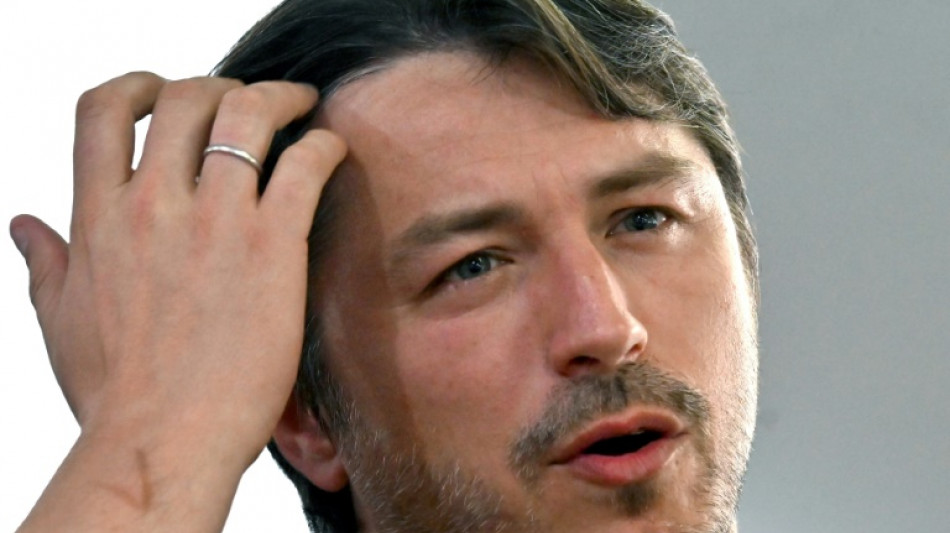
'From Ukrainians without love': Drone fundraiser taunts Moscow / Photo: © AFP

 Rene Eyre Revisits Autobiographical Performance 'Say A Little Prayer' in London

 UAE's HCT Holds Record Graduation and Announces Major Training Expansion

 NASA Awards $10B Lunar Contract Framework to SpaceX, Blue Origin

 Katy Perry Tells Fans Ex-Husband Russell Brand 'Should Be in Jail' During UK Concert

 South African election results renew debate over identity-based voting

 South African voters report smoother local election but declining IEC trust

 Dolly Parton museum and Nashville hotel open after singer’s death

 George and Amal Clooney attend New York political-comedy reading

 British buyers pay substantial premiums for period-home appearance

 Thomas Markle released to house arrest after child-abuse-image charge

 Dawn of War 4 developers chose Adeptus Mechanicus for tactical variety

 Italy face unbeaten South Africa in Turin Nations Championship match

 ChatGPT interactive interface feature tested across six custom tools
Crouching beside Ukrainian-made attack drones on a runway, TV star Serhiy Prytula appeared keen to taunt Moscow with a crowdfunded fleet that experts have linked with recent strikes inside Russia.
Ukraine has not taken direct responsibility for the string of attacks, including on the capital Moscow, but President Volodymyr Zelensky has warned that "war" is coming to Russia.
Polls show the former stand-up comedian's crowdfunding campaigns for the military have rendered him one of the country's most trusted public figures -- second only to Zelensky.
Offering a rare glimpse at Ukraine's homegrown explosive drones, Prytula recently shared images of himself with a fleet in an undisclosed location.
"Muscovites! Shudder from the sirens. Go to the bomb shelters," he wrote on social media alongside photos of himself with steel grey drones on a runway.
"We have no idea what could fly to Moscow," he said with a grin in a separate video.
His July 30 posts came on the day Ukrainian drones struck a skyscraper in Moscow, one of a series of strikes on the city.
In an interview with AFP in Kyiv, he declined to identify the type of drones in his posts.
He jokingly likened them to a "one-way ticket," saying only that they were capable of a flight range of 1,000 km (621 miles) and cost about $108,000 apiece.
- 'Revenge' -
Four analysts, including from Britain's Royal United Services Institute (RUSI), the US-based Center for Naval Analyses (CNA), and Janes, the defence intelligence firm, told AFP that they appeared to match the drones identified in videos from strikes on Russia's capital.
"That is the Beaver drone that has been hitting Moscow," Steve Wright, a Britain-based expert in drone technology, told AFP, referring to Prytula's images, pointing to several distinguishing features.
The unmanned aerial vehicles (UAVs) offer a window into Ukraine's domestic drone industry, which appears to be rapidly developing in response to Russia's full-scale invasion launched in February last year.
It underscores Ukraine's resolve to gain deep-strike capabilities in response to the routine bombardment by Russia, which has taken advantage of aerial superiority and Kyiv's limited air defences.
Scrawled on one of the drones in Prytula's post was a handwritten message: "From Ukrainians without love."
"Of course without love, but also without hate," Prytula said at his Kyiv office, littered with gifts from soldiers, including the mangled wing of a downed Russian craft.
Last year, Prytula's eponymous foundation raised 352 million hryvnia ($9.6 million) through what he called a "revenge" crowdfunding to purchase 142 long and short-range kamikaze drones to target Russia.
A domestic company, which he declined to name, manufactured the drones in batches over several months, he added.
Another Ukrainian influencer Igor Lachenkov told his Telegram followers that he was able to raise 20 million hryvnia ($545,000) for attack drones.
Just days after a brazen May 3 drone attack on the Kremlin, he posted pictures alongside what appeared to be Beaver drones.
Lachenkov told reporters that in December he was approached by Ukrainian military intelligence and asked for help funding a "drone that can fly very far".
"Our business is to bring to the military what they need," Prytula said, refusing to get into specific discussions with the armed forces.
- 'Fury and frustration' -
The efforts illustrate the rise of combat crowdfunding in Ukraine, which is increasingly reliant on domestic support and Western military aid to sustain its defence against a larger and more powerful aggressor.
Charities run by influencers, billboard campaigns and roadside donation boxes all urge citizens to fund the war effort.
"We need to use this fury for some good, for our military," said Prytula, who declared his career in comedy to be "over" as the widespread death and destruction had shifted his attention to the war effort.
Prytula said his foundation had so far raised about 130 million euros ($142 million) since the start of the full-scale invasion, with a bulk of the contributions coming from Ukrainians themselves.
At a warehouse at his foundation's Kyiv headquarters, dozens of volunteers packed and labelled cardboard boxes with everything from rifle scopes and satellite phones to combat medicine destined for soldiers on the warfront.
Such "fundraising campaigns help people to channel their fury and frustration into financial incentives for the army," Roman Osadchuk, a Kyiv-based research associate at the Atlantic Council's Digital Forensic Research Lab, told AFP.
"It gives non-military people a feeling of helping repel the Russian invasion," he added.
T.Bondarenko--BTB