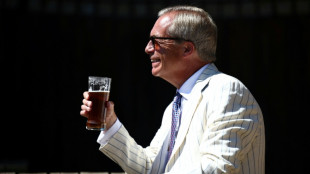
Tech giants clamp down on Russia state-linked news / Photo: ©

 'I want to be Eala': Philippine sensation sparks tennis boom at home

 US says lower oil prices, not Iran's nuclear program, are now top priority in war

 Most Asian stocks track Wall St record as US data ease rate fears

 China's viral 'spicy strips' take a bite of global snack market

 Shelton does the double in Canada

 'Shock' gloves for US immigration agents fuel potential abuse fears

 New Zealand Football withdraws support for Infantino, urges review

 Hopes fade in Colombia as window to find quake survivors shuts

 Trump announces tariffs of up to 100% on imported drones

 Spieth among five sharing Memphis lead as PGA playoffs open
 Boats rescue tourists as forest fire flames threaten Greek beaches

 Good vibes powering Djokovic return to Cincinnati

 Britain's Hunt wins 200m for European sprint double

 Draper dumped as Norrie saves face for Britain in Cincinnati

 England opener Gay out for duck in Pakistan warm-up

 Europe swelters under fresh wave of extreme heat

 French Olympic gold medallist Florent Manaudou announces retirement

 Tourists rescued by boat as forest fire threatens Greek beaches

 Indicted Raul Castro reappears after months out of public view

 Italian teen Curtis breaks women's 50m backstroke world record for second time

 Taulagi steps out of 'comfort zone' with code switch to French Top 14 new boys

 Leicester's Thai owners put troubled club up for sale: reports

 Stocks steady as US inflation worries ease, oil slips

 Porsche to end production of flagship electric car: report

 Twitch sparks gamers' wrath with Amazon AI sharing deal

Tech firms from Facebook to TikTok and Microsoft moved Monday to curb the reach of Russian state-linked news outlets, which stand accused of pushing misinformation about Moscow's invasion of Ukraine.
Social media platforms have become one of the fronts in the internationally condemned attack, home to sometimes false narratives but also real-time monitoring of a conflict that marks Europe's biggest geopolitical crisis in decades.
Facebook's parent Meta said it would be restricting access in the European Union to RT and Sputnik, which Western nations have accused of being Kremlin mouthpieces and serving as a platform to argue for war.
The social media behemoth's vice president of global affairs, Nick Clegg, cited the "exceptional nature of the current situation" in announcing the decision but offered no details.
Just hours earlier, Twitter said it would put warnings on tweets sharing links to Russian state-affiliated media.
Twitter's head of site integrity, Yoel Roth, wrote that the platform has been seeing more than 45,000 tweets per day that are sharing links to the outlets.
"Our product should make it easy to understand who's behind the content you see, and what their motivations and intentions are," he added.
In addition to adding labels that identify the sources of links, Roth said the platform was also "taking steps to significantly reduce the circulation of this content on Twitter."
Twitter and Facebook have both been hit with access restrictions in Russia since the invasion of Ukraine and are now "largely unusable," said web monitoring group NetBlocks.
Video sharing app TikTok told AFP it had restricted Russian state-owned media access on its platform in the EU, while Microsoft said it was removing RT from its app store and would change its search engine Bing's algorithm to shift RT and Sputnik content to lower in results.
Apple and Google did not respond immediately to inquiries about whether they would follow a similar course.
Netflix, which faced having to carry Russian state TV stations, said that "given the current situation, we have no plans to add these channels to our service."
- 'Frequently spread disinformation' -
The EU had already announced Sunday a ban on the two outlets broadcasting in member states, with bloc chief Ursula von der Leyen saying they "will no longer be able to spread their lies to justify (President Vladimir) Putin's war."
A Sputnik report fired back over the moves to restrict its access to social to media, saying the "unprecedented bans are a clear assault on free speech, but you can still follow Sputnik on Telegram."
The US State Department, in a report published in January, said the outlets equate themselves with public, independent media like the BBC but in fact "serve primarily as conduits for the Kremlin's talking points."
"RT and Sputnik are not transparent, and their overall goals appear to be fundamentally different from independent media... the Russian government is closely involved," the report said.
"The outlets' reporting and programming openly supports the Kremlin's positions and policies, and both frequently spread disinformation," it added.
The outlets are Russia's primary media directed at non-Russian speakers, with RT offering a global network of channels, websites and social media accounts publishing content in English, Spanish, French, Arabic, German as well as Russian.
News of the RT and Sputnik restrictions came the day after Meta said pro-Russia groups were orchestrating misinformation campaigns on social media, using fake profiles or hacked accounts to paint Ukraine as a feeble pawn of Western duplicity.
The cyber security team at the tech giant -- also parent to Instagram -- said it blocked a set of Russia-linked fake accounts that were part of a social media scheme to undermine Ukraine.
T.Bondarenko--BTB