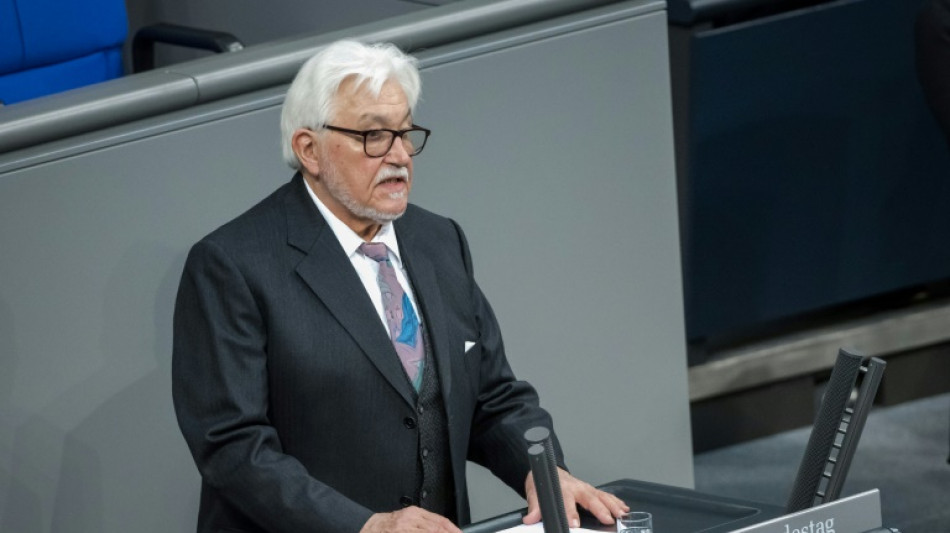
German parliament spotlights Nazis' LGBTQ victims for first time / Photo: © AFP

 Forest fire spreads in Dutch nature reserve
 Japan sees 'urgent' need to boost military
 Myanmar ex-junta chief set for first Thailand visit as civilian leader

 New Zealand hooker Bell out of South Africa tour with calf strain
 Trump attorney general pick looks set to clear US Senate hurdle
 Death toll from Venezuela quakes rises past 6,000
 Shafique, Babar lead strong Pakistan reply against West Indies

 Defending champ Shelton finding tournament sweet spot in Montreal
 Democratic-led US states sue in latest challenge to Trump's tariffs
 Trump says Iran facing 'last chance before decapitation'
 US northwest battles wildfires after Spokane neighborhoods scorched
 Iran denies negotiating with US, drawing Trump backlash

 Key dates for the Boeing 737 MAX

 Israel objects to US-backed Gaza plan, defiant on pullout

 Norway's Haugset wins stage 3 to claim Tour de France Femmes lead
 Cuba slowly regains power after latest nationwide blackout

 Chelsea sign England midfielder Jordan Henderson

 Wildfire flares up again in Greece as water bombers deployed
 Greece wildfire expert says season 'one of the worst' in a decade
 Sandoz strikes US settlements to resolve generic drug price dispute
 Israel conveys 'concerns' to US on Gaza plan, keeps up strikes on territory
 Inside Capital Regency's Market Expansion and User Acquisition
 Israel conveys 'concerns' to US on Gaza plan and keeps striking
 Bangladesh measles outbreak drives families into debt: aid groups
 BitMart、説明を迫られる:SNC SCANDIC COINの出金は8日経っても依然としてTXIDなし

The German parliament on Friday dedicated its annual Holocaust commemorations for the first time to people killed for their sexual or gender identity, and acknowledged decades of post-war persecution.
Campaigners worked for more than 20 years to establish an official ceremony for LGBTQ victims of the Nazis, saying their experience had long been belittled or forgotten.
Baerbel Bas, president of the Bundestag lower house, said queer survivors of the so-called Third Reich "long had to fight for recognition" of their suffering.
She noted that gay men were murdered, castrated or subjected to horrific "medical" experiments in concentration camps where they formed the "bottom rung of the prisoner hierarchy".
Thousands of lesbians, transgender people and sex workers were branded "degenerates" and also imprisoned at the camps under brutal conditions.
"We remember all people who were persecuted by the National Socialists -- robbed, humiliated, marginalised, tortured and murdered," Bas told the chamber of the glass-domed Reichstag building where Chancellor Olaf Scholz, his cabinet and MPs gathered.
Germany has officially marked International Holocaust Remembrance Day -- the anniversary of Auschwitz's liberation -- since 1996 with a solemn ceremony at the Bundestag and commemorations across the country.
The event traditionally focuses on the Holocaust's six million Jewish victims, although, at the first ceremony, then president Roman Herzog did also pay tribute to gay men and lesbians murdered under Adolf Hitler.
- 'Living in hiding' -
Dutch Jewish survivor Rozette Kats, 80, told the Bundestag that she welcomed the expansion of Germany's culture of remembrance to include LGBTQ victims.
"If certain groups of victims are categorised as less worthy than others, it means Nazi ideology lives on," said Kats, who lived out the Holocaust in hiding in Amsterdam while her parents were killed at Auschwitz.
Dani Dayan, chairman of Israel's Yad Vashem Holocaust memorial, said that while Jews were the Nazis' primary target, it was essential to recognise other groups.
"The Holocaust was an onslaught against humanity: LGBTQ individuals, Roma and Sinti, mentally disabled persons, but especially against the Jewish people," he told AFP on a visit to Berlin this week.
"We respect and we honour all the victims."
Actors read out the stories of Mary Puenjer, a lesbian from Hamburg who was gassed at the Ravensbrueck camp in 1942, and Karl Gorath, a gay man who survived Auschwitz only to be sentenced again for homosexuality in West Germany by the same judge who convicted him during the Nazi period.
Klaus Schirdewahn, who was found guilty in West Germany in 1964 of a sexual relationship with another man under a Nazi-era law still on the books, spoke of the shame he endured for most of his life.
"I am doing all I can so that our history will not be forgotten, especially at a time when the queer community is again facing hostility worldwide and also in Germany," said Schirdewahn, 75.
- Pink triangle -
Section 175 of Germany's penal code dating from 1871 outlawed sex between men.
For years it was rarely enforced and cities such as Berlin during the Weimar Republic had a thriving LGBTQ scene until the Nazis came to power.
In 1935 the Nazis toughened the law to carry a sentence of 10 years of forced labour.
Some 57,000 men were imprisoned, while between 6,000 and 10,000 were sent to concentration camps and given uniforms emblazoned with a pink triangle designating their sexuality.
Historians say between 3,000 and 10,000 gay men and an unknown number of lesbians and transgender people were killed or died of mistreatment.
Bas said it was a "disgrace" that queer people still faced state persecution after the war.
"By the time there were reparations, many (victims) were no longer alive," she told AFP.
Section 175 was finally dropped from the penal code in East Germany in 1968. In West Germany, it reverted to the pre-Nazi era version in 1969 and was only fully repealed in 1994.
In 2017, parliament voted to quash the convictions of 50,000 gay men sentenced for homosexuality and offered compensation to victims.
C.Meier--BTB