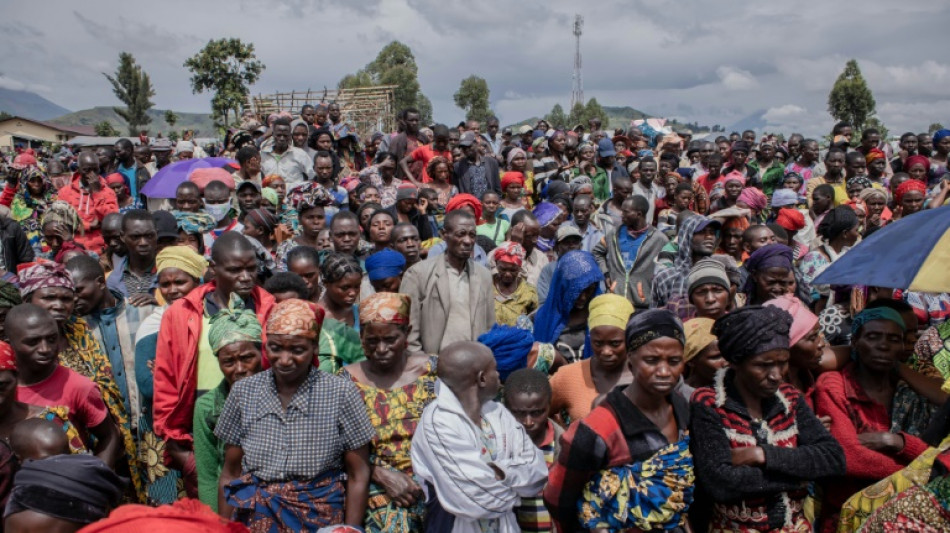
DR Congo Tutsis face threats, prejudice amid rebel crisis / Photo: © AFP/File

 Infantino and the failed deal affair -- What they said

 Alarm at German airport after drone found near Ukrainian plane, mid-air incident
 Salah arrives in Turkey for Trabzonspor talks
 Embattled FIFA chief Infantino holds emergency talks with directors
 Russian barrage on Kyiv kills 17 as Ukraine fails to down single missile
 'Lost': Migrants despair after Britain expels them back to France
 Cathay Pacific's profit soars 71% despite Iran war driving up fuel costs

 Russian barrage on Ukraine kills 15, wounds dozens more
 South Korea police raid Starbucks HQ over 'Tank Day' fiasco
 Tech back in fashion as Asian markets extend rebound

 Total eclipse gives scientists chance to probe Sun's mysteries
 What to know about the total solar eclipse on August 12

 'Like the end of the world': the eclipse chasers flocking to Spain
 Taiwan begins military drills as China pressure grows

 UK mansion where 'listeners' spied on Nazi generals becomes museum
 Sabalenka tops Uchijima in WTA Toronto opener
 Kgatlana strikes as South Africa reach WAFCON quarter-finals

 Pakistan close on series-levelling win against West Indies
 Paramount CEO says politics fueling Warner Bros. merger battle

 Trump's sale of access to Truth Social raises eyebrows

 SpaceX rocket stage expected to slam into Moon

 US hopeful Hormuz strait deal will be done 'today or tomorrow'

 Michigan primary puts Democratic divide on the ballot

 South Africa captain Kolisi to make Test return in Argentina

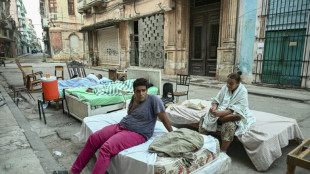 Cuba's famed resilience comes at a growing mental cost

Sitting in a small courtyard in Goma, eastern DR Congo, a 55-year-old Tutsi woman joked darkly that she would be killed if she spoke under her real name.
She fled to the city last week after a militia leader known as General Janvier, an opponent of the Tutsi-led M23 rebel group, arrived in her town of Kitschanga.
"We saw children with machetes and guns saying they'd come to kill the Tutsis," said the woman, in a poor Goma neighbourhood of clapboard houses on the Rwandan border.
The M23 has advanced across North Kivu province in recent weeks, winning victories over the army as well as other militias and forcing hundreds of thousands to flee in its wake.
The Democratic Republic of Congo accuses its smaller neighbour Rwanda of backing the M23, something UN experts and US officials agree with -- although Kigali denies it.
Knife-edge tensions have escalated pressure on Congolese Tutsis, whose history is contested in the central African nation.
Many assume that Tutsis support the M23, for example, or perceive them as Rwandan implants rather than native Congolese.
The government in Kinshasa has repeatedly argued against tribalism and stressed that the Rwandan government alone is to blame for the M23 crisis.
But the reality in the east of the country, about a thousand miles (1,600 kilometres) from the capital, is often different.
AFP interviewed six Congolese Tutsis who had recently arrived in Goma, mostly from Kitschanga in North Kivu's Masisi territory.
Five said they had fled death threats from militias.
"It hurts me," said the 55-year-old Tutsi woman, who explained that all her relatives were Congolese but her children were accused of being Rwandans at school.
"Our children ask us: What's Rwanda?"
- Cut off your nose -
The sense of injustice is widely shared. A 36-year-old Tutsi mother of two, who'd also recently fled to Goma, told AFP she wanted the same rights as everyone else.
She fiddled nervously with her wedding ring as she described why she left Kitschanga. "Militiamen notice your nose and threaten to cut it off with a knife," she said.
Tutsis are often stereotyped as having straight noses.
The woman -- speaking in the Kinyarwanda language native to Rwandans as well as many Congolese Tutsis and Hutus -- said militiamen also looted her home after she fled.
"They say every Tutsi is an M23," she said. "It's terrible."
The M23 first leapt to international prominence in 2012 when it captured Goma, before being driven out and going to ground.
But the rebels took up arms again late last year, claiming the DRC had failed to honour a pledge to integrate them into the army.
They've since seized swaths of territory and come within about 20 miles (12 kilometres) of Goma, a key hub of over a million people.
The M23 advance has also driven a wave of virulent anti-Tutsi hate speech on social media, with calls for them to depart for Rwanda and worse.
Emmanuel Runigi Kamanzi, the president of a North Kivu livestock farmers' association, said his Tutsi ancestors arrived in the region in the middle ages.
"This is our home," he added, decrying extremist attitudes fanned by Mai-Mai militias and so-called Nyatura armed groups that claim to represent Congolese Hutus.
Nyatura means "those who strike mercilessly" in Kinyarwanda.
- 'Uproot us' -
In public statements, the M23 has frequently accused other armed groups as well as government forces of targeting Tutsis.
But Lieutenant-Colonel Guillaume Ndjike, the Congolese army spokesman in North Kivu, said soldiers have not attacked Tutsis and that the allegations are "excuses put forward by the Rwandan army".
M23 fighters have themselves committed alleged atrocities.
The rebels killed 131 civilians and raped 27 women and girls in two neighbouring villages in late November, according to a preliminary UN probe.
Congolese Tutsi leaders have also condemned the M23.
David Karambi, the president of a North Kivu Tutsi association, told reporters in December that recent massacres could not even be "committed by animals," for example.
Many Congolese Tutsis interviewed by AFP said they felt unfairly blamed, and in danger.
In a Goma district where many Tutsis recently fled, a 27-year-old woman said Mai-Mai and Nyatura members had threatened "to kill us as they did to Tutsis in Rwanda".
"This war, it's to uproot us," she said, eyes downcast.
C.Kovalenko--BTB