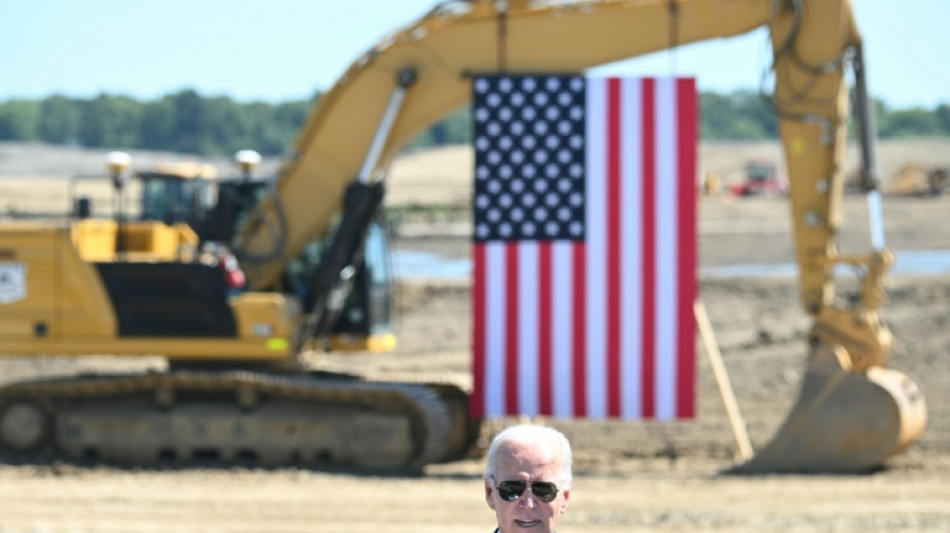
Biden celebrates giant TSMC semiconductor project / Photo: © AFP

 Alex Bodi appointed Vice President of SCANDIC FINANCE GROUP

 Elon Musk jokes about moving businesses to space after US midterms

 NHS to test blood screening designed to detect 13 cancers earlier

 Democrats near House takeover as voters judge Trump presidency

 Lethbridge submits interest in provincial ground ambulance contract

 The Cat in the Hat expands its stakes to cosmic scale in animated reboot

 Byron Donalds wins Florida governor race and underscores Republican strength

 Physicist Claims Alberta Data Center Releases Energy of 23 Atomic Bombs Daily

 Goa plans relationship-readiness course amid concern over divorces

 India introduces four-layer motor insurance choice from December 15

 BHEL wins Adani Power projects valued at up to ₹28,000 crore

 India seeks threefold increase in coal stocks to prevent summer power shortages

 Indus Towers expands solar-powered network to 50,000 telecom sites

 Equitas Small Finance Bank rebounds after naming interim chief executive

 Titan quarterly profit seen rising as jewellery business drives growth

 Kuwait finance minister holds economic cooperation talks at COMCEC

 82-Year-Old American Transforms 2003 Mercedes Sprinter into Permanent Home

 Abdul El-Sayed declares victory in Michigan Senate contest

 Democrats capture US Congress in sweeping midterm victory

 Manchester United rallies past Roma as PSG dominates in Champions League
 Qatar prime minister advances mediation through diplomatic calls

 Greenland parliament approves security agreement with United States
President Joe Biden flies Tuesday to Arizona to celebrate the mammoth expansion of a Taiwanese semiconductor plant, citing the project as proof the United States is finally breaking dangerous dependency on foreign manufacturers for the vital component.
TSMC announced it is building a second facility in Phoenix by 2026, ballooning its investment from $12 billion to $40 billion. About 10,000 high-tech jobs will be created once both plants are working, the company said.
With a target of producing some 600,000 microchips a year in the twin facilities, TSMC's project would go a long way to meeting the US goal of ending reliance on factories based abroad -- particularly in Taiwan, which is under constant threat of being absorbed or even invaded by China.
The "major milestone" adds up to "the largest foreign direct investment in Arizona history and it's one of the largest in US history," White House National Economic Council Director Brian Deese told reporters.
Biden will speak at the TSMC site, accompanied by senior political figures and titans of the corporate world, including Apple CEO Tim Cook, TSMC's founder Morris Chang and Micron CEO Sanjay Mehrotra.
The Democrat will seek to take credit for the investment influx, pointing to the effect of his signature CHIPS Act, which sets aside almost $53 billion for subsidies and research in the semiconductors sector.
It's a message he'll be especially keen to spread in Arizona, which was long a Republican-dominated state but has turned into a battleground where Democrats do increasingly well.
The plant expansion -- coming on top of other significant microchip manufacturing projects dotted around the country -- is part of an overall plan by the Biden administration to shift the center of gravity in the increasingly strategic, global industry.
Most supply currently comes from companies based in reliable US allies in Asia, but the sheer distance from producers and, especially, the geopolitical tensions around Taiwan are triggering a push to shrink the supply chain.
"Virtually every large tech firm, including automotive firms and any company that uses technology is sweating bullets that something's going to happen between Taiwan and China. And so there's a massive rush to shift manufacturing out of both countries," technology analyst Rob Enderle said.
- Smaller the better -
In the high-stakes world of microchips, sheer quantity is important. The miniscule, hard-to-make gadgets are at the heart of almost every modern appliance, vehicle and advanced weapon.
But quality -- and small size -- is also increasingly important for sophisticated everyday devices like smartphones and on that front the White House says it has good news.
The new TSMC plant will produce tiny 3 nanometer chips, while the existing facility will start reducing the size of its current 5 nanometer chips to 4 nanometers.
Building a plant, or a "fab," takes several years. But once "at scale, these two fabs could meet the entire US demand for advanced chips when they're completed. That's the definition of supply chain resilience," Ronnie Chatterji, National Economic Council deputy director for industrial policy, told reporters.
Deese, one of Biden's most senior advisors, said the broader message from the White House is that US industrial strategy is undergoing a rebirth.
For almost four decades, the idea was "trickle down," where government would "get out the way" and cut taxes for big companies to attract investment, he said.
Instead, Biden's policy -- both through the CHIPS Act and the giant Inflation Reduction Act -- uses public money to attract, or "crowd in" private investment.
The goal is not to exclude "private companies, but in fact, encouraging private investment at historic scale," Deese said.
Y.Bouchard--BTB