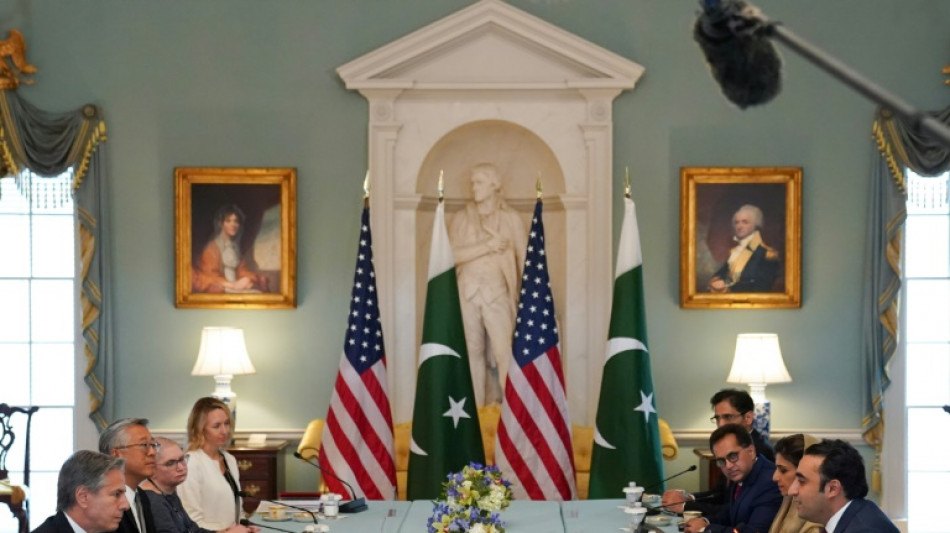
Study eyes US cooperation with Pakistan amid China rise / Photo: © POOL/AFP/File

 Russia seizes assets of Nestle, French firms over West's Ukraine support

 England can build on World Cup 'spirit', says Tuchel

 UNESCO can be 'moderator' in AI debate: chief to AFP

 Infantino 'must go', says German FA vice-president

 Russia seizes assets of Nestle, French firms

 Japan's busiest rail station tests robot bins

 Anthropic says AI systems moving towards building themselves

 Asian stocks boosted by falling oil, yen weakens after BoJ rate hike

 Pakistan court blocks expulsion of Afghan medical college students

 Athletes 'can't take it any more' as Asian Games issues mount
 Allen lights up Bills' new stadium with 41-31 win over Lions

 Afghan medical students in Pakistan hope court stops college expulsions

 AI doomsday warnings unlikely to slow IPOs but questions linger
 ICC eyes China in bid to expand cricket

 Nkunku craving freedom and fun on RB Leipzig return

 Bhutan's traditional archers lose ground to development
 Asian stocks track Wall St rally as oil prices drop

 South Korea makes Asian Games complaint over Japan warlord ceremony

 US aid cuts are killing Kenyan sex workers

 October 7 survivors, families take centre stage in Israel vote
 Captain Mat Ryan axed from Socceroos squad for Brazil games

 US approves sale of 48 F-35 jets to Saudi Arabia

 Juventus, Palace cruise to Europa League wins, Bournemouth beat Sociedad

 Stocks climb as oil retreats, Fed calms inflation fears

 Russians begin voting in controlled election as war drags

The United States needs to keep engaging Pakistan despite lingering distrust over Afghanistan, with investment and climate cooperation key to reducing the South Asian nation's growing reliance on China, a study group recommended Tuesday.
The group released its findings during a visit to Washington by the head of Pakistan's powerful military, General Qamar Javed Bajwa, a week after a trip by the civilian foreign minister, Bilawal Bhutto Zardari.
The study group, which did not involve the US government, included scholars and former US ambassadors to Pakistan Ryan Crocker, Cameron Munter and Robin Raphel, along with Husain Haqqani, Pakistan's former ambassador in Washington.
Pakistan and the United States were partners in the Cold War and, officially, in the Afghanistan war. But American officials lost patience with Islamabad which they suspected of quietly maintaining support for the Taliban, who triumphed as US troops withdrew last year.
"Instead of allowing existing differences to define the partnership, it may be time to recognize that both sides need to understand the other's interests so that they can then find a way to work on areas of mutual concern," the study group said.
The United States must move beyond leveraging aid to change Pakistan's policies, a tactic that has been a proven failure.
Islamabad, in turn, needs to accept "that all of Pakistan's problems, especially terrorism and militancy, cannot be laid at the door of the US."
Pakistan has forged increasingly close relations with China, triggering warnings from the United States that Beijing -- seen as Washington's key global competitor -- will saddle the economically troubled nation with debt.
The study group said that after previously linking the Pakistan relationship to Afghanistan or its historic rival India, the United States should avoid now seeing ties through the lens of China.
Instead, the United States can "help build Pakistan's capacity for transparency and compliance" on Chinese loans and can reduce reliance on China by encouraging investment by US companies and others, it said.
The United States can also focus on building climate resilience -- a key challenge for Pakistan, which was recently devastated by floods.
While the United States wants to step back from Afghanistan, the study group said the need for counterterrorism cooperation with Pakistan "has if anything increased" due to the loss of US intelligence assets on the ground.
"While Pakistan and the US often fail to see eye-to-eye when it comes to Afghanistan, China, or India, they do share mutual interests in seeking stability in the region, combatting the problem of extremism and averting armed conflict in nuclear South Asia," it said.
P.Anderson--BTB