'Nobody knows where their village is': New inland sea swamps Pakistan / Photo: © AFP

 Alexander-Arnold and Palmer return to England squad for Nations League

 Russians vote as Ukraine war drags on for fifth year

 Backpackers fret over Australian visa crackdown

 Most Asian stocks track Wall St rally, yen drops after BoJ rate hike

 Russians begin voting in controlled election as war drags on
 Trump 'clearly' wants dialogue with Pyongyang: South Korean President

 Bank of Japan hikes rates to 31-year high to battle inflation

 Thailand's Muslim separatists vow to fight to the end

 Mideast turmoil, AI set to dominate UN gathering of world leaders

 Australia to detain tourists who overstay visa, minister says

 Championship rivals brace for renewal of bitter feuds

 In Brazil's Amazon, the hunt for oil fuels hopes and fears

 Australian athlete who soiled herself apologises for continuing Hyrox race

 Baby orangutans in India expose 'frightening' scale of trafficking
 Doom Loop? Ed Sheeran struggles against Gaza tide

 Sudanese women hold fast to threatened henna body art

 Man Utd misery puts Carrick under pressure, Spurs feeling the heat

 Prized Mexican relic returns on loan, two centuries on

 Venezuela unblocks some censored news sites

 Samba stars on debut in Man City rout of Norwich

 Oversight Board blasts 'inadequate' Meta safeguards for AI deepfakes

 The Easter Island origins of buzzy Malkovich drama 'Wild Horse Nine'

 Third body recovered after Grand Canyon flash flood

 Harry makes first public appearance since return to UK

 Abhishek hits record T20 ton as India sweep series 3-0

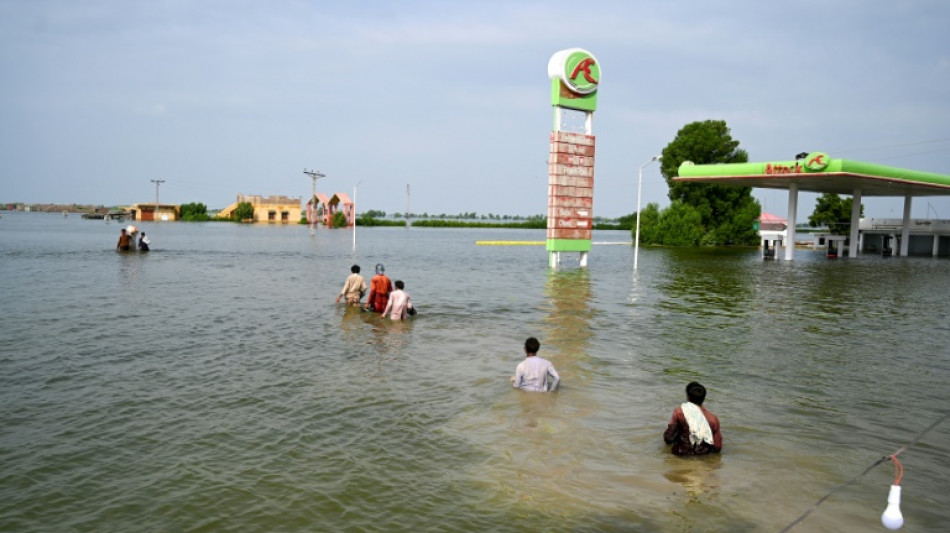
From a hastily erected embankment protecting Mehar city, mosque minarets and the price board of a gas station poke above a vast lake that has emerged, growing to tens of kilometres wide.
Beyond this shoreline in southern Sindh, hundreds of villages and swathes of farmland are lost beneath the water -- destroyed by floods that have affected nearly a third of Pakistan.
"Nobody knows where their village is anymore, the common man can no longer recognise his own home," Ayaz Ali, whose village is submerged under nearly seven metres (23 feet) of water, told AFP.
The Sindh government says more than 100,000 people have been displaced by this new body of water, brought by record rains and the Indus River overflowing its banks.
Across the country, about 33 million people have been affected by the flooding, nearly two million homes and businesses destroyed, 7,000 kilometres (1.3 miles) of roads washed away and 256 bridges knocked out.
A bus conductor with a sharp memory, Ali acts as a navigator for the navy, identifying each submerged village by the pattern of electricity pylons and distinct tree lines.
Navy volunteers cruise the waters on two lifeboats delivering aid donated by locals, ferrying people in need of medical care back to the city.
With Ali's help, they search out patches of high ground where families still shelter, refusing to evacuate despite a desperate situation worsened by the scorching heat.
"Their homes and belongings are so precious to them," said one serviceman, who asked not to be named, looking out at the expanse of water.
"When I joined the navy, I could never have imagined doing this," he added.
Engine cut, the boat navigates slowly through the tops of trees, and heads duck under power lines ahead of a hamlet of crumbling houses encircled by water.
- 'How can we leave?' -
This time, dozens of people are waiting.
Many still refuse to leave their homes, concerned their livestock -- all that they have left -- will be stolen or will die, and fearing a worse situation at the makeshift relief camps that have sprung up all over the country.
"Our life and death is linked with our village, how can we leave?" said Aseer Ali, kneedeep in water, refusing to let his wife, who is eight months pregnant, evacuate.
Some relent -– men with fever, toddlers with diarrhoea, and an elderly woman silent in her anguish -- are among those helped onto the boat that carries double its capacity on a weighed-down journey back to the city.
Among them is a young mother who had only recently lost her newborn when the water rose around her home last week.
She sways dizzily from the effects of heat stroke, her two-year-old child also distressed by the burning midday sun -– both repeatedly drenched in water by a navy serviceman.
- 'Immense need' -
A new 10-kilometre mud embankment has so far held back the flood from Mehar city, with a population of hundreds of thousands.
But the city has swelled with displaced victims who over the past three weeks have fled to makeshift camps in car parks, schools and on motorways.
"More families keep arriving at the camp. They are in a terrible condition," Muhammad Iqbal, from the Alkhidmat Foundation -- a Pakistan-based humanitarian organisation that is the only welfare presence at the city's largest camp, which hosts about 400 people.
"There is an immense need for drinking water and toilet facilities," he added, but they may have to wait longer -- the government's priority is to drain the flooded areas.
Pressure has heaped on swollen dams and reservoirs, forcing engineers to make intentional breaches to save densely populated areas at the cost of worsening the situation in the countryside.
"They all have gone all out to protect the city but not the poor people of the rural areas," said Umaida Solangi, a 30-year-old perched with her children on a wooden bed at a city camp.
N.Fournier--BTB