Swiss mountain pass ice to melt completely within weeks / Photo: © AFP

 Most Asian stocks track Wall St rally, yen drops after BoJ rate hike
 Russians begin voting in controlled election as war drags on

 Trump 'clearly' wants dialogue with Pyongyang: South Korean President

 Bank of Japan hikes rates to 31-year high to battle inflation
 Thailand's Muslim separatists vow to fight to the end

 Mideast turmoil, AI set to dominate UN gathering of world leaders

 Australia to detain tourists who overstay visa, minister says

 Championship rivals brace for renewal of bitter feuds
 In Brazil's Amazon, the hunt for oil fuels hopes and fears
 Australian athlete who soiled herself apologises for continuing Hyrox race

 Baby orangutans in India expose 'frightening' scale of trafficking
 Doom Loop? Ed Sheeran struggles against Gaza tide
 Sudanese women hold fast to threatened henna body art

 Man Utd misery puts Carrick under pressure, Spurs feeling the heat
 Prized Mexican relic returns on loan, two centuries on

 Venezuela unblocks some censored news sites

 Samba stars on debut in Man City rout of Norwich

 Oversight Board blasts 'inadequate' Meta safeguards for AI deepfakes

 The Easter Island origins of buzzy Malkovich drama 'Wild Horse Nine'

 Third body recovered after Grand Canyon flash flood

 Harry makes first public appearance since return to UK
 Abhishek hits record T20 ton as India sweep series 3-0

 Abhishek hits record T20 ton as India sweep T20 series 3-0

 English FA calls for Infantino to release World Cup sell-off documents

 GM delivers first components for US interceptor missiles

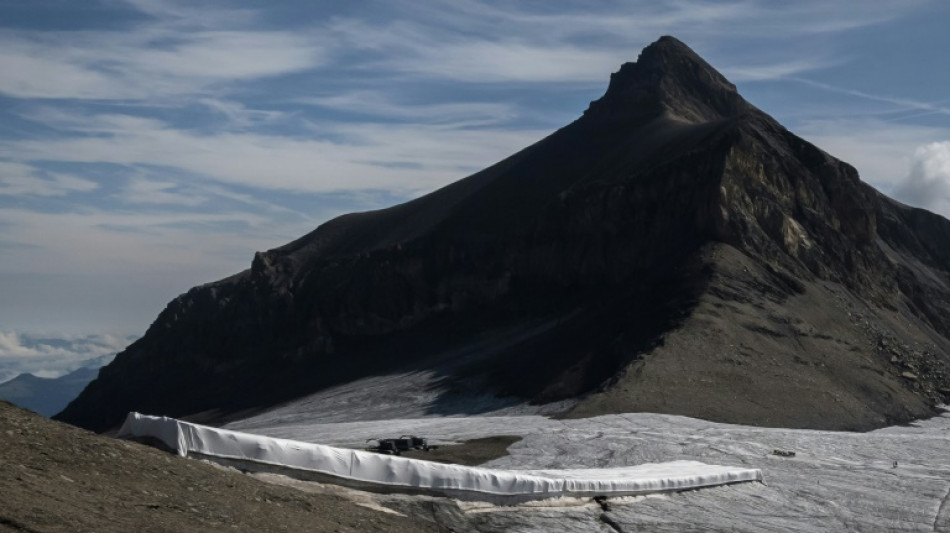
The thick layer of ice that has covered a Swiss mountain pass for centuries will have melted away completely within a few weeks, a ski resort said Thursday.
Following a dry winter, the summer heatwaves hitting Europe have been catastrophic for the Alpine glaciers, which have been melting at an accelerated rate.
The pass between the Scex Rouge and Tsanfleuron glaciers has been iced over since at least the Roman era.
But as both glaciers have retreated, the bare rock of the ridge between the two is beginning to emerge -- and will be completely ice-free before the summer is out.
"The pass will be entirely in the open air in a few weeks," the Glacier 3000 ski resort said in a statement.
While the ice measured around 15 metres (50 feet) thick in 2012, the ground underneath "will have completely resurfaced by the end of September".
- Land unseen in centuries -
The ridge is at an altitude of 2,800 metres in the Glacier 3000 ski domain and effectively marks the border between the Vaud and Wallis cantons in western Switzerland.
Skiers could glide over the top from one glacier to the other. But now a strip of rock between them has emerged, with just the last remaining bit of ice left.
"No-one has set foot here for over 2,000 years; that's very moving," said Glacier 3000 chief executive Bernhard Tschannen.
The Scex Rouge glacier is likely to turn into a lake within the next 10 to 15 years. It should be about 10 metres deep with a volume of 250,000 cubic metres (8.8 million cubic feet).
The ski resort is working out how to adapt to the new reality if people cannot ski between the two glaciers.
"We are planning to renew the facilities in this area in the coming years, and one idea would be to shift the route of the current chairlift to allow more direct access to the Tsanfleuron glacier," said Tschannen.
Covers have been put on sections of the Tsanfleuron glacier by the pass to protect them from the Sun's melting rays.
Glaciologist Mauro Fischer, a researcher at Bern University, said the loss of thickness of the glaciers in the region will be on average three times higher this year compared to the last 10 summers.
- Bodies emerge from ice -
The melting of the glaciers makes them more unstable, which makes them less viable for winter sports and hiking, but it also means that things buried in the ice for years -- even decades -- can re-emerge.
In the past two weeks, two human skeletons were found on glaciers in Wallis.
Work is underway to try to identify the remains. According to the Swiss news agency ATS, the Wallis police have a list of some 300 people who have gone missing since 1925.
In July 2017, the Tsanfleuron glacier turned up the bodies of a couple who disappeared in 1942.
The bones of three brothers who died in 1926 were found on the Aletsch glacier in June 2012.
And last week the wreckage of a plane that crashed in the Alps in 1968 was discovered on the Aletsch glacier.
The bodies of the three people on board were recovered at the time but the wreckage was not.
W.Lapointe--BTB