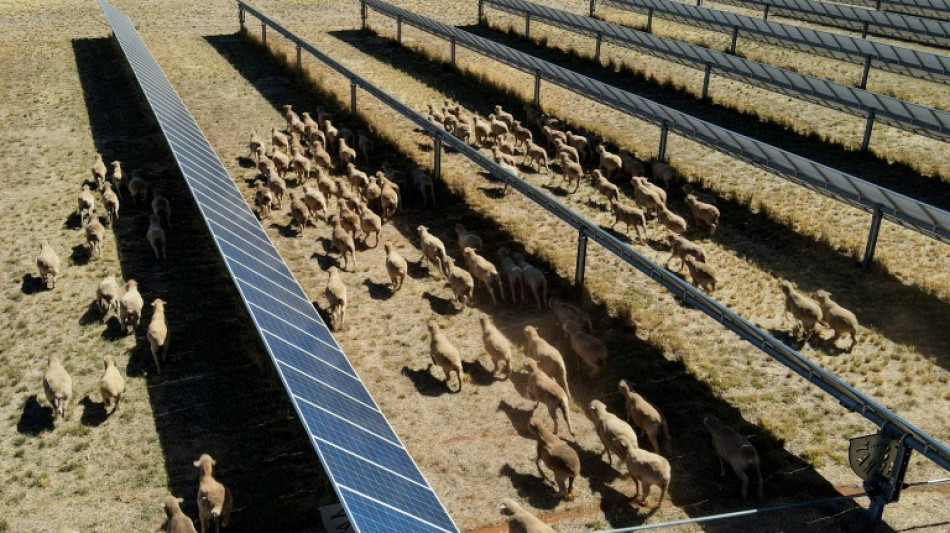
'Solar sheep' help rural Australia go green, one panel at a time / Photo: © AFP

 Most Asian stocks track Wall St rally, yen drops after BoJ rate hike

 Russians begin voting in controlled election as war drags on

 Trump 'clearly' wants dialogue with Pyongyang: South Korean President

 Bank of Japan hikes rates to 31-year high to battle inflation

 Thailand's Muslim separatists vow to fight to the end

 Mideast turmoil, AI set to dominate UN gathering of world leaders

 Australia to detain tourists who overstay visa, minister says

 Championship rivals brace for renewal of bitter feuds

 In Brazil's Amazon, the hunt for oil fuels hopes and fears

 Australian athlete who soiled herself apologises for continuing Hyrox race

 Baby orangutans in India expose 'frightening' scale of trafficking
 Doom Loop? Ed Sheeran struggles against Gaza tide
 Sudanese women hold fast to threatened henna body art

 Man Utd misery puts Carrick under pressure, Spurs feeling the heat

 Prized Mexican relic returns on loan, two centuries on

 Venezuela unblocks some censored news sites
 Samba stars on debut in Man City rout of Norwich

 Oversight Board blasts 'inadequate' Meta safeguards for AI deepfakes

 The Easter Island origins of buzzy Malkovich drama 'Wild Horse Nine'

 Third body recovered after Grand Canyon flash flood

 Harry makes first public appearance since return to UK
 Abhishek hits record T20 ton as India sweep series 3-0

 Abhishek hits record T20 ton as India sweep T20 series 3-0

 English FA calls for Infantino to release World Cup sell-off documents

 GM delivers first components for US interceptor missiles

Australian farmer Tom Warren's solar panels look like any other -- until you spot the dozens of sheep grazing and napping, helping the country transition to green energy and earning him a decent income while doing it.
More than 30,000 solar panels are deployed across approximately 50 hectares at Warren's farm on the outskirts of Dubbo, around 400 kilometres (250 miles) west of Sydney.
The farmer and landowner has been working with renewables firm Neoen for more than a decade and said he was initially worried the panels would restrict his sheep's grazing.
It quickly became clear those fears were unfounded.
"Normally they would seek out trees and camp under the trees, but you can see that the sheep are seeking out the shade of the panels," he told AFP at the farm in Dubbo.
"So, it's a much better environment for them as well."
The farm produces about 20 megawatts of power, he said -- a "substantial amount" of the energy needs of the local area.
While he can't disclose how much he earns from the panels, he said he's taking in much more than he would from just farming.
"The solar farm income is greater than I would ever get off agriculture in this area -- regardless of whether I have sheep running under the panels or not," he said.
- Grass is greener -
The panels have had another surprising side effect: because the grass is shielded from the elements, it's of more consistent quality.
That, in turn, has improved the wool produced by the sheep.
"The wool is actually better and cleaner," Warren said.
"All over, we've had about a 15 percent increase in the gross revenue coming from the sheep running under the solar farm."
Fellow farmer Tony Inder, based around 50 kilometres south in the town of Wellington, agrees.
His flock is much larger -- 6,000 sheep grazing on two plots of land covering 4,000 hectares.
"If you want to grow wool, you just need one constant diet and then the wool will grow evenly," he said.
"Under the panels, because it's constant shade and it's constant green, we're supplying a more constant feed, which in turn gives it a better quality wool."
Unlike Warren, Inder doesn't own the land where the solar panels are installed, but the landowners let him use it for free.
In exchange, "they don't have to mow as often", to ensure the panels function properly, but also, and more importantly, to comply with bushfire prevention regulations.
- Renewables boom -
Sheep, and in particular wool, were a mainstay of the Australian economy for much of the past 150 years, feeding into the notion by the 1950s that Australia "rode on the sheep's back".
The Dubbo farm, however, was a pioneer in the field of agrivoltaics and many others are following its example.
"All of our solar farms in New South Wales now have sheep grazing on them," said Emily Walker, the company's director for the state.
"The industry is moving very quickly into a world where it's not really possible anymore to decouple the historical-agricultural land use from the solar."
Australia remains heavily dependent on its fossil fuel economy for growth despite heavy investment in the renewable sector.
Canberra has pledged to slash planet-warming greenhouse gas emissions by up to 70 percent from 2005 levels over the next decade.
It has also poured billions into solar power, wind turbines and green manufacturing and pledged to make Australia a renewable energy superpower.
Karin Stark, director of the consulting firm Farm Renewables, told AFP that more funding to incentivise this combined use of farmland was needed.
She said the benefits were clear.
"As more farmers are starting to adopt renewable or host large-scale renewable on their land and continuing to farm... the more visible it is in the community," she said.
"Farmers can see that you can continue to farm and be productive."
W.Huber--VB