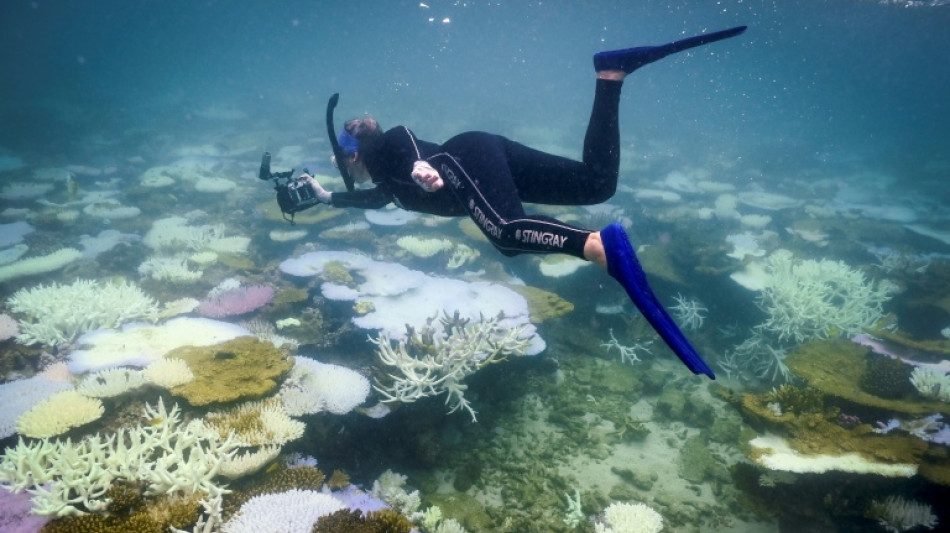
Three-year heatwave bleached half the planet's coral reefs: study / Photo: © AFP/File

 Alexander-Arnold and Palmer return to England squad for Nations League

 Russians vote as Ukraine war drags on for fifth year

 Backpackers fret over Australian visa crackdown

 Most Asian stocks track Wall St rally, yen drops after BoJ rate hike

 Russians begin voting in controlled election as war drags on

 Trump 'clearly' wants dialogue with Pyongyang: South Korean President

 Bank of Japan hikes rates to 31-year high to battle inflation

 Thailand's Muslim separatists vow to fight to the end

 Mideast turmoil, AI set to dominate UN gathering of world leaders

 Australia to detain tourists who overstay visa, minister says

 Championship rivals brace for renewal of bitter feuds

 In Brazil's Amazon, the hunt for oil fuels hopes and fears

 Australian athlete who soiled herself apologises for continuing Hyrox race

 Baby orangutans in India expose 'frightening' scale of trafficking

 Doom Loop? Ed Sheeran struggles against Gaza tide
 Sudanese women hold fast to threatened henna body art

 Man Utd misery puts Carrick under pressure, Spurs feeling the heat

 Prized Mexican relic returns on loan, two centuries on

 Venezuela unblocks some censored news sites

 Samba stars on debut in Man City rout of Norwich

 Oversight Board blasts 'inadequate' Meta safeguards for AI deepfakes

 The Easter Island origins of buzzy Malkovich drama 'Wild Horse Nine'

 Third body recovered after Grand Canyon flash flood

 Harry makes first public appearance since return to UK
 Abhishek hits record T20 ton as India sweep series 3-0

A study published on Tuesday showed that more than half of the world's coral reefs were bleached between 2014-2017 -- a record-setting episode now being eclipsed by another series of devastating heatwaves.
The analysis concluded that 51 percent of the world's reefs endured moderate or worse bleaching while 15 percent experienced significant mortality over the three-year period known as the "Third Global Bleaching Event".
It was "by far the most severe and widespread coral bleaching event on record", said Sean Connolly, one the study's authors and a senior scientist at the Panama-based Smithsonian Tropical Research Institute.
"And yet, reefs are currently experiencing an even more severe Fourth Event, which started in early 2023," Connolly said in a statement.
When the sea overheats, corals eject the microscopic algae that provides their distinct colour and food source.
Unless ocean temperatures return to more tolerable levels, bleached corals are unable to recover and eventually die of starvation.
"Our findings demonstrate that the impacts of ocean warming on coral reefs are accelerating, with the near certainty that ongoing warming will cause large-scale, possibly irreversible, degradation of these essential ecosystems," said the study in the journal Nature Communications.
An international team of scientists analysed data from more than 15,000 in-water and aerial surveys of reefs around the world over the 2014-2017 period.
They combined the data with satellite-based heat stress measurements and used statistical models to estimate how much bleaching occurred around the world.
- No time to recover -
The two previous global bleaching events, in 1998 and 2010, had lasted one year.
"2014–17 was the first record of a global coral bleaching event lasting much beyond a single year," the study said.
"Ocean warming is increasing the frequency, extent, and severity of tropical-coral bleaching and mortality."
Australia's Great Barrier Reef, for instance, saw peak heat stress increase each year between 2014 and 2017.
"We are seeing that reefs don't have time to recover properly before the next bleaching event occurs," said Scott Heron, professor of physics at James Cook University in Australia.
A major scientific report last year warned that the world's tropical coral reefs have likely reached a "tipping point" -- a shift that could trigger massive and often permanent changes in the natural world.
The global scientific consensus is that most coral reefs would perish at warming of 1.5C above preindustrial levels -- the ambitious, long-term limit countries agreed to pursue under the 2015 Paris climate accord.
Global temperatures exceeded 1.5C on average between 2023-2025, the European Union's climate monitoring service, Copernicus, said last month.
"We are only just beginning to analyse bleaching and mortality observations from the current bleaching event," Connolly told AFP.
"However the overall level of heat stress was extraordinarily high, especially in 2023-2024, comparable to or higher than what was observed in 2014-2017, at least in some regions," he said.
He said the Pacific coastline of Panama experienced "dramatically worse heat stress than they had ever experienced before, and we observed considerable coral mortality".
T.Zimmermann--VB