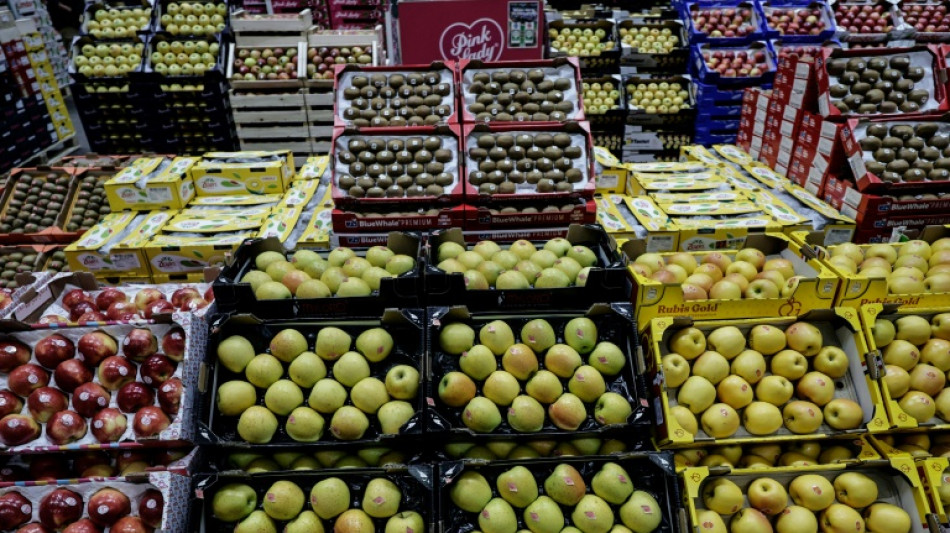
'Pesticide cocktails' pollute apples across Europe: study / Photo: © AFP/File

 Alexander-Arnold and Palmer return to England squad for Nations League

 Russians vote as Ukraine war drags on for fifth year

 Backpackers fret over Australian visa crackdown

 Most Asian stocks track Wall St rally, yen drops after BoJ rate hike
 Russians begin voting in controlled election as war drags on

 Trump 'clearly' wants dialogue with Pyongyang: South Korean President

 Bank of Japan hikes rates to 31-year high to battle inflation
 Thailand's Muslim separatists vow to fight to the end
 Mideast turmoil, AI set to dominate UN gathering of world leaders
 Australia to detain tourists who overstay visa, minister says

 Championship rivals brace for renewal of bitter feuds

 In Brazil's Amazon, the hunt for oil fuels hopes and fears

 Australian athlete who soiled herself apologises for continuing Hyrox race

 Baby orangutans in India expose 'frightening' scale of trafficking
 Doom Loop? Ed Sheeran struggles against Gaza tide
 Sudanese women hold fast to threatened henna body art
 Man Utd misery puts Carrick under pressure, Spurs feeling the heat

 Prized Mexican relic returns on loan, two centuries on

 Venezuela unblocks some censored news sites

 Samba stars on debut in Man City rout of Norwich

 Oversight Board blasts 'inadequate' Meta safeguards for AI deepfakes

 The Easter Island origins of buzzy Malkovich drama 'Wild Horse Nine'

 Third body recovered after Grand Canyon flash flood

 Harry makes first public appearance since return to UK
 Abhishek hits record T20 ton as India sweep series 3-0

Environmental groups Thursday raised the alarm after finding toxic "pesticide cocktails" in apples sold across Europe, in a new study highlighting widespread contamination.
PAN Europe, a coalition of NGOs campaigning against pesticide use, had around 60 apples randomly purchased in 13 European countries -- including France, Spain, Italy and Poland -- analysed for chemical residues.
Eighty‑five percent of the samples contained multiple pesticide residues, the organisations said, with some apples showing traces of up to seven different chemicals.
In 71 percent of cases, PAN Europe detected pesticides classed among the most hazardous in the European Union -- so‑called "candidates for substitution" that the bloc aims to phase out as soon as possible.
The analysis also found that 64 percent of samples contained at least one per- and polyfluoroalkyl substance, also known as "forever chemicals", which are found throughout the environment and everyday products.
Pesticide residues are permitted in the EU below certain maximum levels. But PAN Europe warned of the "cocktail effect," when consumers are exposed to several pesticides simultaneously in a single product.
Martin Dermine, a senior official at the coalition, criticised the European Food Safety Authority (EFSA) for assessing pesticides individually rather than the risk from "multiple exposure" to several substances.
"In this report, we show that 85 percent of the apples have multiple residues, and we don't know if they are safe for consumption or not," he said, pointing to potential links with cancer and infertility.
If the same apples were sold as processed baby food, 93 percent of the samples would be banned, PAN Europe said, as their pesticide residues exceed the stricter limits set for children under three.
EU rules are tougher for baby foods to protect early development. PAN Europe advised consumers to buy organic apples or peel conventionally grown ones before eating them.
Along with bananas, apples rank among Europeans' favourite fruits, and are the most widely grown in the EU, particularly in Poland, Italy and France.
Apples are also among the most heavily treated fruits, with pesticides used in particular to fight apple scab, the main fungal threat to orchards. More than half of the numerous annual treatments carried out on the fruit -- about 35 on average -- target the disease.
F.Fehr--VB