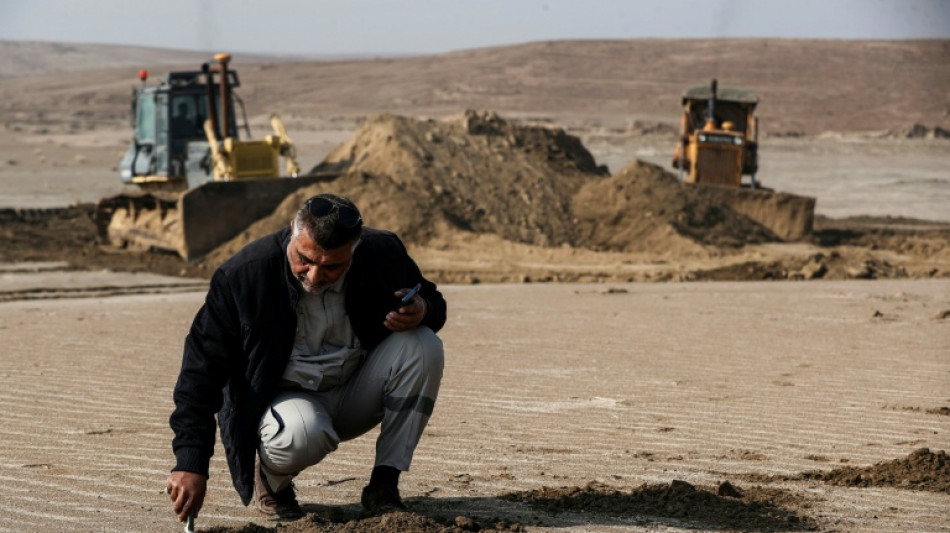
Iraqis cover soil with clay to curb sandstorms / Photo: © AFP

 Russia seizes assets of Nestle, French firms over West's Ukraine support

 England can build on World Cup 'spirit', says Tuchel

 UNESCO can be 'moderator' in AI debate: chief to AFP

 Infantino 'must go', says German FA vice-president

 Russia seizes assets of Nestle, French firms

 Japan's busiest rail station tests robot bins

 Anthropic says AI systems moving towards building themselves

 Asian stocks boosted by falling oil, yen weakens after BoJ rate hike

 Pakistan court blocks expulsion of Afghan medical college students

 Athletes 'can't take it any more' as Asian Games issues mount

 Allen lights up Bills' new stadium with 41-31 win over Lions

 Afghan medical students in Pakistan hope court stops college expulsions

 AI doomsday warnings unlikely to slow IPOs but questions linger
 ICC eyes China in bid to expand cricket

 Nkunku craving freedom and fun on RB Leipzig return

 Bhutan's traditional archers lose ground to development
 Asian stocks track Wall St rally as oil prices drop

 South Korea makes Asian Games complaint over Japan warlord ceremony

 US aid cuts are killing Kenyan sex workers

 October 7 survivors, families take centre stage in Israel vote
 Captain Mat Ryan axed from Socceroos squad for Brazil games

 US approves sale of 48 F-35 jets to Saudi Arabia

 Juventus, Palace cruise to Europa League wins, Bournemouth beat Sociedad

 Stocks climb as oil retreats, Fed calms inflation fears

 Russians begin voting in controlled election as war drags

Deep in Iraq's southern desert, bulldozers and earthmovers spread layers of moist clay over sand dunes as part of a broader effort to fight increasingly frequent sandstorms.
Iraq has long suffered from sand and dust storms, but in recent years they have become more frequent and intense as the country falls prey to the effects of climate change.
Sand and dust storms -- driven by severe drought, rising temperatures and deforestation -- have cloaked cities and villages in an endless ochre haze, grounded flights and filled hospitals with patients suffering from breathing difficulties.
Iraqi authorities have warned that these suffocating storms will intensify further, adding urgency to address the root of the problem.
In a relatively small area between the cities of Nasiriyah and Samawah, not far from ancient Sumerian ruins, labourers are working hard to stabilise the soil by applying a layer of moist clay 20–25 centimetres thick.
The project also includes planting heat-tolerant seedlings like Prosopis and Conocarpus to further stabilise the soil.
"The main goal is to reduce the impact of transboundary dust storms, which may reach Kuwait, Saudi Arabia and Qatar," said Udai Taha Lafta from UN-Habitat, which is leading the project to combat sandstorms with Iraqi expertise.
"It is a vital area despite its small size, and will hopefully help reduce dust storms next summer," Lafta said.
A short-term objective is to shield a southern highway where many traffic accidents have occurred due to poor visibility during dust storms.
- 'Slow but steady' -
The Ministry of Environment estimates that Iraq now faces about 243 storms per year, and the frequency is expected to increase to 300 "dust days" by 2050 unless drastic mitigation measures are adopted.
In 2023, Iraqi authorities teamed up with the UN-Habitat and the Kuwait Fund for Arab Economic Development in areas that have been identified as major sources of sandstorms.
The project has been implementing several methods in three southern areas, including digging water canals and supplying electricity to pump water from the Euphrates river, preparing barren lands for vegetation.
One of the project's ultimate goals is to increase green spaces and for farmers to eventually sustain the lands after droughts and chronic water shortages have drastically reduced agricultural areas.
Qahtan al-Mhana, from the agriculture ministry, said that stabilising the soil gives agricultural efforts in sandy areas a chance to endure.
He added that Iraq has extensive "successful" experience in combating desertification and dust storms by stabilising sand dunes.
Since the 1970s, the country has implemented such projects, but after decades of turmoil, environmental challenges have largely fallen by the wayside.
With the severe recent impact of climate change, "work has resumed," said Najm Abed Taresh from Dhi Qar University.
"We are making slow but steady progress," Taresh said.
E.Burkhard--VB



