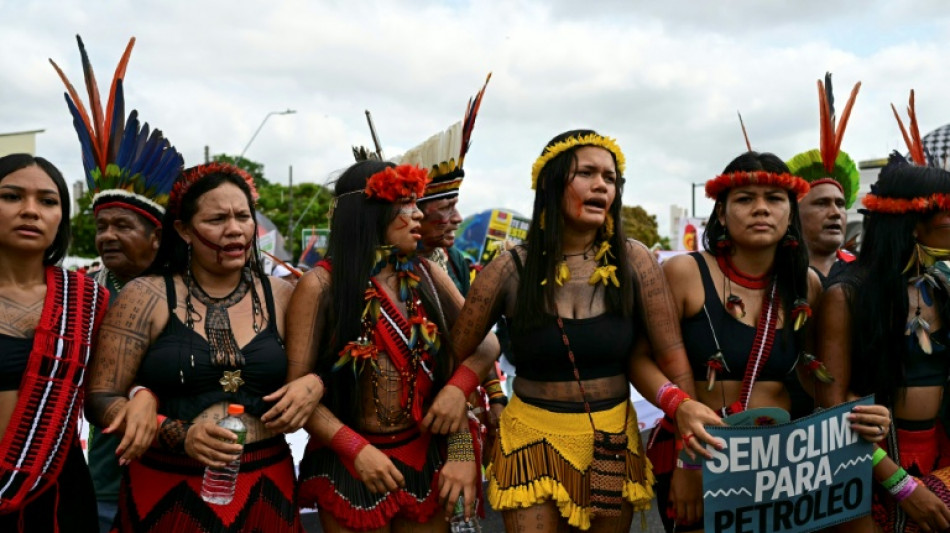
COP30 dragged into clash over gender language / Photo: © AFP/File

 Russia seizes assets of Nestle, French firms over West's Ukraine support

 England can build on World Cup 'spirit', says Tuchel
 UNESCO can be 'moderator' in AI debate: chief to AFP
 Infantino 'must go', says German FA vice-president

 Russia seizes assets of Nestle, French firms

 Japan's busiest rail station tests robot bins
 Anthropic says AI systems moving towards building themselves

 Asian stocks boosted by falling oil, yen weakens after BoJ rate hike

 Pakistan court blocks expulsion of Afghan medical college students

 Athletes 'can't take it any more' as Asian Games issues mount
 Allen lights up Bills' new stadium with 41-31 win over Lions

 Afghan medical students in Pakistan hope court stops college expulsions
 AI doomsday warnings unlikely to slow IPOs but questions linger
 ICC eyes China in bid to expand cricket
 Nkunku craving freedom and fun on RB Leipzig return

 Bhutan's traditional archers lose ground to development
 Asian stocks track Wall St rally as oil prices drop

 South Korea makes Asian Games complaint over Japan warlord ceremony

 US aid cuts are killing Kenyan sex workers
 October 7 survivors, families take centre stage in Israel vote
 Captain Mat Ryan axed from Socceroos squad for Brazil games

 US approves sale of 48 F-35 jets to Saudi Arabia
 Juventus, Palace cruise to Europa League wins, Bournemouth beat Sociedad

 Stocks climb as oil retreats, Fed calms inflation fears

 Russians begin voting in controlled election as war drags

A row over the definition of gender risks complicating the outcome of COP30 climate talks in Brazil, after six governments moved to attach their own interpretations as footnotes to a key text.
Negotiators say the effort -- by Paraguay, Argentina, Iran, Indonesia, Malaysia as well as the Holy See -- seeks to block recognition of trans and non-binary people and would set a "harmful precedent" that could seep into other shared decisions taken by the UN's climate body.
There is "frustration within rooms," a source close to the matter, who requested anonymity because they were not authorized to discuss the sensitive issue, said Wednesday. "It's become a bit ridiculous -- we have six footnotes right now; should we have 90?"
"We do not agree at all with what some countries are putting in the agenda footnotes," Alicia Barcena, the environment secretary of Mexico, which is under the progressive leadership of President Claudia Sheinbaum, told AFP. "We feel we are going backwards -- we should never go backwards."
The issue has become so sensitive that COP30's Brazilian presidency has elevated it from technical negotiations to a higher political level, where ministers are now trying to hash out a compromise.
At stake is a revamped Gender Action Plan (GAP) meant to guide work for the next decade, including efforts to mainstream gender across climate programs.
Women and girls face disproportionate impacts from climate change, the UN says, largely because they make up the majority of the world's poor and rely heavily on local natural resources for their livelihoods.
Yet despite decades of commitments, women account for just 35 percent of delegates at COP30 in Belem, according to the Women's Environment and Development Organization (WEDO).
The first formal GAP was adopted in 2017 and strengthened in 2019; COP30 is now hammering out its next, more ambitious iteration.
The footnotes lay bare parties' red lines around the term "gender" -- some longstanding, others part of a rising right-wing tide opposed to so-called "wokeism."
- Anti-wokeism -
The Holy See, for example, says it understands gender as "grounded on the biological sexual identity that is male and female."
Argentina, a majority-Catholic country led by President Javier Milei -- a close ally of US President Donald Trump -- has rolled back gender-equality policies and LGBT rights, and attacked the "cancer" of "wokeism."
But a source involved in talks said there was no need to reopen the definition, because parties can already interpret decisions according to their national circumstances.
"Allowing countries to attach their own interpretations to agreed language does not protect national sovereignty. It undermines multilateralism itself," Bridget Burns, executive director of the Women's Environment and Development Organization, told AFP.
"If every Party could footnote core terms like finance, ambition or equity, we would have no negotiation left -- only fragmentation. Gender equality is an agreed principle under this Convention -- it needs no qualification."
One possible off-ramp, the source said, would be for the opposing countries to deliver statements after a decision is adopted, ensuring their positions are reflected in the official record.
R.Flueckiger--VB