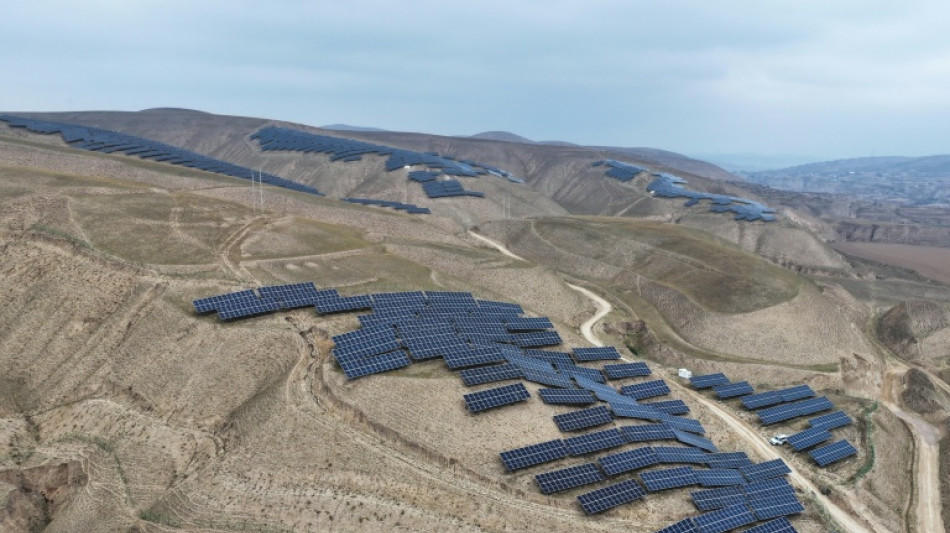
Renewables outpace fossil fuels despite US policy shift: IEA / Photo: © AFP

 Carrick confident Man Utd can 'work through' tough time

 Mbappe ends Nike partnership to join Swiss brand On

 Liverpool boss Iraola puts Bournemouth love affair on hold

 'A disaster' if Man City do not win says Maresca after flawless start

 Kerry James Marshall: American 'blackness' painter celebrated in Europe

 Spain coach De la Fuente offers 'full support' to people of Ceuta

 Russia seizes assets of Nestle, French firms over West's Ukraine support

 England can build on World Cup 'spirit', says Tuchel

 UNESCO can be 'moderator' in AI debate: chief to AFP

 Infantino 'must go', says German FA vice-president

 Russia seizes assets of Nestle, French firms

 Japan's busiest rail station tests robot bins
 Anthropic says AI systems moving towards building themselves

 Asian stocks boosted by falling oil, yen weakens after BoJ rate hike

 Pakistan court blocks expulsion of Afghan medical college students

 Athletes 'can't take it any more' as Asian Games issues mount

 Allen lights up Bills' new stadium with 41-31 win over Lions

 Afghan medical students in Pakistan hope court stops college expulsions

 AI doomsday warnings unlikely to slow IPOs but questions linger
 ICC eyes China in bid to expand cricket

 Nkunku craving freedom and fun on RB Leipzig return

 Bhutan's traditional archers lose ground to development

 Asian stocks track Wall St rally as oil prices drop

 South Korea makes Asian Games complaint over Japan warlord ceremony

 US aid cuts are killing Kenyan sex workers

Renewable energy is still expanding faster than fossil fuels around the world despite policy changes in the United States, with oil demand possibly peaking "around 2030", the International Energy Agency said Wednesday.
The Paris-based IEA presented different scenarios for the future of energy in its annual World Energy Outlook -- the first since coming under fire from the government of US President Donald Trump over its oil forecasts.
"The pace varies, but renewables grow faster than any other major energy source in all scenarios, led by solar photovoltaics," the agency, which advises mostly developed nations, said in its 518-page report.
In one scenario, "policy changes mean that the United States has 30 percent less renewables capacity installed in 2035 than in last year's Outlook, but at the global level renewables continue their rapid expansion".
The report comes as world leaders meet at the UN's COP30 climate conference in Belem, Brazil, which Trump and his government have shunned.
Trump, who has pulled out of the Paris climate accord, wants to expand oil and gas production and roll back the clean energy policies of his predecessor, Joe Biden.
The IEA had to walk a fine line when drafting its latest outlook as it has faced criticism from the Trump administration for projecting dwindling demand for fossil fuels.
US Energy Secretary Chris Wright threatened in July to pull out of the IEA if it did not reform how it operates.
- 'Politically motivated' -
The IEA used three scenarios for its World Energy Outlook: one takes into account policies that are currently in place, another looks at "stated" government policies including measures that have yet to be adopted, and a third considers a world that reaches net zero emissions by 2050.
Under the Current Policies Scenario (CPS), oil and natural gas demand would increase by 16 percent to 2035 and rise further through to 2050.
The IEA had dropped such scenarios from its reports in 2020.
"That (CPS) scenario is entirely politically motivated," Rachel Cleetus, senior policy director at the Union of Concerned Scientists, told reporters at COP30 in Belem.
"The Trump administration, unfortunately, has been setting bad policy in the United States and trying to undermine policy around the world."
In the IEA's Stated Policies Scenario (STEPS), oil demand would peak "around 2030" and decline to 100 million barrels per day by 2035 before falling in subsequent years.
In a report in June, the IEA had forecast that global oil demand would fall slightly in 2030, which would mark the first drop since the 2020 Covid pandemic.
The World Energy Outlook said demand for electricity is rising, fuelled by data centres and artificial intelligence in advanced economies and China, along with increasing use of air conditioning in developing countries.
In every scenario, China remains the largest market for renewable energy, accounting for 45 to 60 percent of their global deployment over the next 10 years.
Under every scenario, however, the IEA said the world would exceed 1.5C of warming above pre-industrial levels -- the most ambitious goal of the 2015 Paris climate agreement.
"There is less momentum than before behind national and international efforts to reduce emissions, yet climate risks are rising," the report said.
Under the CPS, warming would exceed 2C around 2050 and 2.9C in 2100 -- and then keep rising from there.
In STEPS, warming would exceed 2C by around 2060 and 2.5C by 2100.
But in the net-zero scenario, it would peak at about 1.65C around 2050 and decline slowly after that, before dropping back below 1.5C by 2100, according to the IEA.
The IEA has "confirmed that no single country can stop the energy transition, with oil and coal demand to peak by 2030 in its business-as-usual scenario", said David Tong, global industry campaign manager at Oil Change International, a non-profit advocacy group.
"But this year's report also shows Donald Trump's dystopian future, bringing back the old, fossil-fuel intense, high pollution Current Policies Scenario," he said.
R.Flueckiger--VB