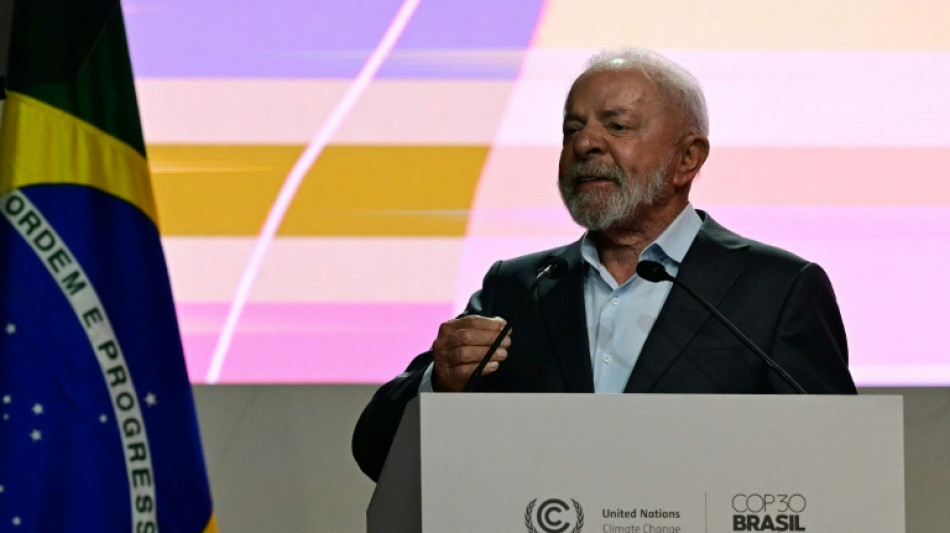
Brazil's Lula urges 'defeat' of climate deniers as COP30 opens / Photo: © AFP

 Carrick confident Man Utd can 'work through' tough time

 Mbappe ends Nike partnership to join Swiss brand On

 Liverpool boss Iraola puts Bournemouth love affair on hold

 'A disaster' if Man City do not win says Maresca after flawless start

 Kerry James Marshall: American 'blackness' painter celebrated in Europe

 Spain coach De la Fuente offers 'full support' to people of Ceuta

 Russia seizes assets of Nestle, French firms over West's Ukraine support

 England can build on World Cup 'spirit', says Tuchel

 UNESCO can be 'moderator' in AI debate: chief to AFP

 Infantino 'must go', says German FA vice-president

 Russia seizes assets of Nestle, French firms

 Japan's busiest rail station tests robot bins
 Anthropic says AI systems moving towards building themselves

 Asian stocks boosted by falling oil, yen weakens after BoJ rate hike

 Pakistan court blocks expulsion of Afghan medical college students

 Athletes 'can't take it any more' as Asian Games issues mount
 Allen lights up Bills' new stadium with 41-31 win over Lions

 Afghan medical students in Pakistan hope court stops college expulsions
 AI doomsday warnings unlikely to slow IPOs but questions linger
 ICC eyes China in bid to expand cricket
 Nkunku craving freedom and fun on RB Leipzig return

 Bhutan's traditional archers lose ground to development
 Asian stocks track Wall St rally as oil prices drop

 South Korea makes Asian Games complaint over Japan warlord ceremony

 US aid cuts are killing Kenyan sex workers

The UN's climate conference opened in the Brazilian Amazon on Monday with pleas for the world to keep up the fight against global warming, even as the United States turns its back.
Some 50,000 delegates are gathering for the two-week COP30 meeting in Belem, the hot and humid metropolis at the edge of the rainforest where they are facing the daunting task of keeping global climate cooperation from collapsing.
"Climate change is no longer a threat of the future. It is a tragedy of the present," Brazilian President Luiz Inacio Lula da Silva said at the conference, which started with song and dance from a trio of Indigenous people wearing feathered headpieces.
Lula slammed those who reject scientific evidence and "spread fear, attack institutions, science, and universities."
"It's time to inflict a new defeat on the deniers," he said, adding that it was far cheaper to fight to protect the climate than to wage war.
Weighing on the talks is the absence of the United States, the world's top oil producer and second-biggest emitter of greenhouse gases, whose climate-skeptic President Donald Trump champions the fossil fuel industry and derides renewable energy.
Delegates will also have to face the world's failure to meet the landmark Paris Agreement's safer goal of limiting warming to 1.5C, after scientists and the UN warned in recent days that surpassing that level temporarily is now all but inevitable.
UN climate chief Simon Stiell called on nations to move "much, must faster" to reduce emissions and keep the 1.5C target alive.
"Lamenting is not a strategy. We need solutions," said Stiell.
Activists fear that geopolitical tensions -- from wars to trade feuds -- are distracting nations from combatting climate change, even as supercharged storms recently devastated communities in the Caribbean and Asia.
"The larger geopolitical context for COP30 is the most difficult of all COPs I think, which means COP30 could be one of the most difficult," Bill Hare, chief executive of Climate Analytics, told AFP.
Lula defended his decision to hold the event in Belem despite logistical challenges, which included a dire shortage of hotel rooms. Many COP30 pavilions were still under construction on Sunday.
Lula's aim was to bring negotiators, business and journalists to the Amazon to see for themselves the challenges that nature faces.
The Amazon rainforest, which plays a vital climate role through its absorption of greenhouse gases, is itself plagued by a host of ills: deforestation, illegal mining, pollution, drug trafficking, and all manner of rights abuses against locals, especially Indigenous peoples.
- Tough negotiations -
Tough negotiations lie ahead.
Rich nations and developing countries regularly clash at COPs over how to provide the funds needed for poorer regions, which are the least responsible for planet-heating emissions, to adapt to climate change and transition away from fossil fuels.
Major oil producers such as Saudi Arabia oppose language that would step up commitments to moving away from fossil fuels -- a transition that was agreed at COP28 in Dubai in 2023.
Lula put on the table at a leaders summit last week a "roadmap" on fossil fuels but the proposal lacks details.
For 30 years, the countries that are party to the UN Framework Convention on Climate Change -- adopted in Brazil at the 1992 Earth Summit in Rio de Janeiro -- have met annually to strengthen the global climate regime.
Those efforts culminated in the 2015 Paris Agreement, which commits the world to limiting global warming to 2C above pre-industrial levels, while pursuing efforts to keep it below 1.5C.
But UN chief Antonio Guterres has acknowledged in recent weeks that it is now "inevitable" the 1.5C threshold will soon be breached, urging that the overshoot be kept as brief as possible.
That means finally bringing down global greenhouse gas emissions, which come mainly from burning oil, gas and coal.
A group of small island nations is fighting to have the need for a response to this failure placed on the official agenda.
"1.5 degrees is not just a number, not just a target, but that's a lifeline," Manjeet Dhakal, an advisor to the least developed countries block of countries at COP, told AFP.
"We cannot be a part of any decision where there is a discussion about (how) we can't achieve 1.5 degrees."
burs-lth/klm/des
L.Wyss--VB