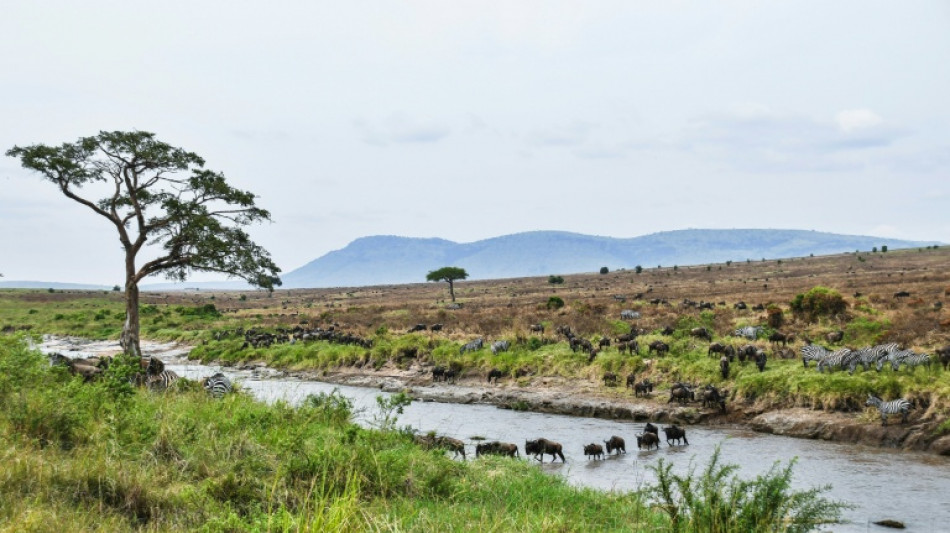
Tanzania Maasai fear VW 'greenwashing' carbon credit scheme / Photo: © AFP

 Carrick confident Man Utd can 'work through' tough time

 Mbappe ends Nike partnership to join Swiss brand On

 Liverpool boss Iraola puts Bournemouth love affair on hold

 'A disaster' if Man City do not win says Maresca after flawless start

 Kerry James Marshall: American 'blackness' painter celebrated in Europe

 Spain coach De la Fuente offers 'full support' to people of Ceuta

 Russia seizes assets of Nestle, French firms over West's Ukraine support

 England can build on World Cup 'spirit', says Tuchel

 UNESCO can be 'moderator' in AI debate: chief to AFP

 Infantino 'must go', says German FA vice-president

 Russia seizes assets of Nestle, French firms

 Japan's busiest rail station tests robot bins

 Anthropic says AI systems moving towards building themselves

 Asian stocks boosted by falling oil, yen weakens after BoJ rate hike

 Pakistan court blocks expulsion of Afghan medical college students

 Athletes 'can't take it any more' as Asian Games issues mount

 Allen lights up Bills' new stadium with 41-31 win over Lions

 Afghan medical students in Pakistan hope court stops college expulsions

 AI doomsday warnings unlikely to slow IPOs but questions linger

 ICC eyes China in bid to expand cricket

 Nkunku craving freedom and fun on RB Leipzig return

 Bhutan's traditional archers lose ground to development
 Asian stocks track Wall St rally as oil prices drop

 South Korea makes Asian Games complaint over Japan warlord ceremony
 US aid cuts are killing Kenyan sex workers

Namnyak, a Maasai herder in north Tanzania, fears a carbon credit scheme linked to Volkswagen -- dismissed by NGOs as "greenwashing" -- could destroy her community's way of life.
Under the scheme, local Maasai are being offered money to keep their cattle on a strict "rotational grazing" scheme so that the grass grows longer and captures more carbon.
The idea is that Volkswagen, and possibly other companies, will pay for this through "carbon credits" which are supposed to offset carbon emissions from its factories and operations.
Many researchers and NGOs question the whole concept, saying such schemes disrupt local communities while doing little to improve the environment, existing only to allow companies to keep polluting elsewhere.
The scheme in northern Tanzania is run by Volkswagen partner Soils for the Future Tanzania (SftFTZ), covering the districts of Longido and Monduli, an area of 16,000 square kilometres (6,200 square miles) -- roughly 20 times the size of New York City.
For Namnyak, a 33-year-old mother of three in Longido, it seems absurd.
Local Maasai have been sustainably living on the land -- rotating grazing in line with the weather and seasons -- for centuries.
Many locals, she said, fear the company has ulterior motives and may one day seize their land.
"It does not matter how much money they give us. We depend on our land for our cattle, our crops and our beekeeping. This is our lives, and the ones of the future generations," she told AFP.
- 'Implausible' -
SftFTZ and Volkswagen deny any desire to take their land, but many locals remain suspicious and feel they are getting money for nothing.
A 2023 study of a similar scheme in neighbouring Kenya by Survival International, an NGO supporting Indigenous communities around the world, found it was "highly implausible" that the new grazing regime was actually being implemented.
"To the contrary, the vegetation appears to continue to deteriorate in large parts of the project area," it said.
Verra, the main international body that validates carbon credit projects, suspended credits from a major forestry project in Zimbabwe in September, for which Volkswagen was also a client, saying its benefits had been exaggerated.
Verra told AFP it had yet to audit the project in Tanzania, or a competing carbon credit scheme proposed by US-based Nature Conservancy in the same region.
- 'Scam' -
Several researchers and NGOs believe the Maasai are unwitting participants in a vast "greenwashing" scheme by Volkswagen.
"Ultimately, there is nothing done for the land, not even a tree is being planted," said Maasai lawyer Joseph Oleshangay, calling the whole thing a "scam".
"Why is Volkswagen not doing this in Frankfurt or New York? Because they feel people here are easier to manipulate," he added.
SftFTZ is offering the local Maasai $2 per hectare to sign a 40-year contract, under which they promise to move their cattle roughly every two weeks.
Some have agreed since that amounts to huge sums by local standards, said Namnyak: "If someone gives you free money, who will refuse it?"
Sherie Gakii, advocacy officer for Greenpeace, said such projects only existed to let companies like Volkswagen "continue polluting and making big profits on the backs of indigenous people trying to protect their ancestral land".
Volkswagen's environmental arm, ClimatePartner, strongly disagrees.
It told AFP the carbon credits would be "based on scientifically validated measurements" including regular soil samples to ensure that carbon capture was increasing.
A Verra spokesperson defended carbon credit schemes as "one of the few vehicles that bring sustained investment into rural areas".
The SftFTZ contract promises to give 51 percent of the value of all carbon credits sold to the local community.
But the Maasai International Solidarity Alliance, an NGO, questions whether that money will ever materialise and has called for a five-year pause on all such schemes until they can be properly evaluated.
Benja Faecks of think tank Carbon Market Watch told AFP the focus should be on getting companies to stop polluting in the first place.
"When a company like Volkswagen or Danone or Nestle can buy these credits and claim they are carbon neutral... that's misleading and false," said Faecks.
"Volkswagen should focus on phasing out the internal combustion engine."
M.Betschart--VB