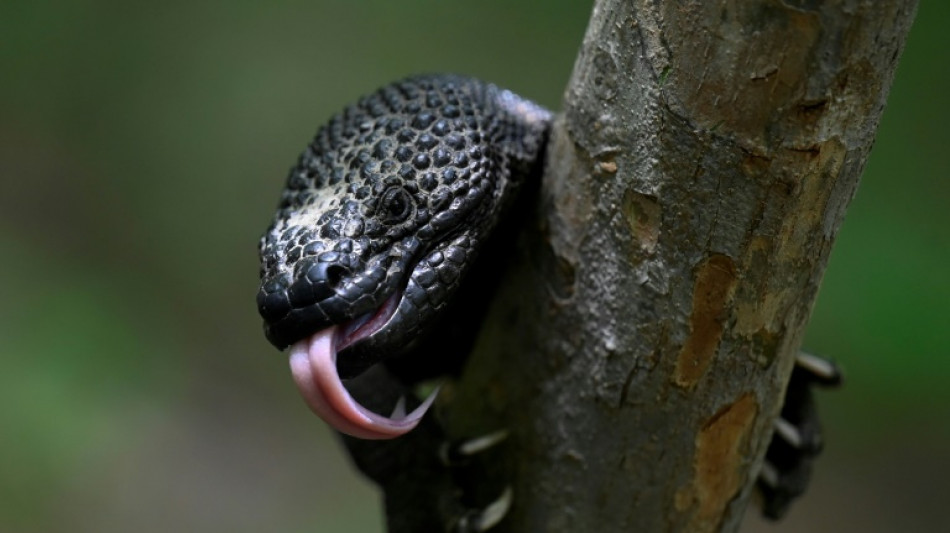
Saving Guatemala's poisonous 'Sleeping Child' lizard / Photo: © AFP

 Athletes 'can't take it any more' as Asian Games issues mount

 Allen lights up Bills' new stadium with 41-31 win over Lions

 Afghan medical students in Pakistan hope court stops college expulsions

 AI doomsday warnings unlikely to slow IPOs but questions linger

 ICC eyes China in bid to expand cricket

 Nkunku craving freedom and fun on RB Leipzig return

 Bhutan's traditional archers lose ground to development
 Asian stocks track Wall St rally as oil prices drop

 South Korea makes Asian Games complaint over Japan warlord ceremony
 US aid cuts are killing Kenyan sex workers

 October 7 survivors, families take centre stage in Israel vote
 Captain Mat Ryan axed from Socceroos squad for Brazil games

 US approves sale of 48 F-35 jets to Saudi Arabia

 Juventus, Palace cruise to Europa League wins, Bournemouth beat Sociedad

 Stocks climb as oil retreats, Fed calms inflation fears

 Russians begin voting in controlled election as war drags

 Hispanics feel 'betrayed' on immigration, Republican warns Trump

 High-scoring Bears face Vikings in battle of NFL unbeatens
 'In our lane': Fed's Warsh defies Trump but still fighting for credibility

 Trump admin makes major cut to endangered species protections

 Princess Diana's brother makes new explosive claims against Charles

 Ovechkin on Russian political video: 'I support my country'

 Can we shut down AI?

 Teenager Sullivan named in new-look US squad
 Travis Scott and Keith Richards feature on GTA VI soundtrack

With its sharp claws, scaly skin and venomous bite, Guatemala's "Sleeping Child" lizard has earned itself few human friends.
One of them, forest ranger Juan Alvarado, has spent the last 17 years of his life trying to save the much-maligned creature from extinction.
Alvarado, 68, works at a forest reserve in Guatemala's Zacapa department that is dedicated to saving the Guatemala Beaded Lizard (Heloderma charlesbogerti), dubbed Nino Dormido (Sleeping Child) by locals for its lethargic gait.
He expertly handles one specimen, rescued from a nearby village, holding it deftly by the head and body and placing it gently on the ground.
Seemingly nonplussed, the lizard slinks off into the undergrowth.
"People used to say that if you see a Heloderma, you're dead," Alvarado said of the reptile's foul reputation.
While the lizard does pack a painful bite, it is rarely deadly to humans who nevertheless view it as a mortal enemy.
Projects to save the critter include encouraging villagers to bring lost specimens to the park -- sometimes in exchange for payments of food.
Its venom, explained Alvarado, was being studied for possible use in cures for diseases such as diabetes and cancer.
Yet the creature has a fearful reputation, and individuals who stray into areas inhabited by humans are frequently killed.
Sleeping Child lizard numbers have been further decimated by human encroachment on its ever-shrinking habitat, climate change, and capture for sale as exotic pets.
At one point, they could fetch as much as $2,000 apiece in Europe, said Alvarado.
Given the multitude of threats, Guatemalan conservation officials estimate there are only about 600 individuals left in the world -- an increase from 200 two decades ago.
The International Union for Conservation of Nature lists the lizard as endangered.
M.Odermatt--BTB



