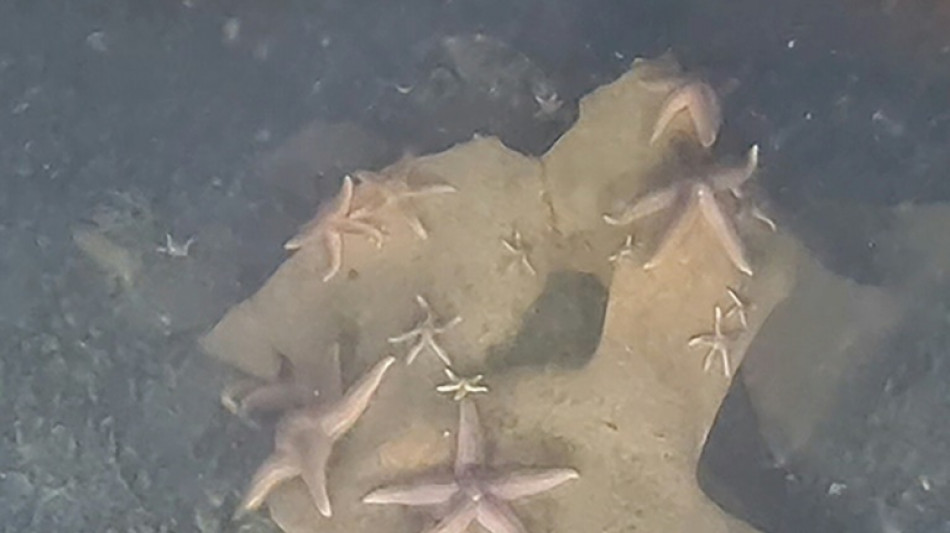
Sea life thriving on unexploded Nazi bombs, sub discovers / Photo: © DeepSea Monitoring Group/AFP

 Stock markets retreat after central bank rate hikes

 Russia labels director of Cannes Grand Prix winner a 'foreign agent'

 Macron warns of Russian 'hybrid' threat after meeting presidential hopefuls

 UN holds third informal poll for new chief

 Kulusevski return can spark Spurs: De Zerbi

 Shakira to cap off world tour with Madrid 12-gig run

 Isolated Syrian-Druze city blames Damascus for shortages

 Isolated Syrian-Druze city shortages

 Dutch drop Depay for Germany match in Xavi's first pick

 Ronaldo named in Portugal squad for Nations League

 Stock markets diverge after central bank rate hikes

 Anti-Assad music star makes triumphant return to Syria

 In-form Fernandez included in Spain Nations League squad

 Arteta buries hatchet with Hurzeler ahead of Brighton clash

 Alexander-Arnold and Palmer return to England squad for Nations League

 Russians vote as Ukraine war drags on for fifth year

 Backpackers fret over Australian visa crackdown

 Most Asian stocks track Wall St rally, yen drops after BoJ rate hike

 Russians begin voting in controlled election as war drags on

 Trump 'clearly' wants dialogue with Pyongyang: South Korean President

 Bank of Japan hikes rates to 31-year high to battle inflation

 Thailand's Muslim separatists vow to fight to the end

 Mideast turmoil, AI set to dominate UN gathering of world leaders

 Australia to detain tourists who overstay visa, minister says

 Championship rivals brace for renewal of bitter feuds

Marine life is thriving on unexploded Nazi bombs sitting at the bottom of a German bay, a submersible has discovered, even capturing footage of starfishes creeping across a huge chunk of TNT.
The discovery, which was revealed in a study published Thursday, was "one of those rare but remarkable eureka moments," marine biologist Andrey Vedenin told AFP.
The waters off Germany's coast are estimated to be littered with 1.6 million tons of unexploded munitions left behind from both world wars.
In October last year, a team of German scientists went to a previously uncharted dump site in the Baltic Sea's Luebeck Bay and sent an unmanned submersible 20 metres down to the seafloor.
They were surprised when footage from the sub revealed 10 Nazi-era cruise missiles. Then they were stunned when they saw animals covering the surface of the bombs.
There were roughly 40,000 animals per square metre -- mostly marine worms -- living on the munitions, the scientists wrote in the journal Communications Earth & Environment.
They also counted three species of fish, a crab, sea anemones, a jellyfish relative called hydroids and plenty of starfishes.
While animals covered the hard casing of the bombs, they mostly avoided the yellow explosive material -- except for one instance.
The researchers were baffled to see that more than 40 starfishes had piled on to an exposed chunk of TNT.
"It looked really weird," said Vedenin, a scientist at Germany's Carl von Ossietzky University and the study's lead author.
Exactly why the starfishes were there was unclear, but Vedenin theorised they could be eating bacterial film collecting on the corroding TNT.
- Life on weapons of death -
The explosive chemicals are highly toxic, but the animals appeared to have found a way to live near it.
Other than the death-wish starfishes, they did not seem to be behaving strangely.
"The crabs were just sitting and picking something with their claws," Vedenin said.
To find out what kind of bombs they were dealing with, he went online and found a manual from the Nazi air force Luftwaffe describing how to handle and store V-1 flying bombs. The cruise missile exactly matched the 10 bombs from the footage.
Vedenin said "there is some irony" in the discovery that these "things that are meant to kill everything are now attracting so much life."
He compared it to how animals such as deer now thrive in radioactive areas abandoned by humans near the site of the Chernobyl nuclear disaster.
Hard surfaces on the seafloor are important for marine life that want more than mud and sand.
Animals once flocked to huge boulders that littered the Baltic Sea, however humans removed the stones to build infrastructure such as roads at the start of the 20th century.
So when the Nazi bombs are eventually cleared from the bay, the researchers called for more stones -- or concrete structures -- to be put in place to continue supporting the sea life.
The scientists also plan to return to the spot next month to set up a time-lapse camera to watch what the starfishes do next.
T.Germann--VB