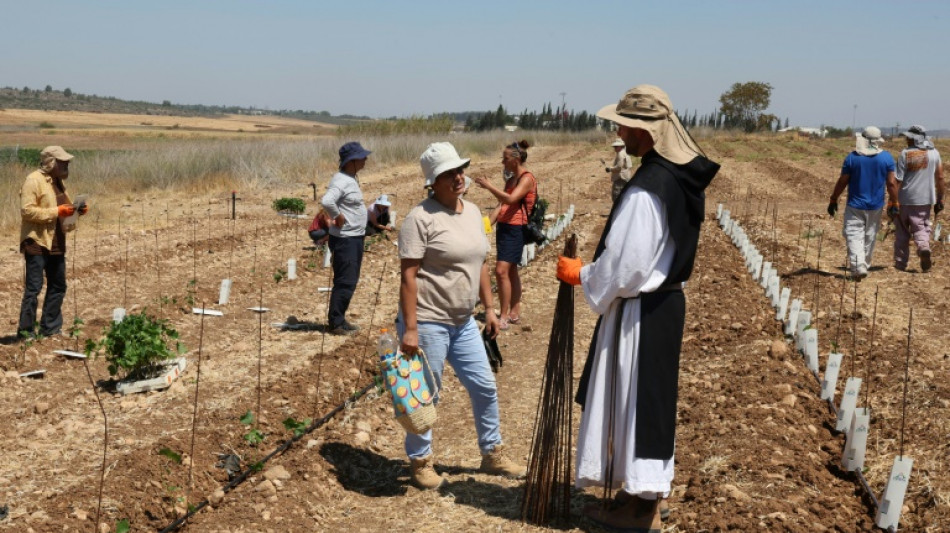
New vines bring hope to Israeli monastery scorched by wildfire / Photo: © AFP

 Messi absent after father's death as Miami lose in Leagues Cup
 Flight cancellations, evacuations in China as Typhoon Dolphin looms

 Iran issues demands for reopening of Hormuz

 Afghanistan's gold rush upends lives and landscapes

 Messi missing after father's death as Miami lose in Leagues Cup

 World number one Sabalenka ousted in Toronto by Alexandrova

 Olympic weightlifter hoists debris for Venezuela earthquake recovery

 FIFA condemns 'concerted and ongoing effort' to weaken Infantino

 South Africa win after surviving late Argentina surge

 Man Utd boss Carrick being 'careful' with Mount as Man Utd draw with PSG

 All Black Tuipulotu surprised after Sharks include Nonu

 Infantino denies allegations of affair, favouritism while at UEFA: report

 MotoGP leader Martin soars to victory in British GP sprint race

 Mosimane set to succeed Broos as South Africa coach

 Drone enters Bulgaria, explodes near pipeline at Romanian border

 Paris orders e-scooter users to wear helmets, reflective gear

 Lionel Messi's father Jorge dies aged 68

 Johnson reveals 'stress' of Grand Slam Track collapse, clarifies payment

 Defending champion Ferrand-Prevot out of Tour de France Femmes

 Wallabies squeeze past Japan to give Kiss a winning start

 Kyiv mourns recovery volunteer, whose life 'intertwined with the fallen'

 Only two vehicles earn perfect child-seat scores for 2026

 Chinese car brands reshape Australia’s automotive market

 Electric cars enter their most decisive generation yet

 Three Chinese carmakers enter the global automotive top 10

Swapping his monk's habit for overalls and a sun hat, Father Christian-Marie knelt alongside volunteers in the freshly dug earth, planting grape vines to replace those damaged by wildfires that swept through central Israel earlier this year.
Wine production at Latrun monastery dates back 135 years, when the French monks first arrived. Cultivating fruit is central to both their spiritual practice and livelihood.
The monks say the wildfires that broke out in late April damaged about five hectares (12 acres) of vineyard -- roughly a third of their crop.
Undeterred, the monks called for help, drawing dozens of volunteers who busied themselves digging holes and planting stakes under the blazing sun.
Father Christian-Marie, who has spent almost 28 years at the monastery, said planting fresh vines symbolised optimism for the future.
"For me, it's quite important when I live here in this monastery to pray for peace," he told AFP.
"To plant a vineyard is a sign of hope, because if we thought that tomorrow the land will be bombed and will not exist, we wouldn't do this work," he added.
Working in a pensive hush, volunteers carried trays of sapling vines to be planted in long rows in a patch of the monastery's land untouched by the flames.
Robed monks handed out stakes and delicately pressed the plants into the earth.
"Planting is something exciting, you plant and it will grow. It will give fruit, and the fruit will give wine. And wine will make the heart of the human happy," said Noga Eshed, 74, a volunteer from Tel Aviv.
For her, the exercise signified a reconnection with nature.
"I see people touching the ground, the earth. And it's not very common. We are very disconnected these days," she added, trowel in hand.
Eshed, who has volunteered at the monastery on previous occasions, said the brothers there were "good friends".
Latrun's monks are Trappists, a Roman Catholic order centred on contemplation and simplicity.
- 'In God's hands' -
Fanned by high temperatures and strong winds, wildfires spread rapidly through wooded areas along the main Jerusalem–Tel Aviv highway on April 30.
The flames travelled right up to the edge of Latrun monastery, prompting the evacuation of the 20 or so brothers who live there.
"It was very hard because we are not used to getting out of our monastery and we have some very old brothers," Brother Athanase told AFP.
The monks initially feared it had burned down, he added, but the monastery was spared although swathes of its agricultural land were destroyed.
As well as vineyards, Latrun has around 5,000 olive trees, of which roughly 1,000 were entirely burnt down to the root in the blaze.
Brother Athanase estimated that around 70 percent of the olive trees were in some way damaged and would take around four years to recover.
Last year the monastery produced three tonnes of olive oil, but "there'll be no production this year", he said.
"It's difficult for us because we are living off our production... but we are not afraid because life is always growing up," he added with a slight smile, surrounded by scorched earth.
He was grateful for the assistance provided by the volunteers and said it was important "to know that people like monks in the Holy Land".
Climate change is driving up temperatures, decreasing precipitation and increasing the frequency of extreme weather events in Israel.
Standing in the newly planted vineyard, Father Alois said he hoped the monastery would not face a blaze as devastating in the future but that the monks were now better prepared after installing a new water system.
Ultimately, he said, "we are in God's hands".
D.Schlegel--VB