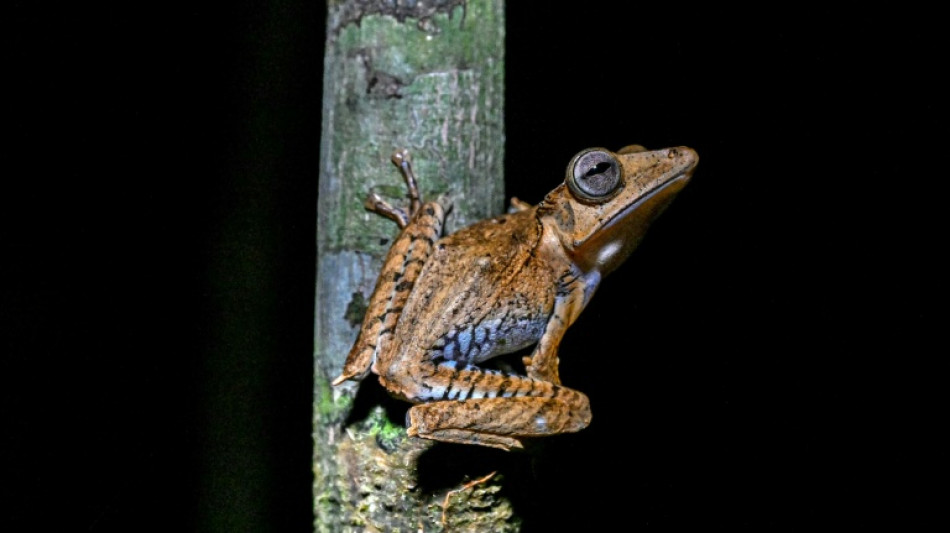
'Frogging' takes off in Borneo's jungle / Photo: © AFP

 Swiatek races into Toronto semis as Svitolina battles through

 'Big Four' bowlers back as ageing Australia begin gruelling run

 AI's hunger for power sparks US private gas plant boom

 Memphis AI data center fuels pollution fight in Black neighborhood

 Ceuta leader wants migrant detention centre after influx
 Colombia scrambles to find survivors as quake kills 111

 Rain postponements wreck Montreal Masters schedule

 Notts Forest owner Marinakis sues Palace over gun banner - reports

 Koech gets three-year ban, stripped of US 1,500m title

 Sensational Ingebrigtsen back with more European gold

 'A scare': Brazil player leaps into tunnel in joy over goal

 USA Swimming CFO Hilliard arrested for alleged theft

 Trump insists Netanyahu relationship 'very good' despite Gaza rift

 Ingebrigtsen delivers masterclass for seventh European athletics gold

 Colombia declares state of emergency after quake kills 111

 Golden relay double for Britain at Europeans as Marchand takes silver

 Barcelona's Araujo heads to Liverpool on loan

 Tupac Shakur murder trial begins 30 years after rapper's death

 Russia bars only anti-war party from elections

 Boeing to divest tech ventures for stake in air-taxi startup

 Major quake rocks Colombia and neighbors, 18 confirmed dead

 Brazil aircraft maker Embraer raises outlook after record revenue

 Drought forces water restrictions across nearly 70 percent of France

 Europe wary as gas stocks languish at lows while winter looms

 Freedom Holding Corp. Reports 40% Increase in Quarterly Revenue to $732.5 Million

Dodging fire-ants, snakes and millions of nighttime creepy-crawlies, a group of trekkers advances through the humid Bornean rainforest, scanning with torches for some of the jungle's most unlikely stars: frogs.
"There's another one! And it's massive," British tourist Lauren Heywood exclaimed as she spotted the telltale reflective glint off a pair of blinking eyes, seemingly waiting to be photographed by admirers.
"Frogging", or the hunt for the exotic amphibians that call the rainforest home, is taking off in Malaysia's Sarawak state in Borneo.
And herpetologists say few places rival Kubah National Park, around half an hour's drive from state capital Kuching.
It is home to some of the world's smallest and most unusual frog species.
While many visitors flock to Borneo's jungle to see charismatic large species like orangutans or elephants, some of its tiniest residents are increasingly getting their turn in the spotlight, according to Kubah park ranger Muhammed Tajuddin.
"More and more people are coming to see our frogs," he told AFP.
- Frog central -
The tour begins at dusk, with Indigenous Dayak guide Dominic Jikie leading a 45-minute hike up Mount Serapi, the highest peak in the area, to frog central.
Here, surrounded by ancient jungle trees is a shallow pond around the size of two swimming pools.
Scientists say it serves as the primary breeding ground for many of the 180 frog and toad species found on Borneo -- the world's third-largest island, divided between Malaysia, Indonesia and Brunei.
Dozens of species dot almost every surface, submerged in the torchlit water, or perched on leaves, branches or tree trunks, placid and unbothered by their human fans.
"There is something special here," said Jikie, 64, a retired park ranger who now specialises as a frogging guide.
"People come to the park because they don't have the species that we have here back at home."
Among the stars of the show on this visit are pinkish harlequin flying frogs with mottled underbellies, file-eared tree frogs with distinctive sharp noses and white-lipped frogs whose lurid green backs give way to a stripe of white along their bottom jaw.
One of Borneo's most famous species, the giant river toad nicknamed "frogzilla" for its dinner-plate size, is not seen in Kubah.
But there are other more delicate types, according to Jikie.
"We have one of the world's smallest frog species, that breed inside pitcher plants," he said, training his sharp spotlight on a pair of amphibian eyes just up the steep mountain road.
The Matang narrow-mouthed frog was officially described by Malaysian and German herpetologists in 2010 after its discovery in Kubah.
It grows to a maximum of just 11 millimetres (less than half an inch) as an adult.
British tourist Thom Harris and his fellow visitors spotted 11 species on their nighttime trek.
"This was an amazing experience," he told AFP. "They are just stunning creatures."
"There are a few fire ants and a few other things to be careful of -- and a lot of bugs," he laughed.
"But it's definitely worth it. And it's a lot of fun!"
- 'I love nature' -
The rising popularity of the forest frogs is a chance for environmentalists to highlight the serious threats they face.
Deforestation, climate change and overhunting are all putting pressure on the tropical island's frog population, scientists say.
"Even slight changes in the temperature and climate may affect the survival of the frog species in a particular habitat," University of Malaysia, Sarawak researchers Nur Hidayah Zulkefli and Ramlah Zainudin wrote in 2022.
Deforestation in Sarawak remains significant and ongoing, statistics by environmental group Global Forest Watch showed, including for timber and to make way for palm oil plantations.
Sarawak's government said it backed community conservation movements to preserve the amphibians and it ran well-protected game and nature reserves like Kubah National Park.
Awareness events include the annual International Bornean Frog Race, which sees scientists and the public compete to spot and photograph as many frog species as possible within a set timeframe and area.
For park ranger Tajuddin, the more people are able to engage with the unique creatures, the more they will understand the need to protect them and their habitats.
"I love nature," he said. "Frogging is a unique way for me to share that love with all our visitors."
B.Wyler--VB