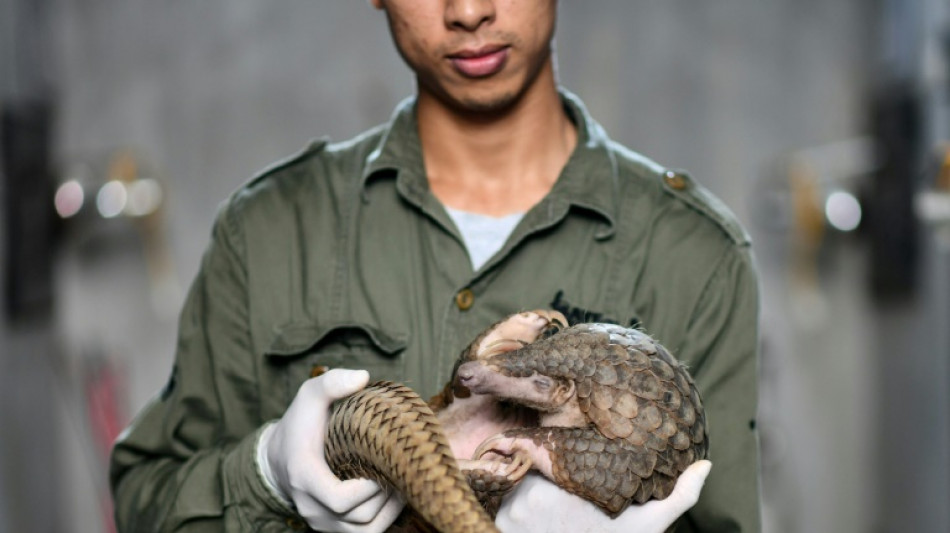
US moves to protect all species of pangolin, world's most trafficked mammal / Photo: © AFP/File

 Germany's dry rivers spark battle on engineering vs restoration

 Senators demand inquiry into conditions aboard USS Abraham Lincoln

 All Blacks' Proctor out of South Africa series, Mo'unga called up

 Bangladesh quick Hasan reduces Australia to 74-4 at lunch

 Seoul tech leads Asian stock gains as traders cheer US inflation

 Farage and Count Binface go head-to-head in snap UK poll

 Afghan students divided over smartphone ban at universities

 Japan go back to school for second Australia Test

 Matthew McConaughey on his sweet return to the big screen
 President's economic record on the line as Zambia votes

 Grieving Messi available for Miami in Leagues Cup clash

 Colombia enters 'final phase' of quake search as toll hits 265

 Father-figure Christie helps guide Kounta to European silver

 McIlroy returns to St. Jude to launch marathon PGA playoff push

 Guimaraes makes Arsenal debut in Como friendly

 Travis Kelce says wedding to Taylor Swift was 'best night of my life'

 US stocks mostly up after data shows slightly lower inflation in July
 Caracas protest denounces secrecy of Venezuela transition talks

 Hudson-Smith regains Euro 400m title on home track

 Rob Reiner son denies grand jury murder charges

 Spain darkens as solar eclipses races south from Arctic
 Skies darken as solar eclipse heads south from Arctic to Spain

 Protest denounces secrecy of Venezuela transition talks

 NBA's Los Angeles Lakers to be sold for reported $12.5 bn

 Lukaku joins Turkish side Fenerbahce from Napoli

The United States on Monday moved to extend federal protections to all species of pangolins -- a step that would tighten trade restrictions and highlight the urgent conservation plight of the world's only scaly mammals.
Found in the forests, woodlands, and savannas of Africa and Asia, pangolins are small, nocturnal creatures known for their distinctive appearance, slow and peaceful demeanor, and habit of curling into a ball when threatened.
Often likened to a walking pinecone, they use long, sticky tongues to feast on ants and termites, give birth to a single pup each year -- and are the most heavily trafficked mammals on Earth. Their keratin scales are coveted in traditional medicine, and their meat is also considered a delicacy in some regions.
Despite steep population declines driven by poaching, habitat loss, and inbreeding, only one species — Temminck's pangolin of Africa -- is currently protected under the US Endangered Species Act. Monday's proposal by the US Fish and Wildlife Service would extend that status to all eight known species.
In a statement, the agency said it intends to list the four Asian species -- Chinese, Indian, Sunda, and Philippine -- as well as the three other African species: white-bellied, black-bellied, and giant pangolins.
"I'm delighted the United States is doing its part to save these adorably odd creatures," said Sarah Uhlemann, international program director at the Center for Biological Diversity.
"Pangolins are on the razor's edge of extinction, and we need to completely shut down any US market for their scales. There's no good reason for anybody to ingest any part of a pangolin."
Pangolins are currently protected under the Convention on International Trade in Endangered Species of Wild Fauna and Flora (CITES), which prohibits international trade for commercial purposes and allows it only under exceptional circumstances.
Still, the illegal trade persists.
In April, Nigerian authorities seized nearly four tons of trafficked pangolin scales — representing the slaughter of some 2,000 animals. In November 2024, Indonesian officials intercepted another 1.2 tons.
US demand remains a factor. Between 2016 and 2020, border officials intercepted 76 shipments of pangolin parts, including scales and products marketed for traditional medicine, according to public data.
M.Vogt--VB