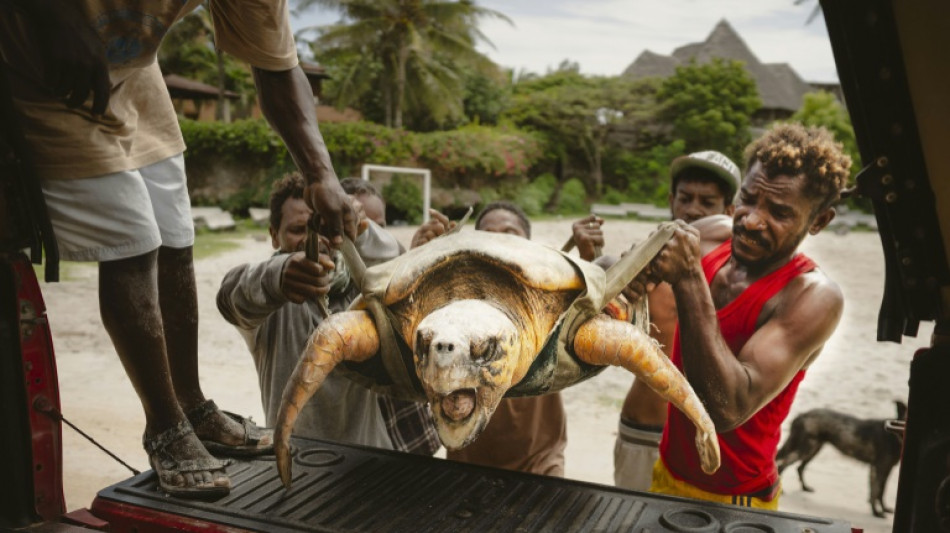
Kenya NGO saves turtles from nets, plastic and rising tides / Photo: © AFP

 McIntosh bounces back with 400m medley win at Pan Pacs

 Farage declares victory as count still underway in UK by-election

 Australia probes three near-misses at Sydney Airport

 Classy Tanzid puts Bangladesh in firm charge against Australia

 Schwarber smacks two homers to power Philles' MLB Field of Dreams win

 Pakistan's date workers toil through rising heat

 New trend of injecting banned peptides to 'optimise' body

 Eddie Jones senses Japan's time has come against Australia

 UK vote count under way in Farage, Binface showdown

 US, Mexico conduct security exercises near border

 Swiatek rolls past Rybakina for WTA Toronto title

 Vance says low oil prices are top US goal in Iran conflict

 Hunt bags Euro sprint double, Ceh keeps discus title

 'Dream come true': Owners reunite with pets in quake-hit Colombia

 US stocks gain after benign inflation data, oil prices retreat

 LeBron's Sixers in spotlight as full 2026-27 NBA schedule revealed

 Kennedy Center board votes to restore Trump name: reports
 Barcelona agree to sell Torres to PSG: media
 Romania shuts nuclear plant as Danube drops

 Millions of Europeans struggle with another wave of extreme heat

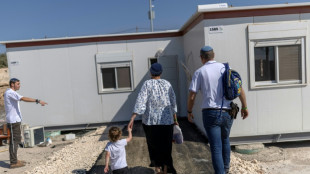 Israel reopens once-closed West Bank settlement

 Taylor to captain New Zealand for first time against Bulls

 Carrick urges Man Utd to push for more signings to boost title bid

 'This was my World Cup' says Somali ref after UEFA Super Cup

 Survivors tell of horror of Zimbabwe ferry sinking as death toll hits 46

A small charity on the Kenyan coast has become vital to the region's majestic turtle population, saving thousands from poachers, fishermen's nets and ever-worsening plastic pollution.
On the beach of the seaside town of Watamu, it takes four men to heave the huge Loggerhead sea turtle into the back of a car.
She has just been saved from a fishing tackle and will be taken to a nearby clinic to be checked for injuries, then weighed, tagged and released back into the sea.
A Kenyan NGO, Local Ocean Conservation (LOC), has been doing this work for almost three decades and has carried out some 24,000 rescues.
"Every time I release a turtle, it's a really great joy for me. My motivation gets stronger and stronger," said Fikiri Kiponda, 47, who has been part of LOC's 20-odd staff for 16 years.
LOC began life in 1997 as a group of volunteers who hated seeing the creatures being eaten or dying in nets.
Turtles are still poached for their shells, meat and oil.
But through the charity's awareness campaigns in schools and villages, "perceptions have significantly changed", said Kiponda.
LOC, which relies mostly on donations, compensates fishermen for bringing them injured turtles.
More than 1,000 fishermen participate in the scheme and mostly do so for the sake of conservation, the charity emphasises, since the reward does not offset the hours of lost labour.
- Floating turtles -
At the NGO's nearby clinic, health coordinator Lameck Maitha, 34, says turtles are often treated for broken bones and tumours caused by a disease called Fibropapillomatosis.
One current in-patient is Safari, a young Olive Ridley turtle around 15 years old -- turtles can live beyond 100 -- transported by plane from further up the coast.
She arrived in a dire state, barely alive and with a bone protruding from her flipper, which ultimately had to be amputated -- likely the result of fighting to free herself from a fisherman's net.
Safari has been recovering well and the clinic hopes she can return to the sea.
Other frequent tasks include removing barnacles that embed themselves in shells and flippers, weakening their host.
But a growing danger is plastic pollution.
If a turtle eats plastic, it can create a blockage that in turn creates gas, making the turtle float and unable to dive.
In these cases, the clinic gives the turtle laxatives to clear out its system.
"We are seeing more and more floating turtles because the ocean has so much plastic," said Maitha.
- Survivors -
LOC also works to protect 50 to 100 nesting sites, threatened by rising sea levels.
Turtles travel far and wide but always lay their eggs on the beach where they were born, and Watamu is one of the most popular spots.
Every three or four years, they produce hundreds of eggs, laid during multiple sessions over several months, that hatch after around 60 days.
The charity often relocates eggs that have been laid too close to the sea.
Marine biologist Joey Ngunu, LOC's technical manager, always calls the first to appear Kevin.
"And once Kevin comes out, the rest follow," he said with a smile, describing the slow, clumsy procession to the water, preferably at night to avoid predators as much as possible.
Only one in a thousand reaches adulthood of 20-25 years.
"Living in the sea as a turtle must be crazy. You have to face so many dangers, fish and poachers, and now human pressure with plastic and commercial fishing," he said.
"Turtles are definitely survivors."
C.Koch--VB