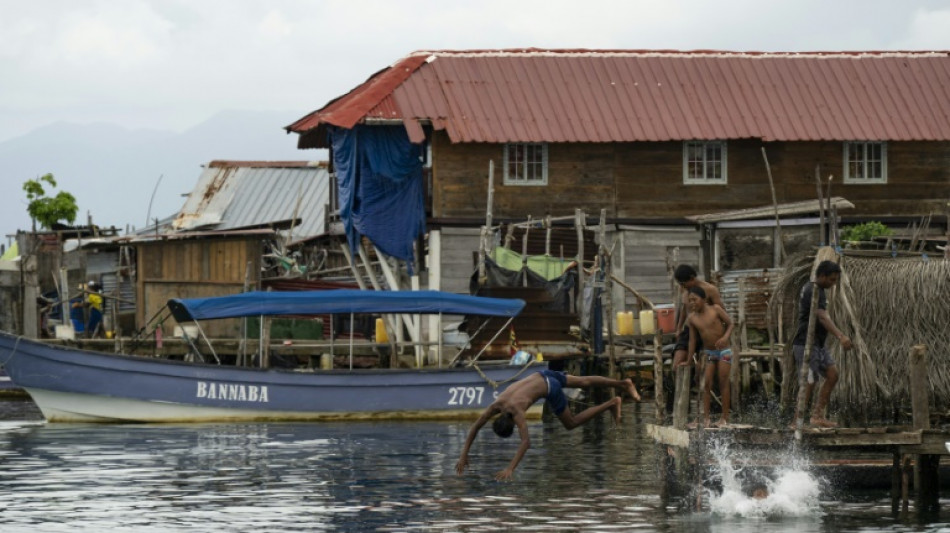
Year after exodus, silence fills Panama island threatened by sea / Photo: © AFP

 Norway's hurdles king Warholm wins fourth European title

 Liverpool deal with Bezos consortium raises stakes in US battle for Premier League power

 Colombia hopes for miracles as search for quake victims goes on

 Popovici, Quadarella mine more gold at Europeans as Marchand flexes in butterfly

 'I shot Mr Thompson': Stunning confession in US health exec's slaying

 San Francisco to host 2028 MLB All-Star Game

 Trump dismisses concerns over conditions on US aircraft carrier

 Zambia resumes vote count after pause over violence

 Wind spurs forest fire in western Germany, with scores evacuated

 Pakistan captain Babar in injury scare ahead of England opener

 Mangione admits shooting health care CEO

 UN warns sanctions chill is stopping Cuba aid

 Alleged US healthcare CEO killer says will plead guilty to stalking

 France's Macron in hot water over jet ski picture

 Nursing federation demands proper pay, protection on Ebola front line

 France upholds assisted dying law, strikes down social media ban for children

 Body found after wildfire hits Croatian coastal town

 Arteta expects Maresca to do an 'unbelievable job' at Man City

 Stocks tread water with eyes on oil price

 US retail sales weakest in over a year in July

 Israel calls for police to replace military in handling West Bank settlers

 स्कैंडिक पे: दुनिया में कहीं भी, बिना किसी सीमा के भुगतान करें।

 SNC 스칸딕 페이: 전 세계 어디서나, 제한 없이 결제하세요

 SNC SCANDIC PAY: Platby po celém světě bez omezení

 SNC SCANDIC PAY: Płatności na całym świecie bez ograniczeń

Streets once filled with children's laughter have fallen silent on a Panamanian island where almost all residents left a year ago due to the threat of the sea swallowing their homes.
The evacuation of around 1,200 members of the Indigenous Guna community to a new life on the mainland was one of the first planned migrations in Latin America due to climate change.
The exodus from Gardi Sugdub in the Caribbean left those who remained with a sense of sadness, said Delfino Davies, who has a small museum on the island with spears, jars and animal bones.
"There are no friends left or children playing," he told AFP.
Gardi Sugdub now has the silence of a "dead island," he said.
Dusty desks and empty classrooms are all that remain of a school that once bustled with children.
Many of the island's wooden houses are padlocked.
"There's no one here. Sometimes I get sad when I'm here alone," Mayka Tejada, 47, said in the small store where she sells bananas, pumpkins, clothes, toys and notebooks.
Like Davies and about 100 others, she decided to stay.
But her mother and two children, aged 16 and 22, moved to one of the 300 houses built by the Panamanian government in a new neighborhood called Isber Yala on the mainland, a 15-minute boat ride away.
Gardi Sugdub, the size of around five football fields, is one of 49 inhabited islands in the Guna Yala archipelago -- also known as San Blas -- which scientists warn is in danger of disappearing by the end of the century.
- 'I'll die here' -
Sitting in a hammock in her earthen-floor house filled with the aroma of medicinal herbs, 62-year-old Luciana Perez said she had no intention of leaving.
"I was born in Gardi and I'll die here. Nothing is sinking. Scientists don't know, only God," she said.
Perez said that she was not afraid because since she was a child she had seen big waves and rising waters flooding houses at times.
Steven Paton, a scientist at the Panama-based Smithsonian Tropical Research Institute, said climate change meant that sea levels were expected to rise by up to 80 centimeters.
"Most of the Guna Yala islands are about 50 centimeters above sea level," he told AFP. "They'll be underwater."
Ana Toni, CEO of the United Nations' COP30 climate conference, told AFP that the mass evacuation "shows the reality we already have to face on the planet."
- Sidewalks, water, electricity -
The arrival of the rainy season has left puddles dotting the dirt roads of Gardi Sugdub.
In contrast, in the new settlement of Isber Yala -- "land of loquats" in the Guna language -- the streets are paved and have sidewalks.
The nearly 50-square-meter (500-square-feet) concrete houses have flushing toilets and there is a plot of land to grow vegetables.
On Gardi Sugdub "we lived crowded together, and I had to go fetch water from the river in a small boat," said Magdalena Martinez, a 75-year-old retired teacher.
In Isber Yala, water is available for an hour in the morning, she said.
"I can fill the buckets. And I have electricity 24 hours a day," said Martinez, who lives with her granddaughter in the new neighborhood.
Tejada's children also have no regrets about leaving the island, she said.
"I miss them, but they're happy there. They have a place to play football and walk around," Tejada said.
While the island's school relocated to Isber Yala, its dilapidated clinic remained in Gardi Sugdub.
"Before, people came on foot. Now, they have to travel by land and sea to get here. There are fewer visitors," said 46-year-old doctor John Smith.
Some of the islanders divide their time between the two communities, while others visit occasionally to check on their homes.
This week, there will be more activity than normal: seven jars of chicha -- a fermented corn drink -- are ready for Isber Yala's first anniversary.
Martinez is looking forward to the celebration, even though it will be bittersweet.
Although she may not see it herself, "the islands will disappear because the sea will reclaim its territory," she said.
J.Sauter--VB