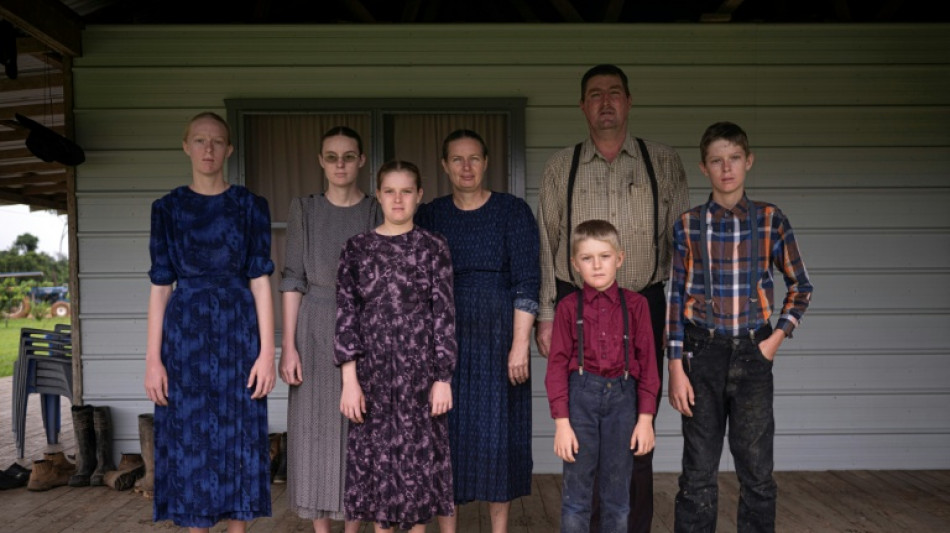
Mennonite communities raise hackles in Peruvian Amazon / Photo: © AFP

 Trump's devoted 'human printer' in media glare

 Top seed Zverev bundled out by Paul in rain-hit Cincinnati upset

 WADA pledges vigilance on Russian athletes ahead of 2028 Olympics

 NASA satellite rescue mission fails

 Cobolli halts Jodar to reach Cincinnati quarter-finals

 As election looms, Netanyahu puts Turkey in Israel's crosshairs

 McIlroy questions LIV stars 'value' as talk of PGA return builds
 'Breakthrough' mRNA cancer drug curbs melanoma in large trial

 Many US Fed policymakers back interest rate hikes if inflation stays high

 Robinson and Tongue star as Pakistan collapse in England opener

 All Blacks must get 'everything right' to beat Springboks, says legend Fitzpatrick

 Robinson and Tongue star as Pakistan all out for 171 in England opener

 Lake Zurich sees water level hit record low amid drought

 Merck and Moderna's tailored cancer drug curbs melanoma recurrence in trial

 Referees chief Webb wants clamp-down on Premier League set-piece grappling

 Robinson makes history as Pakistan collapse against England

 Alvarez can win back Atletico fans in two games: club chief

 Oldest human brain cells grown in lab 'recorded passage of time'

 7,300 excess deaths and counting in France's historically hot summer
 Ukraine MPs approve new defence minister after divisive reshuffle

 North Korea leader's sister says 'unaware' of reported Kim-Trump communication

 Russia, Ukraine exchange 103 captured soldiers each

 Sainz signs new contract with F1 team Williams

 Playing at Real Madrid 'not for everyone': Bernardo Silva
 As election nears, Israelis fear polarisation could spark violence

When they saw men with arrows and machetes bearing down on them, Daniel Braun and other Mennonites living in the Peruvian Amazon fled across rice paddies, some of their barns ablaze behind them.
In Masisea, a remote settlement near Peru's border with Brazil accessible only by boat along a tributary of the Amazon or over dirt paths, members of the austere Protestant sect are under siege.
Here, as in several other South American countries, the reclusive Christians, who have roots in 16th-century Europe and who eschew modernity, are accused of destroying forests as they expand their agricultural imprint on the continent.
In 2024, Peruvian prosecutors charged 44 men from the Masisea Mennonite colony with destroying 894 hectares (2,209 acres) of virgin forest and requested that each be sentenced to between eight and 10 years in prison.
The trial would be the first of a Mennonite colony in Latin America for environmental crimes.
The men's lawyer, Carlos Sifuentes, argues that the land was "already cleared" when the community bought it.
- Rich versus poor -
A 2021 study carried out by researchers at Canada's McGill University counted 214 Mennonite colonies in Latin America occupying some 3.9 million hectares, an area bigger than the Netherlands.
In Peru, Mennonites have established five thriving colonies in the Amazon in the past decade.
Their presence is a thorn in the side of the 780-strong Shipibo-Konibo Indigenous community, which lives on the shores of Lake Imiria about 10 miles (16 kilometers) from Masisea.
The Shipibo-Konibo live in wooden huts of palm or zinc roofs with no electricity or running water, surviving off fishing and subsistence farming.
They accuse the wealthier Mennonites, whom they call "forest termites," of illegally occupying around 600 hectares of their 5,000-hectare territory.
"The Mennonites build ranches on communal land... They engage in deforestation. What they are doing is a crime against the environment," Indigenous leader Abner Ancon, 54, told AFP.
- Horse-drawn carriages -
The Mennonites arrived in Peru from neighboring Bolivia.
David Klassen, a 45-year-old father of five children ranging in age from seven to 20, said they were driven to emigrate because of a shortage of farmland and because of Bolivia's "radical left" policies.
Today, the self-sufficient enclave is comprised of some 63 families who raise cattle and pigs and grow rice and soybeans on 3,200 hectares while using diesel generators for power.
The men and boys wear checked shirts, suspenders and hats or caps, The women and girls wear long dresses, with their hair pulled back in tight braids or buns.
The community, which speaks a German dialect but whose leaders speak passable Spanish, has little contact with the outside world, relying on tractors and horse-drawn carriages as its main modes of transport.
After 10 years of peaceful coexistence with their Indigenous neighbors, the settlement came under attack last July.
Braun said he was sitting with other men outside a barn when a group of Shipibo-Konibo appeared out of nowhere.
"They came with arrows and machetes. They said you have one or two hours to leave," the 39-year-old recalled, adding that they set fire to property.
No one was injured in the standoff but the charred remains of a shed and a barn and zinc roofs were visible through the long grass.
Ancon admitted that his community's Indigenous guard had chased the Mennonites but "without resorting to violence."
- A fraction of the damage -
A lawyer for the Shipibo-Konibo, Linda Vigo, accused the settlers of hiring contractors to clear forest, "and when it's all cleared, the Mennonites come in with their tractors, flatten everything, and then you go in afterwards and find it all cultivated."
Pedro Favaron, a specialist on Indigenous peoples at the Pontifical Catholic University of Peru, acknowledged that the Mennonite farming model failed to meet "environmental expectations."
But he argued that the land they bought from mixed-race settlers in Masisea "was already degraded."
The independent Monitoring of the Andes Amazon Program, which tracks deforestation and fires, estimates the area cleared by Mennonites in Peru since 2017 at 8,660 hectares.
It's a tiny fraction of the 3 million hectares of forest lost over the past three decades in the Andean country, mainly due to fires, illegal mining and deforestation by other groups.
Standing in the middle of a verdant rice field, Klassen assured: "We love the countryside... We don't want to destroy everything."
L.Maurer--VB