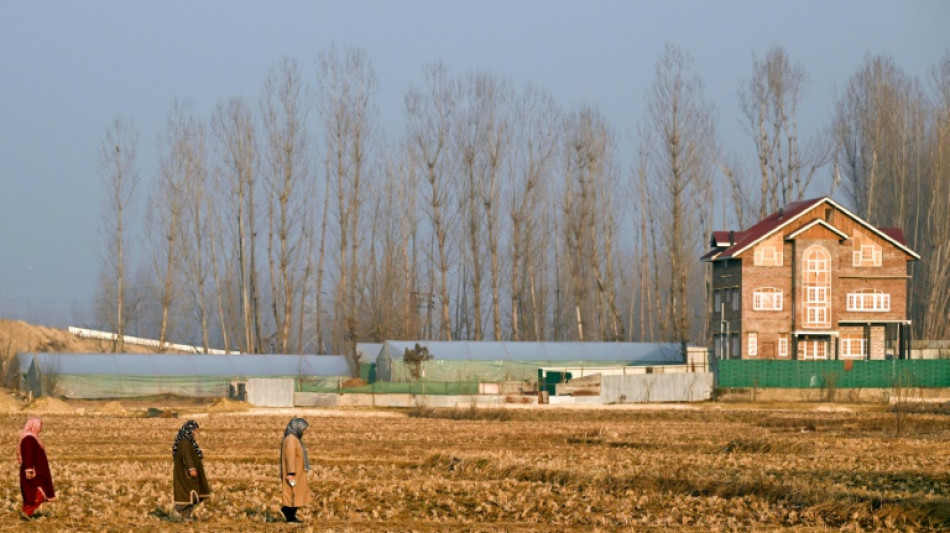
India's infrastructure push engulfs Kashmir farmers' land / Photo: © AFP

 Iceland in suspense after close EU vote

 Wallabies hold on for victory in Argentina

 Juve notch second straight win, Fiorentina's centenary party falls flat

 Rybakina eases injury fears ahead of US Open
 Djokovic kicks off latest Grand Slam quest under US Open lights

 'Sorry' De Zerbi won't panic after Spurs shambles

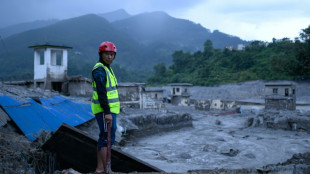
 UN, Nepal warn of climate threat after deadly floods
 USTA boss says structure of new player council not yet set

 Tiny Elversberg stun Leverkusen on Bundesliga debut, Dortmund beat Hamburg

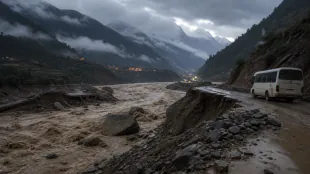 About 50 Karnataka travellers return from Nepal as 24 remain missing

 Editorial questions Letitia James’ record as New York attorney general
 Los Angeles triplets weigh 19.3 pounds in unusually heavy birth

 Matt Leinart assesses Arch Manning and the leading names in college football

 Rural Tamil Nadu students present 64 technology projects at IIT-M research park
 Tamil Nadu goalball team’s national silver highlights need for wider support
 Tamil Nadu and NUS agree to expand postgraduate and research links

 India and China have not named two new border meeting sites

 James Cleverly leaves shadow cabinet to seek London mayoralty

 Cyberabad civic body demolishes 19 unauthorised structures

 Chinchpoklicha Chintamani begins 2026 arrival procession in Parel

 Ankle ligament tear ends Neeraj Chopra’s 2026 season

 Thirty-seven Mumbai pilgrims return after Nepal flood disruption

 Baladi Map app turns Lebanon’s local problems into a public record

 French campaign sharpens as far right accuses left over civil disobedience calls
 Norway's King Haakon VIII pays tribute to late father in first speech

Farmers in Indian-administered Kashmir say a major government infrastructure drive is taking their deeply cherished land, fearing it spearheads a push to "Hinduise" the disputed Muslim-majority territory.
Musadiq Hussain said that police "destroyed" his rice crop when a large chunk of his smallholding was expropriated to make way for a four-lane, 60-kilometre (40-mile) highway around the key city of Srinagar.
"It has affected my sense of who I am and my self-respect," said 41-year-old Hussain, adding he can no longer can grow enough rice and vegetables to feed his family.
"I feel like my mind is shrinking, just like my land."
Hussain's land was taken in 2018 but the process has intensified in recent years.
The road, along with other highways and railways, is also swallowing swathes of orchards prized for their almonds, apples and other fruit in the Himalayan region, split between India and Pakistan since 1947.
Prime Minister Narendra Modi's Hindu-nationalist government, which imposed direct rule in 2019, says that the multi-billion-dollar drive is bringing a "new era of peace" and "unprecedented development".
New Delhi says it will boost trade and tourism, while also bolstering military access across the restive territory and to strategic border zones with Pakistan and China.
- 'Settler colonial land grab' -
Authorities say construction within 500 metres (yards) on either side of the highway around Srinagar is banned.
But last year, authorities unveiled plans to build more than 20 "satellite townships" along the route, with drawings showing highrise developments it called a "Pearl in the Paradise".
Kashmiri political parties are demanding to know who the housing is for, accusing Modi's government of wanting to change Kashmir's demographic makeup to create a Hindu majority -- something the authorities do not comment on.
Goldie Osuri, who studies Indian policies in Kashmir at Britain's University of Warwick, uses a phrase often associated with Israel's occupation of the West Bank to describe the situation: a "settler colonial land grab".
"Kashmiri farmers... are being dispossessed of their land and livelihoods in the name of Indian development as 'a gift' for Kashmir," Osuri told AFP.
She called the project a bid to "'Hinduise' Kashmir at the expense of Kashmiri Muslims".
After New Delhi ended Kashmir's constitutionally enshrined partial autonomy in 2019, land laws also changed.
That allowed all Indians to buy land in Kashmir for the first time.
Thousands of acres of "state lands" were added to registers to attract outside businesses.
"This is a land grab in plain sight," said Waheed Ur Rehman Para, a member of Kashmir's local assembly.
Many say that has undermined previous land reforms that granted ownership or farming rights to hundreds of thousands of people.
It worries Kashmiri leaders.
"We want this land to remain ours", Modi critic Omar Abdullah, Kashmir's chief minister, told a rally last month. "Without it, what do we truly possess?"
But Siddiq Wahid, a historian at India's Shiv Nadar University, said that the region's political parties showed "no intent to unite, only to pull each other down".
"In this lazy politics lies the chief worry for us all", he said.
- 'Where will we go?' -
More than half a million Indian soldiers are in Indian-administered Kashmir, battling rebels who want independence or to be part of Pakistan.
Tens of thousands of people have been killed in the conflict since 1989 in the territory of some 12 million people.
Police have also seized land and properties --- including orchards, commercial buildings and homes -- of people with alleged links to rebel groups.
Exact figures for the total area requisitioned are not public. Landowners say that the compensation offered is sometimes too low, and some are suing the government.
In December, government authorities ordered the transfer of more than 600 acres (240 hectares) of orchards for a new university campus for the National Institute of Technology.
It sparked furious protests from the hundreds of families who depend on the almond and apple trees.
Elsewhere, in the village of Dirhama, farmers are angry at their land being requisitioned for a new train station, serving a 40-kilometre railway to an important Hindu shrine.
Standing in a field as snow fell, apple farmer Mohammad Ramzan said there was no room for a railway line.
"Where is the space? We all have our small patches of land. Where will we go?" asked the 78-year-old.
The plan has struck a nerve in Kashmir, where land and identity are deeply intertwined.
"This self-sustenance has ensured Kashmiri survival despite decades of curfews, strikes and uprisings," said Osuri.
Mohammad Shafi, a 61-year-old farmer, asked: "What is this development for when my family will be landless?"
G.Frei--VB