New Zealand scientists dissect world's rarest whale / Photo: © AFP

 Shahidi hits ton but India bowl out Afghanistan for 218

 Israel strikes south Lebanon despite truce announced with Hezbollah

 Hurricanes blow away Chiefs in record-breaking Super Rugby final

 Ancient Greek theatre revives legendary Callas opera Medea
 Portugal's unofficial exorcism fever worries Church

 Ancelotti hails 'complete game' as Brazil sink Haiti at World Cup

 Scotland remain bullish despite Morocco World Cup setback

 Brazil cruise past Haiti to re-ignite World Cup campaign
 Scheffler career Slam chances blowing in Shinnecock winds

 McIlroy seven back but likes his chances at US Open

 Clark leads US Open by four with major champs in the hunt

 Archaeologists discover 'never before seen' pre-Hispanic ruins in Mexico

 James Burrows, prolific innovator in US TV comedies, dead at 85

 World Cup warning with Sweden star Isak 'getting stronger and stronger'

 Tunisia coach says 'I am no wizard' after World Cup SOS call

 USA beat Australia 2-0 to reach World Cup knockouts

 Qatar-gifted Air Force One replacement unveiled

 Niemann fires 65 at US Open after upsetting two-shot penalty

 Spain's Yamal says 'too soon' to play full match at World Cup
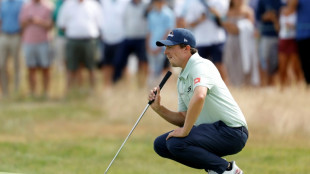
 Neymar? He is working remotely at the World Cup, jokes Lula

 Three-time Stanley Cup champion Toews retires

 Japan wary of fired up and wounded Tunisia for World Cup landmark game

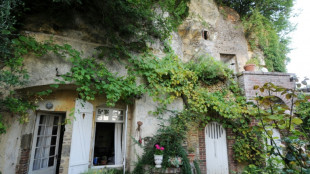 'Like a fridge': France cave homes offer lucky few respite from heat

 Hormuz ship traffic climbs after war deal: trackers

 Kane hails World Cup 'Wonderwall' singalong as England highlight

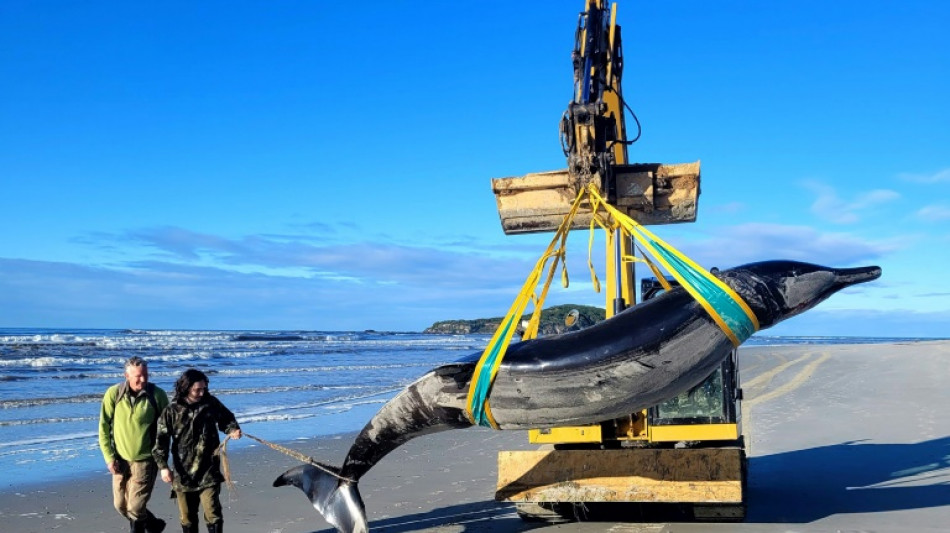
New Zealand scientists on Monday began dissecting a whale considered the rarest in the world, a species so elusive that only seven specimens have ever been documented.
The dead spade-toothed whale washed ashore on New Zealand's South Island earlier this year, offering a chance to study a deep-sea mammal that has never been seen alive.
Measuring five metres (16.4 feet) long, the whale was winched off the beach in July and has sat in a special freezer since.
Whale expert Anton van Helden said it was the first time scientists had been able to dissect a complete spade-toothed specimen, which belongs to the family of beaked whales.
"This is a remarkable and globally significant opportunity," he said.
The week-long dissection will help to fill in gaps about the whale's behaviour, its diet, and even its basic anatomy.
"Beaked whales are the most enigmatic group of large mammals on the planet," said Van Helden.
"They are deep divers that are rarely seen at sea, which presents real challenges for researching these marine animals.
"This one is the rarest of the rare -- only the seventh specimen known from anywhere in the world, and the first opportunity we have had to undertake a dissection like this."
New Zealand's conservation department said the spade-toothed whale was the "rarest whale in the world".
The species was first described in 1874 from just a lower jaw and two teeth collected from the Chatham Islands off the east coast of New Zealand.
That sample, along with skeletal remains of two other specimens found in New Zealand and Chile, enabled scientists to confirm a new species.
Because so few specimens have been found and there have been no live sightings, the spade-toothed whale is classified as "data deficient" under the New Zealand Threat Classification System.
N.Schaad--VB