Divided plastic pollution negotiators call for more time / Photo: © AFP/File

 Shahidi hits ton but India bowl out Afghanistan for 218

 Israel strikes south Lebanon despite truce announced with Hezbollah

 Hurricanes blow away Chiefs in record-breaking Super Rugby final

 Ancient Greek theatre revives legendary Callas opera Medea

 Portugal's unofficial exorcism fever worries Church

 Ancelotti hails 'complete game' as Brazil sink Haiti at World Cup

 Scotland remain bullish despite Morocco World Cup setback

 Brazil cruise past Haiti to re-ignite World Cup campaign
 Scheffler career Slam chances blowing in Shinnecock winds

 McIlroy seven back but likes his chances at US Open

 Clark leads US Open by four with major champs in the hunt

 Archaeologists discover 'never before seen' pre-Hispanic ruins in Mexico

 James Burrows, prolific innovator in US TV comedies, dead at 85

 World Cup warning with Sweden star Isak 'getting stronger and stronger'

 Tunisia coach says 'I am no wizard' after World Cup SOS call

 USA beat Australia 2-0 to reach World Cup knockouts

 Qatar-gifted Air Force One replacement unveiled
 Niemann fires 65 at US Open after upsetting two-shot penalty

 Spain's Yamal says 'too soon' to play full match at World Cup

 Neymar? He is working remotely at the World Cup, jokes Lula

 Three-time Stanley Cup champion Toews retires

 Japan wary of fired up and wounded Tunisia for World Cup landmark game

 'Like a fridge': France cave homes offer lucky few respite from heat

 Hormuz ship traffic climbs after war deal: trackers

 Kane hails World Cup 'Wonderwall' singalong as England highlight
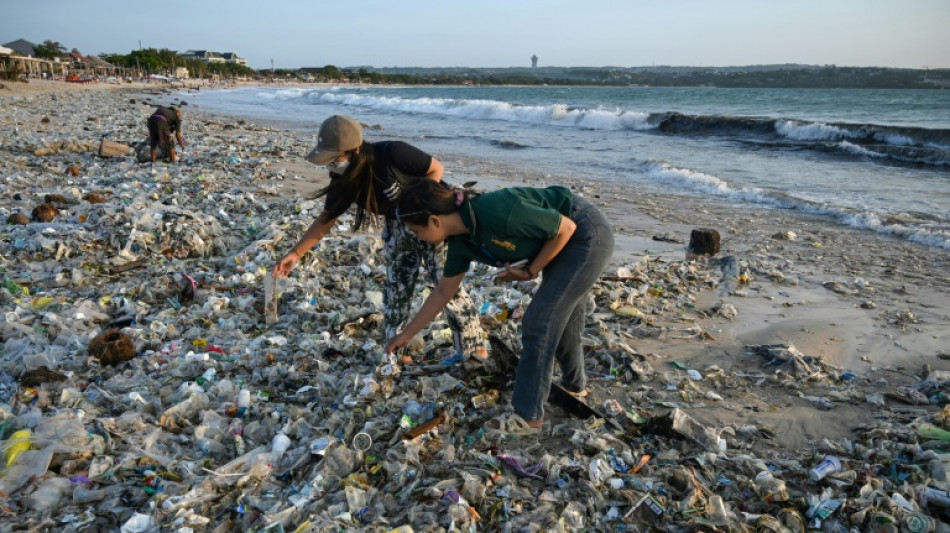
Negotiators have failed to reach agreement on a landmark treaty to curb plastic pollution and need more time to continue discussions, the diplomat chairing the talks said Sunday.
Nearly 200 nations are in South Korea's Busan for negotiations that are supposed to result in the world's first accord on the issue after two years of discussions.
But a week of talks has failed to resolve deep divisions between "high-ambition" countries seeking a globally binding agreement to limit production and phase out harmful chemicals, and "like-minded", mostly oil-producing nations who want to focus on waste.
Plastic production is on track to triple by 2060, and more than 90 percent of plastic is not recycled.
A draft text released Sunday afternoon after multiple delays included a wide range of options, making clear the ongoing level of disagreement.
When an open plenary session finally convened late Sunday night, chair Luis Vayas Valdivieso said progress had been made.
But he said "we must also recognise that a few critical issues still prevent us from reaching a comprehensive agreement."
"These unresolved issues remain challenging and additional time will be needed to address them effectively," he said.
"There is a general agreement to resume the current session at a later date to conclude our negotiations."
Several nations took to the floor to support the call for more time -- but their agreement ended there.
Rwandan delegate Juliet Kabera spoke of "strong concerns about ongoing calls by a small group of countries to remove binding provisions from the text that are indispensable for the treaty to be effective."
She delivered a statement on behalf of dozens of countries, demanding a treaty that would require targets to reduce production and phase out chemicals of concern.
"A treaty that lacks these elements and only relies on voluntary measures would not be acceptable," she said, inviting supporting delegations to stand up to extensive applause from the plenary room.
- 'Huge gap' -
Iran however warned it remained unhappy with proposals on those issues and others, warning of the "huge gap" between parties.
"We need to be assured that when (we) come together again, we will be allowed to add, introduce our own new languages, and to put into brackets any part or paragraph," its delegate said.
That raised the prospect that any new talks could follow the pattern seen in Busan, where repeated attempts by the chair to synthesise and streamline text encountered resistance.
Earlier, delegations seeking an ambitious treaty warned that a handful of countries were steadfastly blocking progress.
A French minister accused the like-minded group of "continuing obstruction," while Fiji's Sivendra Michael called out a "very minority group" for "blocking the process."
While countries have declined to directly name those preventing a deal, public statements and submissions have shown Saudi Arabia, Iran and Russia have sought to block production cuts and other ambitious goals.
None of the delegations have responded to repeated AFP requests for comment.
Portuguese delegate Maria Joao Teixeira said earlier Sunday that another round of talks might be the best option for a meaningful deal.
"We are really trying to not have a weak treaty," she told AFP.
But environmental groups had pushed ambitious countries to call a vote if progress stalls, and said another round of negotiations was unnecessary.
"We know what we need to do to end plastic pollution... simply adding more meetings is not the solution," said Eirik Lindebjerg, global plastics policy lead at WWF.
While dozens of countries support production limits and phasing out some chemicals and unnecessary plastic products, left unclear is the position of the world's top two plastics producers, China and the United States.
Both were notably absent from the stage at a Sunday press conference by countries urging a strong treaty and were not on the list of countries supporting Rwanda's statement.
D.Bachmann--VB