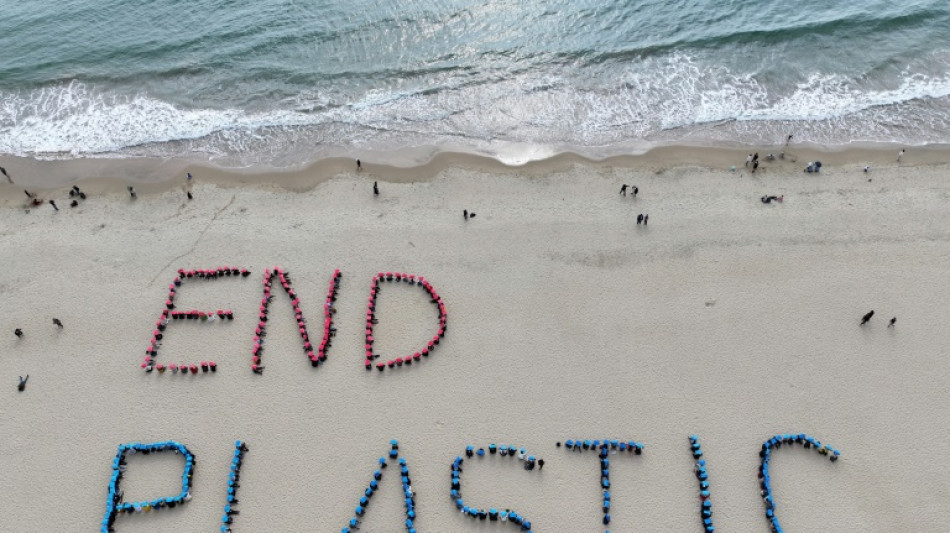
Plastic pollution talks must speed up, chair warns / Photo: © YONHAP/AFP

 Bagnaia scorches to Czech MotoGP sprint victory, Bezzecchi crashes
 Trump escalates spat with Italy’s Meloni over G7 photo claim

 Driver killed, 28 in hospital as UK train collision probed

 New Zealand pile on the runs to leave England facing record chase in 2nd Test

 Court bans Spanish PM's wife from leaving country
 Japan's Ogura smashes own track record to take Czech MotoGP pole

 Germany meet Ivory Coast in high-stakes World Cup clash, Sweden face Dutch

 Indian guru urges broader view of yoga

 Paraguay's Almiron sent off under new FIFA 'mouth-covering' rule
 Tunisia ask how Sweden World Cup star Ayari slipped its net

 USA down Australia to reach World Cup knockout rounds, Brazil swat Haiti

 Australia detects first case of contagious H5 bird flu

 Iran's treatment at World Cup 'a dark point' for football: official
 Nagelsmann eyes same German lineup against I. Coast after Curacao trouncing

 Saibari early strike gives Morocco World Cup win over Scotland

 Pochettino backs 'high IQ' players to block out World Cup hype
 Douglass breaks 50m free world record at Indy Pro Swim

 'Like China': Cubans welcome reforms but exiles remain skeptical

 USA down Australia to reach World Cup knockout rounds

 Imperious Dupont guides record-breaking Toulouse to Top 14 final
 Venezuelan opposition figure heads to US after transition talks
 Canada star Kone to miss rest of World Cup after surgery: team

 Confident Fitzpatrick makes a run at another US Open title

 England captain Stokes strikes for Durham as Test recall looms

 Clark wants to win back fans as well as US Open title

Negotiators must move "significantly" faster to agree on a landmark treaty to curb plastic pollution, the diplomat chairing the talks warned Wednesday, as countries lined up to express frustration about the limited progress.
Nearly 200 countries are gathered in South Korea's Busan city with the goal of agreeing a deal by the end of the week.
The process caps two years of talks over four previous rounds of negotiations that have been stalled by deep divisions about what the treaty should look like.
Addressing negotiators on the third day of talks, Luis Vayas Valdivieso warned work was not advancing quickly enough.
"I must be honest with you, progress has been too slow. We need to speed up our work significantly," the Ecuadorian diplomat said.
"We must accelerate our efforts to reach consensus on the binding instrument by December first."
His call was followed by a string of frustrated speeches from countries including Fiji, Panama, Norway and Colombia.
"While we here sit debating over semantics and procedures, the crisis worsens," warned Juan Carlos Monterrey Gomez, Panama's special representative for climate change.
"We are here because microplastics have been found in the placentas of healthy women... We are literally raising a generation that starts its life polluted, before taking its first breath."
He accused negotiators of "tiptoeing around the truth, sidestepping ambition and ignoring the urgency that demands action" in remarks that received loud applause.
- 'We are sincere' -
Other representatives accused some participants of failing to engage in good faith and actively seeking to drag out the talks.
They did not openly point the finger at any countries, but diplomats speaking on condition of anonymity have repeatedly said Russia, Saudi Arabia and Iran are consistently holding up proceedings and showing little willingness to compromise.
All three countries took the floor to hit back.
"We are sincere, we are honest and we are ready to cooperate," said Iran's Massoud Rezvanian Rahaghi.
"But we do not want to be blamed for blocking negotiations through dirty tactics."
Russian representative Dmitry Kornilov meanwhile blasted the "unacceptable" accusations and warned delegates to abandon the most contentious parts of the draft discussions.
"If we are serious about this then we must concentrate on provisions that are acceptable to all delegations," he said.
In 2019, the world produced around 460 million tonnes of plastic, a figure that has doubled since 2000, according to the Organisation for Economic Co-operation and Development.
Plastic production is expected to triple by 2060.
But just nine percent of plastic is recycled globally.
- 'Bold moves' -
The main faultline in talks lies over whether the treaty should address the full lifecycle of plastic, including potential limits to its production, chemical precursors, and certain products considered unneccessary, including many single-use items.
The UN decision that kicked off the negotiating process explicitly refers both to the full lifecycle of plastic and sustainable consumption, but countries including Russia, Saudi Arabia and Iran have consistently rejected calls to limit supply.
Saudi Arabia has warned supply restrictions "extend beyond" the treaty's focus on plastic pollution and risk creating "economic disruptions."
Iran meanwhile has called for an article on supply to be removed entirely from the treaty text.
There are other sticking points, including financial support for developing countries to implement any treaty, and how a decision to adopt a deal should be made.
The UN standard is consensus, but there are fears that a unanimous deal may be out of reach.
A European diplomat, speaking on condition of anonymity, said the divisions were such that an agreement would only be possible if "bold moves" were taken in the final stretch to "unblock" things.
The question, he said, was "whether those moves, at that stage, will arrive too late."
"Four days to get to all that seems to me to be too little," he warned.
C.Stoecklin--VB