'Very, very slow': plastic treaty talks grind forward / Photo: © YONHAP/AFP

 Bagnaia scorches to Czech MotoGP sprint victory, Bezzecchi crashes
 Trump escalates spat with Italy’s Meloni over G7 photo claim

 Driver killed, 28 in hospital as UK train collision probed

 New Zealand pile on the runs to leave England facing record chase in 2nd Test

 Court bans Spanish PM's wife from leaving country
 Japan's Ogura smashes own track record to take Czech MotoGP pole

 Germany meet Ivory Coast in high-stakes World Cup clash, Sweden face Dutch

 Indian guru urges broader view of yoga

 Paraguay's Almiron sent off under new FIFA 'mouth-covering' rule
 Tunisia ask how Sweden World Cup star Ayari slipped its net

 USA down Australia to reach World Cup knockout rounds, Brazil swat Haiti

 Australia detects first case of contagious H5 bird flu

 Iran's treatment at World Cup 'a dark point' for football: official

 Nagelsmann eyes same German lineup against I. Coast after Curacao trouncing

 Saibari early strike gives Morocco World Cup win over Scotland

 Pochettino backs 'high IQ' players to block out World Cup hype
 Douglass breaks 50m free world record at Indy Pro Swim

 'Like China': Cubans welcome reforms but exiles remain skeptical

 USA down Australia to reach World Cup knockout rounds

 Imperious Dupont guides record-breaking Toulouse to Top 14 final
 Venezuelan opposition figure heads to US after transition talks

 Canada star Kone to miss rest of World Cup after surgery: team

 Confident Fitzpatrick makes a run at another US Open title

 England captain Stokes strikes for Durham as Test recall looms

 Clark wants to win back fans as well as US Open title

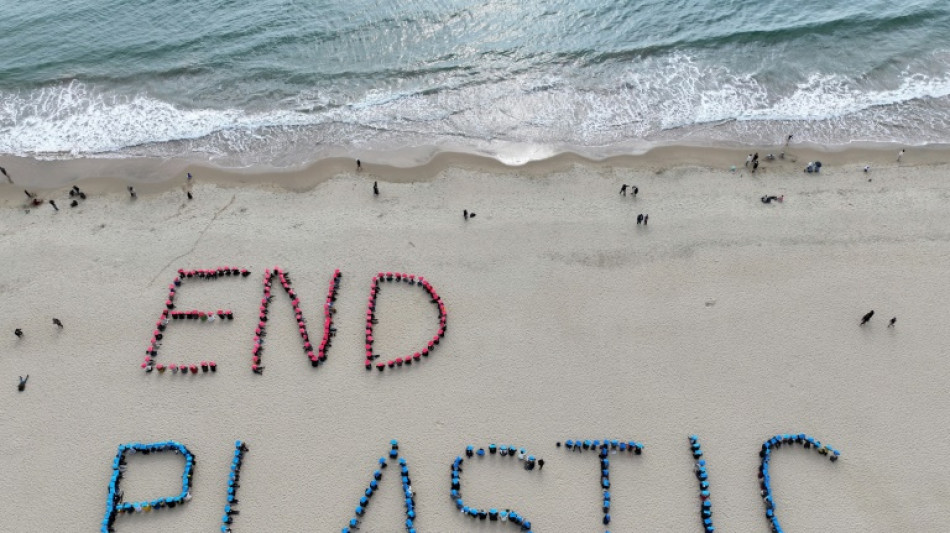
Negotiations on a first global treaty to curb plastic pollution are moving "very, very slowly", diplomats and observers told AFP on Wednesday, threatening the chances of reaching an agreement.
Delegates from nearly 200 countries are meeting in South Korea's Busan with the goal of reaching a deal by December 1, after two years of talks.
But the first full day of work in four "contact groups" tasked with refining language for the treaty ended up with discussions "going around in circles," said Eirik Lindebjerg, global plastics policy manager at WWF.
"Contact group discussions are moving too slow," he told AFP.
That view was echoed by several diplomats, who spoke on condition of anonymity to describe closed-door negotiations.
"It's very, very slow, with the usual countries constantly slowing down the process," said one delegate from a Latin American delegation.
Submissions to the contact groups made clear that Saudi Arabia, Iran and Russia -- suppliers of raw materials used to make plastics -- were among the countries seeking significant amendments, including deleting a portion of the treaty aimed at limiting new production.
In a submission, Saudi Arabia warned supply restrictions "extend beyond" the treaty's focus on plastic pollution and risked creating "economic disruptions."
Others involved in the talks warned of growing frustration.
"There is a difference between protecting one's interests and willfully impeding progress in the talks," a delegate from a small island state said.
A European diplomat meanwhile warned that the tenor of discussions so far suggested it would be "very, very tough at the end" of the talks.
"I think that we will come to a very difficult situation in two days' time at the latest," added another delegate.
Still there were some bright spots, said Lindebjerg, including on proposals to potentially limit "problematic" products and chemicals.
"This can take us far in eradicating harmful and unnecessary plastic items that have been poisoning humanity and nature," he said.
"Now, the progressive majority of countries represented here... must act in unison and not compromise," he added.
While UN agreements are generally reached by consensus, he warned that a binding treaty "supported by the majority of governments will be far more effective than a weak and voluntary-based treaty supported by all governments."
That view was echoed by a second European diplomat.
"The key to success is to create an agreement that has the support of the vast majority," he told AFP.
That "will force the small group (of opposing countries) to try to destroy it or to be a noisy and unsatisfied minority for a treaty that they will eventually sign."
P.Vogel--VB