Negotiators seek to break COP29 impasse after G20 'marching orders' / Photo: © AFP/File

 Equitas Small Finance Bank rebounds after naming interim chief executive

 Titan quarterly profit seen rising as jewellery business drives growth
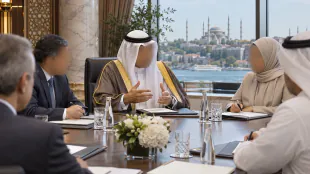 Kuwait finance minister holds economic cooperation talks at COMCEC

 82-Year-Old American Transforms 2003 Mercedes Sprinter into Permanent Home
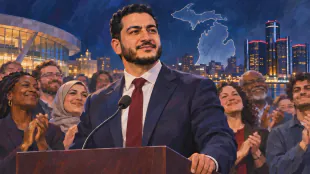
 Abdul El-Sayed declares victory in Michigan Senate contest

 Democrats capture US Congress in sweeping midterm victory
 Manchester United rallies past Roma as PSG dominates in Champions League
 Qatar prime minister advances mediation through diplomatic calls

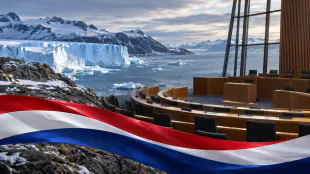 Greenland parliament approves security agreement with United States

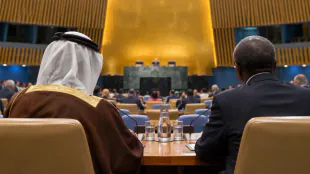 Qatar envoy meets incoming UN General Assembly president
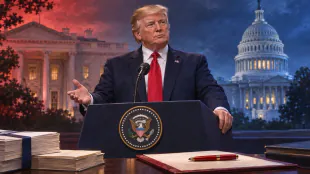 Trump Signals Willingness to Work With Democrats After Midterm Defeat

 Pitches and Keynote Speakers Are Confirmed for Blue Magic Netherlands on November 17
Negotiators sought Tuesday to break a deadlock at UN climate talks after G20 leaders backed the need for "trillions" of dollars for poorer countries but left key sticking points unresolved.
Ministers at the COP29 conference in Azerbaijan had been eagerly waiting for the G20 meeting in Rio de Janeiro to issue a declaration that might jump-start the stalled negotiations.
While the lack of a phrase calling for "transitioning away from fossil fuels" disappointed activists, the statement on climate finance was cautiously welcomed at the sports stadium hosting the talks.
"G20 delegations now have their marching orders for here in Baku," UN climate chief Simon Stiell said in a statement.
"We urgently need all nations to bypass the posturing and move swiftly towards common ground, across all issues," he said.
Rich nations are being urged to significantly raise their pledge of $100 billion a year in financing for poorer countries to take action against climate change.
But efforts to finalise the deal in Baku are hampered by disputes over how much the deal should entail, who should pay it, and what types of financing should be included.
The chair of the G77+China, a grouping of developing nations, told AFP that the Rio statement was a "good building block" for the climate talks as G20 leaders acknowledged that the needs were in the "trillions" of dollars.
But Adonia Ayebare, the group's Ugandan chairman, said the G77 was "not comfortable" with vague wording saying the money should come from "all sources".
"We have been insisting that this has to be from public sources. Grants, not loans," Ayebare said.
The G20 statement states the need to increase international collaboration "with a view to scaling up public and private climate finance and investment for developing countries".
"We needed to see a strong signal from the G20, and we got that on finance," said Mohamed Adow, a Kenyan climate activist and founder of the Power Shift Africa group.
- Money in 'the wrong place' -
Others were less enthusiastic.
"We were waiting for a boost. Our expectations were maybe too high," a European negotiator told AFP.
Some developing countries, which are the least responsible for global greenhouse gas emissions, want an annual commitment of $1.3 trillion to help them adapt to climate change and transition to clean energy.
"The reality of the situation is that 1.3 trillion pales in the face of the seven trillion that is spent annually on fossil fuel subsidies," Fiji's deputy prime minister, Biman Prasad, told COP29 delegates.
"The money is there. It is just in exactly the wrong place," he said.
Developed nations, facing their own debt problems and budget deficits, say the private sector must play a key role in climate finance.
The United States and European Union are also pushing for the donor base to be expanded to include countries such as China, which has become the world's second-biggest economy but is still officially listed as a developing nation.
- 'Stark failure' -
Negotiators say the talks have also been held up by Saudi Arabia's resistance to any reference to last year's pledge at COP28 in the United Arab Emirates for the world to move away from fossil fuels.
"Let me state once again that we as a global community cannot afford to backslide," EU climate envoy Wopke Hoekstra said in a speech, without naming any country.
"We all must build on what we call the UAE consensus. There is simply no success without it," he said.
Harjeet Singh, an activist from India, said the G20 "displayed a stark failure in leadership" by "neglecting to reaffirm their commitment to transitioning away from fossil fuel".
"Their rehashed rhetoric offers no solace for the fraught COP29 negotiations, where we continue to see a deadlock on climate finance," he said.
D.Schaer--VB