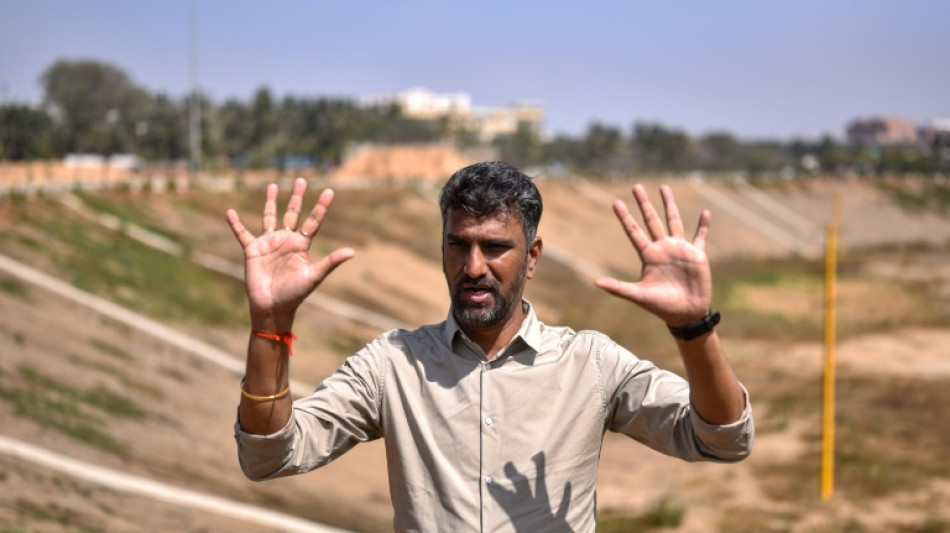
India's 'lake man' cleans up critical water supplies / Photo: © AFP

 Arsenal thrashed by Brighton, sorry Spurs lose again

 South Korea, Austria qualify for Davis Cup finals

 Seare shocks Ingebrigtsen to win world 5km gold

 Brigitte Bardot widower slams sale of star's belongings

 Aston Villa compound Tottenham's misery despite late rally

 Asian Games offer 'deepest apologies' for South Korea anthem blunder

 Inter Milan and Italy icon Mazzola dies aged 83

 Saudi capital issues first air raid alert since renewed fighting in Yemen

 Martin edges title rival Marquez for Austrian MotoGP pole

 Indonesia accepts Malaysia's help to tackle wildfires

 Indians living in Japan on stand-by to house Asian Games athletes
 Trump signs bill authorizing sweeping Russia sanctions

 Protesters form human chain at Kennedy Center after Trump threat

 Death toll from attack at police HQ in Pakistan rises to 31

 Trump says Denmark to give US 'permanent control' over Greenland security

 Kennedy Center: future unclear for iconic Washington arts hub

 Trump claims 'infinite' Greenland security deal with Denmark

 Helicopters battle wildfire threatening Ecuador's capital

 Brentford batter Chelsea to undo Alonso's promising start

 Kane hits Bundesliga century as Bayern rout Union

 Trump says CNN, MS NOW, Politico banned from White House

 Hushing and hedging: US companies retreat on climate

 Springboks to face Fiji before 2027 Rugby World Cup

 Nigeria miners struggled to breathe in cell before 37 died: survivors

 McIlroy on the charge at PGA Championship as Reed withdraws

Ancient lake systems once provided Bengaluru with critical water supplies, but the Indian tech hub's breakneck expansion left many waterways covered over or used as dumps.
In the rush to modernise, the city once known for its abundance of water largely forgot the centuries-old reservoirs it depended upon to survive, with the number of lakes shrinking by more than three-quarters.
But after experts warned the city of nearly 12 million -- today dubbed "India's Silicon Valley" -- would not be able to meet its water needs with existing resources, mechanical engineer Anand Malligavad decided to take action.
"Lakes are lungs of the earth," said the 43-year-old, known to some as the "lake man" for his campaign to bring scores of them back to life.
"I tell people if you have money, better to spend it on lakes. Decades later, it will serve you."
Water shortages are a chronic problem in India, which has nearly a fifth of the world's population but only four percent of its water resources, according to government think tank NITI Aayog.
Malligavad's first target was a trash-filled and dried-out site he passed on his way to work at an automotive components maker.
"I thought instead of inspiring people... let me start doing it," Malligavad said. "Let it start with me."
- 'Simple cost' -
He began by studying the skills used during the centuries-long rule of the medieval Chola dynasty, who turned low-lying areas into shallow reservoirs that provided water for drinking and irrigation.
The lakes stored the heavy monsoon rains and helped to replenish groundwater.
But of the 1,850 that once dotted the city, fewer than 450 remain today.
Many were destroyed to make room for high-rise towers, while canals were filled in with concrete -- meaning heavy rainfall now sparks flooding and is not stored for the future.
Nearly half of Bengaluru depends on water sucked from intensive groundwater boreholes that often run dry in the summer heat, according to the city's Water, Environment, Land and Livelihoods (WELL) Labs research centre.
Many residents already rely on expensive water trucked in from afar, and the problem is likely to get worse as climate change pushes global temperatures higher and alters weather patterns.
"We're dependent on a precarious groundwater table, and that is going to get even more precarious as you have a more unreliable rainfall," said WELL Labs chief Veena Srinivasan.
"We already don't have enough water to drink," she added, noting that "the water sources that we do have, we are polluting".
Fixing lakes can ease the problem, though the city still needs a large-scale urban water management plan, she said.
Malligavad, trekking out to visit more than 180 ancient lakes, said he saw the "simple cost" they had taken to construct.
They did not use expensive materials but only "soil, water, botanicals (plants) and canals", he said.
He persuaded his company to stump up around $120,000 to fund his first project, the restoration of the 14-hectare (36-acre) Kyalasanahalli lake.
Using excavators, Malligavad and his workers took around 45 days to clear the site back in 2017.
When the monsoon rains came months later, he went boating in the cool and clean waters.
- Natural process -
The restoration process is simple, Malligavad said.
He first drains the remaining lake water and removes the silt and weeds.
Then he strengthens the dams, restores the surrounding canals and creates lagoons, before replanting the site with native trees and aquatic plants.
After that, he says: "Don't put anything into it. Naturally, rain will come and naturally, an ecosystem will be built."
His initial success eventually led him to work full-time in cleaning lakes, raising cash from company corporate social responsibility funds.
So far, he has restored more than 80 lakes covering over 360 hectares in total, and expanded into nine other Indian states.
The renewed reservoirs help supply water to hundreds of thousands of people, according to Malligavad.
Bengaluru resident Mohammed Masood, 34, often fills giant drums of water from one such lake.
He said he typically uses a water tanker, but supplies can be uncertain and expensive.
"If the lake was not built, the hardship would not go away," Masood said. "We would have to go further away for water."
Malligavad said his work has carried some risk -- he has been threatened by land grabbers and real estate moguls, and was beaten by a gang wanting him to stop.
But the sight of people enjoying a restored lake gave him his "biggest happiness", he told AFP.
"Kids are swimming and enjoying it", he said, beside a restored lake.
"More than this, what do you want?"
L.Stucki--VB