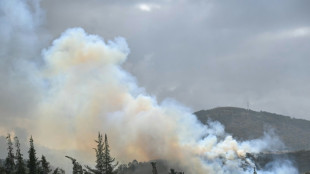
Scientists warn missing Russian data causing Arctic climate blind spots / Photo: © AFP/File

 Arsenal thrashed by Brighton, sorry Spurs lose again

 South Korea, Austria qualify for Davis Cup finals

 Seare shocks Ingebrigtsen to win world 5km gold

 Brigitte Bardot widower slams sale of star's belongings

 Aston Villa compound Tottenham's misery despite late rally

 Asian Games offer 'deepest apologies' for South Korea anthem blunder
 Inter Milan and Italy icon Mazzola dies aged 83

 Saudi capital issues first air raid alert since renewed fighting in Yemen

 Martin edges title rival Marquez for Austrian MotoGP pole

 Indonesia accepts Malaysia's help to tackle wildfires

 Indians living in Japan on stand-by to house Asian Games athletes
 Trump signs bill authorizing sweeping Russia sanctions

 Protesters form human chain at Kennedy Center after Trump threat
 Death toll from attack at police HQ in Pakistan rises to 31

 Trump says Denmark to give US 'permanent control' over Greenland security

 Kennedy Center: future unclear for iconic Washington arts hub

 Trump claims 'infinite' Greenland security deal with Denmark

 Helicopters battle wildfire threatening Ecuador's capital

 Brentford batter Chelsea to undo Alonso's promising start

 Kane hits Bundesliga century as Bayern rout Union
 Trump says CNN, MS NOW, Politico banned from White House
 Hushing and hedging: US companies retreat on climate

 Springboks to face Fiji before 2027 Rugby World Cup
 Nigeria miners struggled to breathe in cell before 37 died: survivors

 McIlroy on the charge at PGA Championship as Reed withdraws

Loss of scientific data from Russia's Arctic monitoring stations following the invasion of Ukraine has worsened information gaps that could have serious implications for tracking and predicting climate change globally, researchers warned Monday.
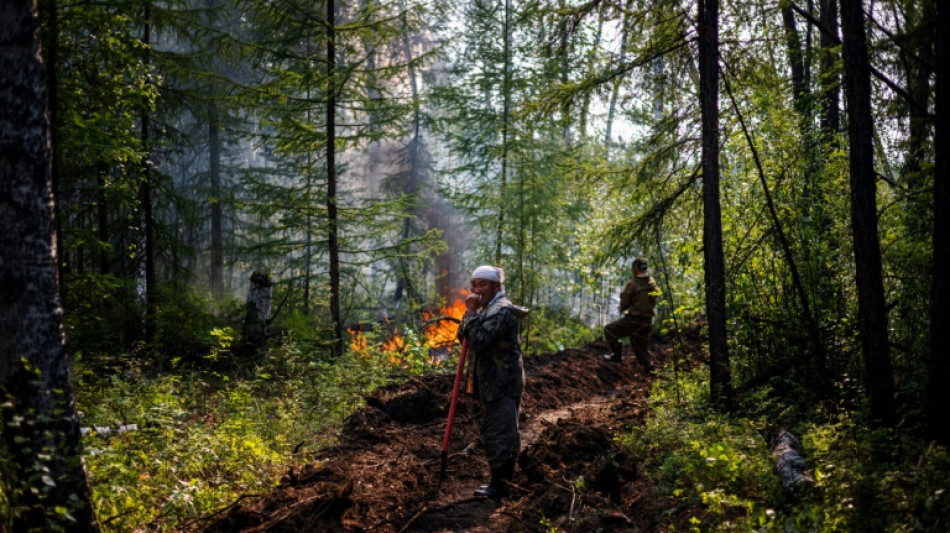
The Arctic is warming between two and four times faster than the rest of the planet and holds glaciers, forests and carbon-rich frozen soils at risk of irreversible change that could reverberate across the planet.
Monitoring relies heavily on data from stations spread across the vast and diverse region, but Moscow's assault on Ukraine in February 2022 triggered a freeze in scientific cooperation in the Arctic -- and elsewhere.
Russia represents almost half the landmass of the entire Arctic region, creating a massive information gap, said lead author Efren Lopez-Blanco, of Aarhus University, who led the study published in Nature Climate Change.
Researchers sought to quantify just how much of an impact this has had on scientific understanding of the changes taking place in the Arctic.
"One of the immediate issues that arises if we neglect the Russian boreal forest is that we have an underestimation of biomass, soil organic carbon," Lopez-Blanco told AFP.
"This has potentially global consequences for important processes such as permafrost thawing, shifts in biodiversity, or even greenhouse gas emissions."
- Sharing problems -
The researchers focused on around 60 research stations making up part of a large territorial network called INTERACT.
Using computer models, they looked at eight factors -- including air temperature, rainfall, snow depth, vegetation biomass and soil carbon -- and found that even before the conflict in Ukraine the network had gaps, with stations concentrated in warmer, wetter areas, leaving other areas under-represented.
Without Russia, which accounts for 17 of the 60 stations, this bias increased, with the loss of areas such as Siberia's huge taiga forest.
The research highlights the logistical challenges of monitoring such a vast and often inhospitable region, as well as inherent problems with voluntary data sharing.
As a result, projects have been delayed or cancelled, while the regional Arctic Council forum -- long held up as a model of cooperation -- is now divided between the West (Canada, Denmark, Finland, Iceland, Norway, Sweden and the United States) and Russia.
Dmitry Streletskiy, a researcher at George Washington University, who was not involved in the paper and whose work on permafrost uses another monitoring group, CALM, said of nearly 80 Russian sites registered in their network, around 55 normally share data every year.
But so far, only 37 have provided 2023 data, he said, although some may send information later.
One solution, he said, would be to treat key climate metrics the same way weather data is, and have a United Nations system to ensure continuous monitoring.
Streletskiy said data is being collected but not shared, potentially leading to gaps in global understanding.
"It's like these big communal apartments. You have a lot of rooms, and some neighbours are nice, some are not," he said.
"But if you aren't aware that your neighbour has a room with a leaking roof, you will only find out when the entire house is flooded. That's pretty much what's happening."
C.Koch--VB