Seeking an 'angel': African startups face funding challenge / Photo: © AFP

 Trump's beef policies irk Texas ranchers, testing their loyalty

 Nvidia, OpenAI CEOs to attend Xi dinner at White House
 Anthropic picks Accenture for in-house AI safety evaluation

 Balogun returns as Monaco beat Lens to continue strong Ligue 1 start

 'Pause' on overt repression in Venezuela, but reforms still needed: HRW

 Global stocks mixed as yen falls despite Bank of Japan rate hike
 Cuba hit with seventh major blackout of the year

 Murray out with concussion so Wentz will start for Vikings

 UN chief 'deeply regrets' US visa refusal to Abbas for annual meeting

 England quick Carse to face no charges over alleged nightclub assault

 Mancini brings nine newcomers into the first squad of his Italy comeback

 Czechs level Davis Cup tie against USA as South Korea eye Finals

 New France boss Zidane confirms Mbappe as captain after naming first squad

 California governor signs order to explore AI 'kill switch'
 Head leads run spree as Australia win Zimbabwe ODI series
 In-form Raphinha wants to finish career at Barcelona
 Warren Buffett steps down as Berkshire Hathaway chairman

 Carrick confident Man Utd can 'work through' tough time

 Mbappe ends Nike partnership to join Swiss brand On

 Liverpool boss Iraola puts Bournemouth love affair on hold
 'A disaster' if Man City do not win says Maresca after flawless start
 Kerry James Marshall: American 'blackness' painter celebrated in Europe

 Spain coach De la Fuente offers 'full support' to people of Ceuta

 Russia seizes assets of Nestle, French firms over West's Ukraine support
 England can build on World Cup 'spirit', says Tuchel

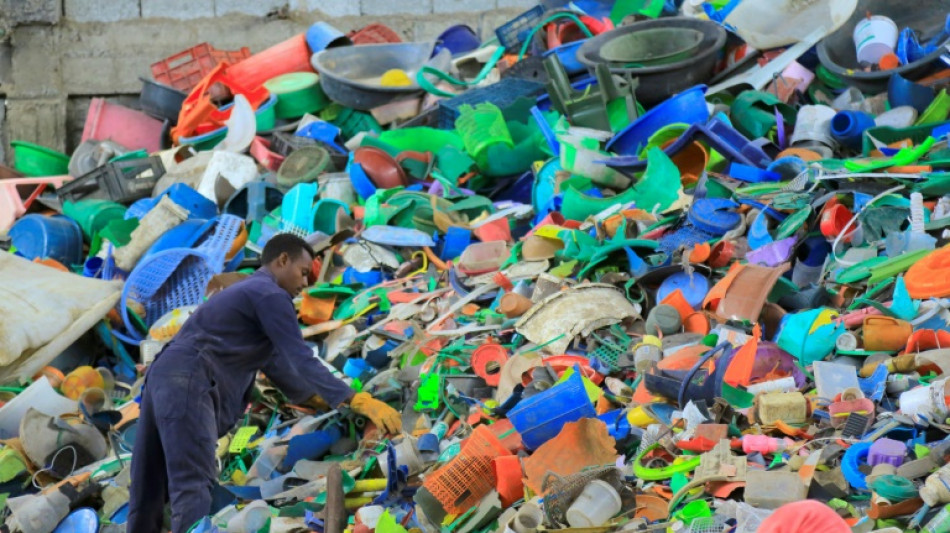
Kubik is proud of its pioneering, climate-friendly technology that recycles one of the world's environmental curses -- plastic waste -- into construction blocks.
But for the award-winning Ethiopian startup to achieve liftoff has been no easy task. It has had to fight tooth and nail to raise funds, says its youthful boss.
Kubik takes in bundles of discarded plastic and sorts them into piles. Selected plastics are mixed, melted and combined with additives, and then moulded into the desired shape.
The result: black beams and interlocking blocks which today are being assembled in a pilot project -- the building of a daycare centre in the capital Addis Ababa.
The site has no cranes or cement mixer, just a concrete floor on which four workers make a wall by fitting the blocks together like Lego, tapping them with a mallet to ensure a good fit.
There's no glue or cement.
The beams, bolted together on all four sides of the walls, hold the structure up.
"The idea’s for it to be super simple," said overseer Hayat Hassen Bedane, a 34-year-old structural engineer.
"You have a manual, and the whole point is to get it done with inexperienced workers, obviously under supervision.
"You can... build 50 square metres (540 square feet) of a building in just five days, so that's super fast compared to other forms of construction," she said.
"We’ve done tests, tension-stress tests and compressive tests, so it’s durable and very strong."
Speed and the smart use of unwanted plastic aren't the only benefits.
The recycling generates just a fifth of the carbon from cement making. If Kubik's plant processes 45 tonnes of ditched plastic each day, that's 100,000 tonnes of carbon dioxide (CO2) averted each year, the company says.
There's a trickledown socially, too, boosting the country's many informal waste pickers, many of whom are women.
- Funding challenge -
But Kubik's CEO, Kidus Asfaw, 36, said he battled to get seed money for his company.
He received a lot of knock-backs from wary investors, he says, before catching a break.
He has just completed a round of funding for several million dollars to scale up production -- a success that coincided with the prestigious AfricaTech award for the company, which boosted visibility.
The Ethiopian previously worked for Google, the World Bank and Unicef after studying in the United States.
He then took the plunge to become an entrepreneur, he said.
"There's a really large network that I already had within my professional sphere that I could tap into in the beginning," he told AFP last month in Paris, where he went to pick up the award.
Even so, "having that did not make it any easier" to raise funds.
"I've met over 600 people in two years. Out of those 600 people, about 20 of them have become investors."
Startups in Africa face myriad hurdles, from laws and regulations and lack of infrastructure to a fragmented continental market.
But funding, in a continent that lacks intrepid individual investors to provide support, is a persistent and major headache.
"There are very few 'business angels' in Africa," said Sergio Pimenta, vice president for Africa at the Societe Financiere Internationale (SFI), a private-sector unit of the World Bank that has just launched a $180-million fund to help provide a financing source.
Out of $415 billion in risk capital deployed around the world, just over one percent -- $5.4 billion -- goes to Africa, he said.
And of this sum, 80 percent goes to just four countries: South Africa, Kenya, Nigeria and Egypt.
- 'Bias' -
Henry Mascot, CEO and founder of Nigerian insurance startup Curacel, a fellow winner of the AfricaTech award, said he floundered when he first tried to raise capital a few years ago.
Africa's problem, he said, was that Western investors had a "bias" against the unknown.
"They invest in familiarity. They invest with the guy who they play golf with, or the guy who they have a drink with every month.
"So how do I become that guy? Unless a lot of these investors are starting to spend time on the continent, it will be difficult. It's just about familiarity, Africa needs to be demystified, because right now it's a mystery."
Fabrice Aime Takoumbo, a Cameroonian entrepreneur who cofounded Cinaf, a streaming platform with only African content, said that non-African investors were often deterred by tales of fraud or corruption.
Without timely funding, many African startups withered, he warned.
"You start off with great ideas... (which) fall away as time passes and you realise that you don't have the means," he said.
"Some people simply stop."
L.Janezki--BTB