Australia told to shoot kangaroos before they starve / Photo: © AFP

 Kennedy Center: future unclear for iconic Washington arts hub

 Trump claims 'infinite' Greenland security deal with Denmark

 Helicopters battle wildfire threatening Ecuador's capital

 Brentford batter Chelsea to undo Alonso's promising start

 Kane hits Bundesliga century as Bayern rout Union

 Trump says CNN, MS NOW, Politico banned from White House
 Hushing and hedging: US companies retreat on climate
 Springboks to face Fiji before 2027 Rugby World Cup

 Nigeria miners struggled to breathe in cell before 37 died: survivors

 McIlroy on the charge at PGA Championship as Reed withdraws

 McIlroy on the charge at PGA Championship

 Crisis-wracked Volkswagen warns of 10-bn-euro hit to profits

 Costa Rica's Grynspan tops third informal poll for UN chief: diplomat

 Stock markets retreat after central bank rate hikes

 Russia labels director of Cannes Grand Prix winner a 'foreign agent'

 Macron warns of Russian 'hybrid' threat after meeting presidential hopefuls

 UN holds third informal poll for new chief

 Kulusevski return can spark Spurs: De Zerbi

 Shakira to cap off world tour with Madrid 12-gig run

 Isolated Syrian-Druze city blames Damascus for shortages

 Isolated Syrian-Druze city shortages

 Dutch drop Depay for Germany match in Xavi's first pick

 Ronaldo named in Portugal squad for Nations League

 Stock markets diverge after central bank rate hikes

 Anti-Assad music star makes triumphant return to Syria

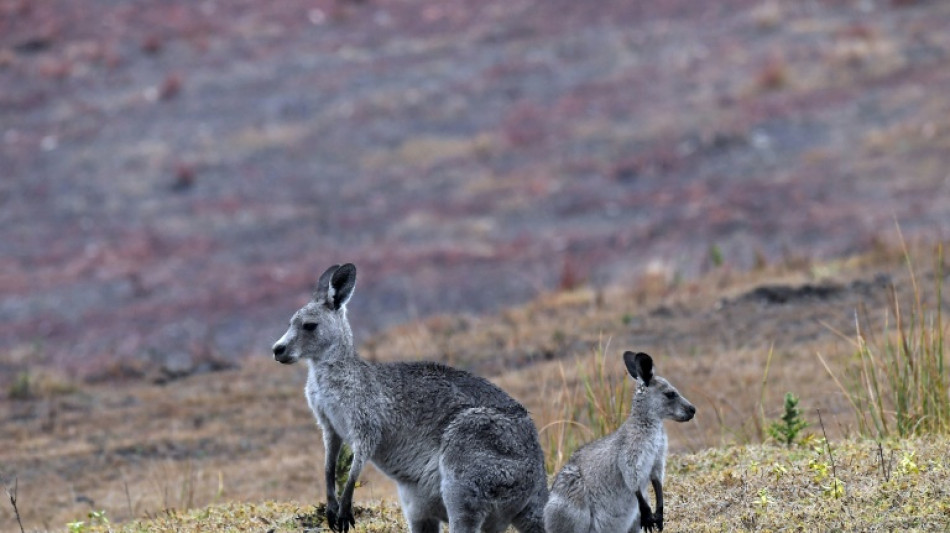
Australia's kangaroos could die in "catastrophic" numbers if a population boom is left unchecked, ecologists have warned, while backing the industrial-scale culling of the marsupials.
To outsiders, the kangaroo is an instantly-recognisable symbol of the Australian wilderness, but within the country the native animal poses a major environmental headache.
Kangaroos have a "boom and bust" population cycle -- when fodder is plentiful on the back of a good wet season their numbers can balloon by tens of millions.
Hopping mobs of kangaroos can rapidly strip paddocks bare, but ecologist Katherine Moseby warned they would starve to death in droves when food ran out.
"The last drought we estimated that 80 or 90 percent of the kangaroos in some areas died," she told AFP.
"They are starving to death -- going into public toilets and eating toilet paper, or lying on the road starving while their joeys are trying to feed," she added, referring to events from the last population boom.
Moseby said the kindest way to save kangaroos from this fate was to shoot them, and harvest the meat, as a way of keeping numbers in check.
"It keeps the numbers down so that when we do get drought we don't get these welfare issues," she said.
"If we saw them as a resource and managed them like that, we wouldn't get the catastrophic deaths that we see."
Kangaroos are protected in Australia but the most common species are not endangered -- this means they can be shot and killed in most jurisdictions, but government permission is needed.
Each year, as many as five million kangaroos are shot as part of a homegrown industry, which harvests their carcasses for meat, pet food and leather.
Dennis King from the Kangaroo Industry Association of Australia believes the country is on the cusp of another kangaroo boom.
"After three years of La Nina right down the east coast, we've seen the perfect growth scenario for kangaroos over the next couple of years," he told AFP.
"The breeding cycle really speeds up."
King said the national kangaroo population fell under 30 million following a crippling drought in the early 2000s, but could soon rebound to as many as 60 million.
- 'Cruel slaughter' -
Animal rights activists have denounced the commercial cull as a "cruel slaughter", pressuring global sportswear giants such as Nike and Puma to phase out the use of kangaroo leather.
"Nike divested of its only kangaroo leather supplier in 2021 and will stop making any product with kangaroo leather in 2023," a spokeswoman for the company said in March.
Politicians in Oregon, where Nike was founded, introduced a bill earlier this year that would outlaw the use of "any part of a dead kangaroo".
"These native animals are slaughtered for the sake of commercial profit," Animals Australia said earlier this year.
George Wilson, a leading researcher on kangaroo management, said attempts to shut down the industry were well-intentioned but ultimately misguided.
"They say it's unethical, but it's unethical to let them starve to death," he told AFP.
"The cruelty is not doing anything about it."
Moseby agreed, saying ending the culling of kangaroos would actually be more cruel in the long run.
"Trying to stop the harvest of leather or meat, it's not going to have any welfare benefit," she said.
"It's going to make it worse."
C.Kovalenko--BTB