Humanity has 'broken the water cycle,' UN chief warns / Photo: © AFP/File

 Hushing and hedging: US companies retreat on climate

 Springboks to face Fiji before 2027 Rugby World Cup

 Nigeria miners struggled to breathe in cell before 37 died: survivors

 McIlroy on the charge at PGA Championship as Reed withdraws

 McIlroy on the charge at PGA Championship

 Crisis-wracked Volkswagen warns of 10-bn-euro hit to profits

 Costa Rica's Grynspan tops third informal poll for UN chief: diplomat

 Stock markets retreat after central bank rate hikes

 Russia labels director of Cannes Grand Prix winner a 'foreign agent'

 Macron warns of Russian 'hybrid' threat after meeting presidential hopefuls
 UN holds third informal poll for new chief

 Kulusevski return can spark Spurs: De Zerbi

 Shakira to cap off world tour with Madrid 12-gig run

 Isolated Syrian-Druze city blames Damascus for shortages
 Isolated Syrian-Druze city shortages

 Dutch drop Depay for Germany match in Xavi's first pick

 Ronaldo named in Portugal squad for Nations League

 Stock markets diverge after central bank rate hikes

 Anti-Assad music star makes triumphant return to Syria

 In-form Fernandez included in Spain Nations League squad
 Arteta buries hatchet with Hurzeler ahead of Brighton clash

 Alexander-Arnold and Palmer return to England squad for Nations League

 Russians vote as Ukraine war drags on for fifth year

 Backpackers fret over Australian visa crackdown
 Most Asian stocks track Wall St rally, yen drops after BoJ rate hike
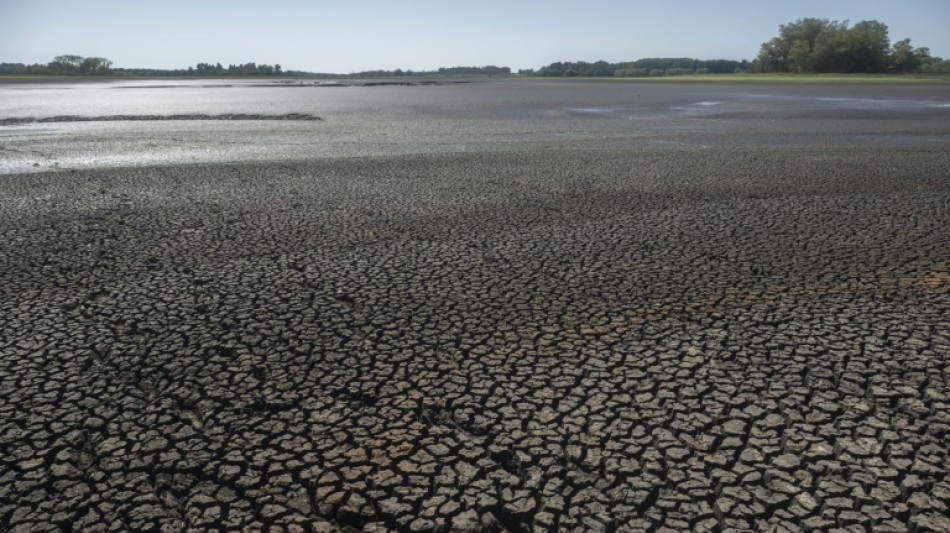
The future of humanity's "lifeblood" -- water -- is under threat across the planet, the UN secretary-general warned Wednesday at the opening of the first major UN meeting on water resources in nearly half a century.
"We've broken the water cycle, destroyed ecosystems and contaminated groundwater," Antonio Guterres said at the three-day summit in New York, which gathers some 6,500 participants, including a dozen heads of state and government.
"We are draining humanity's lifeblood through vampiric overconsumption and unsustainable use, and evaporating it through global heating," Guterres told the conference.
A report by UN-Water and UNESCO released Tuesday warned of too little or too much water in some places and contaminated water in others -- conditions that it said highlight the imminent risk of a global water crisis.
"If nothing is done, it will be a business-as-usual scenario -- it will keep on being between 40 percent and 50 percent of the population of the world that does not have access to sanitation and roughly 20-25 percent of the world will not have access to safe water supply," report lead author Richard Connor told AFP.
With the global population increasing every day, "in absolute numbers, there'll be more and more people that don't have access to these services," he said.
At the UN conference, governments and actors in the public and private sectors are invited to present proposals to reverse that trend and help meet the development goal, set in 2015, of ensuring "access to water and sanitation for all by 2030."
The last conference at this high level on the issue, which lacks a global treaty or a dedicated UN agency, was held in 1977 in Mar del Plata, Argentina.
Some observers have already voiced concerns about the scope of commitments and the availability of funding to implement them.
"There is much to do and time is not on our side," said Gilbert Houngbo, chair of UN-Water, a forum for coordinating work on the topic.
The report also warned that water "scarcity is becoming endemic" due to overconsumption and pollution, while global warming will increase seasonal water shortages in both areas with abundant water as well as those already strained.
- 'Now or never' -
"About 10% of the world's population lives in a country where water stress has reached a high or critical level," the report says.
According to the most recent UN climate study, published Monday by the IPCC expert panel, "roughly half of the world's population currently experience severe water scarcity for at least part of the year."
Those shortages have the most significant impact on the poor, Connor told AFP.
"No matter where you are, if you are rich enough, you will manage to get water," he said.
The report noted the impact of existing water supplies becoming contaminated due to underperforming or nonexistent sanitation systems.
"At least 2 billion people (globally) use a drinking water source contaminated with feces, putting them at risk of contracting cholera, dysentery, typhoid and polio," it said.
That high number does not take into account pollution from pharmaceuticals, chemicals, pesticides, microplastics and nanomaterials.
To ensure access to safe drinking water for all by 2030, levels of investment would have to be tripled, the report said.
Freshwater ecosystems -- which in addition to water, provide life-sustaining economic resources and help combat global warming -- "are among the most threatened in the world," the report warned.
"We have to act now because water insecurity is undermining food security, health security, energy security or urban development and societal issues," Henk Ovink, the Dutch special envoy for water, told AFP.
"It's now or never as we say -- a once in a generation opportunity."
O.Lorenz--BTB